Showing posts with label competition. Show all posts

Tuesday, March 9, 2010

How-to: Make a Fleece Seat Saver for Figure Skating Competitions

I went to a synchronized skating competition a few weeks ago. The rink stands were packed. Like most spectators, we'd brought our no-sew fleece blankets and spread them out carefully over our bench seats. It's a smart thing to do because the folded blankets keep your rear end from freezing to metal benches and the blanket saves your seat if you have to grab a cup of coffee or run to the restroom.
The competition was so packed, though, that other spectators had a hard time leaving and returning to their seats. The folks behind us must have had very small bladders because they kept coming and going, each time crossing over our blankets.
 
These people stepped all over our blankets, trod on our coats, and nearly upended a cup of hot cocoa on me.
 
Competition lesson #1: Never wear anything in the stands that won't look good with a splash of someone else's coffee on it. Ice Grandma? This means you. Do not wear that fur coat, Mom. I don't care if you've just fed it and walked it. Someone's going to spill on it and you'll be loud, obnoxious, and telling everyone in a 50-foot radius how mink looks lousy with mocha. Leave it at home, Mom. Yes, the hat needs to stay home, too.
 
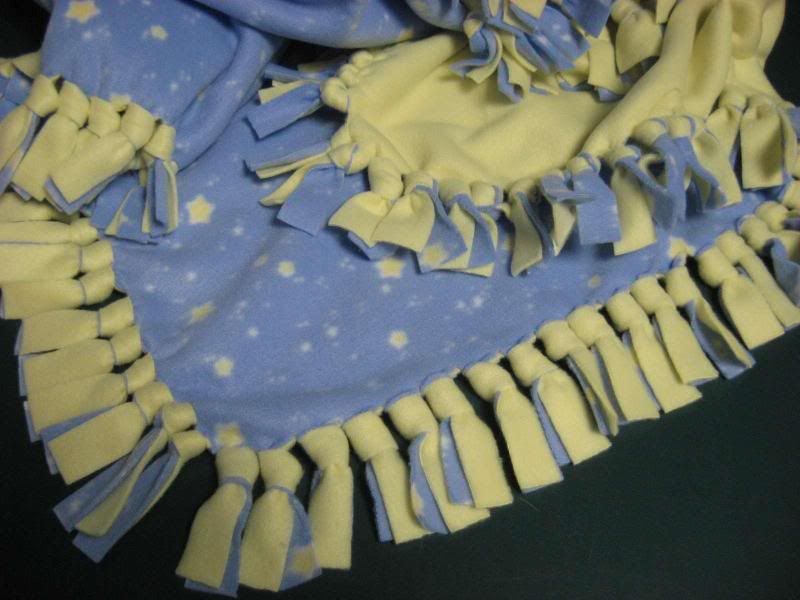
Competition lesson #2: Make cool no-sew fleece seat savers. (It's the same for a big no-sew fleece blanket, just smaller)
 
The synchro team next to ours had a very smart bunch of parents. These people brought no-sew fleece blankets like the rest of us, but theirs were narrow and perfectly sized to fit the bench seats and accommodate two people sitting on them. The blankets had their synchronized skating team colors - one color on each side - and were embroidered with the team's name. Alright, the embroidery was kind of over the top, but I guess the embroidery prevented others from taking them. At least, it prevented me from taking one.
 
Materials:
  • 1 1/2 yards double-sided fleece - any color
  • 1 1/2 yards double-sided fleece - another color
  • sharp shears
  • ruler
 
Method:
  1. Wash and dry the fleece fabric
  2. Lay the fleece fabric on top of one another, wrong sides together and edges squared up
  3. Make a straight line from selvage edge to selvage edge, 15 inches from the cut edge. (The selvage edges are the machine-finished edges of the fabric that run perpendicular to the cut edges.)
  4. Cut along that line
  5. Repeat steps 3 and 4 so you have three pieces of 15" wide fabric
  6. Cut off the selvage edges of the fabric, making sure that the edges of the layers are even
  7. On each corner, measure in three inches and draw a line. You should have a three-inch square at each corner. Cut out the three-inch square and discard
  8. Lay your ruler along one of the cut edges of the missing squares. Make sure that the ruler is straight across the square and parallel to the long edge
  9. Make cuts every inch along the ruler to make the ties. Your cuts will be spaced one inch apart and will be three inches long. Move the ruler as necessary
  10. Once you've finished cutting all the blanket ties, tie the front and back together in a double knot, skipping every other tie
  11. Flip the blanket and tie the remaining blanket ties with a double knot
  12. Look very smug when you put the seat saver blanket down on your bench seat
My plan is to make a couple of these for the next competition. If someone steps on my fleece seat saver, I'll just flip it over. And plot ways to trip those people if they stomp on my stuff again. Maybe I'll spill my hot chocolate on them, accidentally-on-purpose.

 
How about you? How do you survive all day at a competition on hard, cold bench seats? How do you keep your mother from embarrassing you in front of everyone? How do you keep your husband from working the crossword puzzle? Do you have any other competition day tips? Share 'em!

 
As always, please let me know if you have a question for me or the Advisory Board. If you have an idea for a post, or you'd like to write something yourself, that's cool, too! E-mail me at icemom.diane@gmail.com.

 
Ice Mom's Summer Camp Survey

Monday, March 8, 2010

How-to: Display Figure Skating Medals

Reader Anonymous sent me a comment:

[...] I was wondering how you display Ice Girl's medals. My daughter has been skating for a few years now but I have yet to think of a good way to display her medals. What do you think? Thanks!

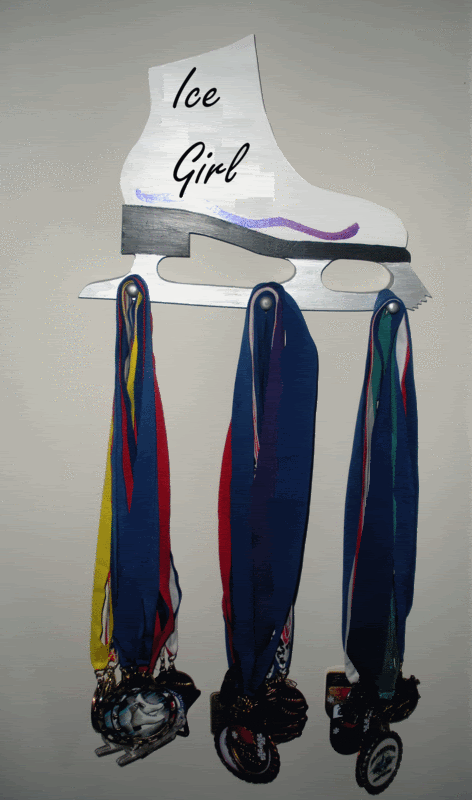
As you can see from the photo, this is how we display Ice Girl's medals.

I bought this wooden skate at a competition for an unbelievable price: $12. I wish I had bought two. The gal who made it had her husband cut the skate out of wood with his jigsaw. She sanded it, painted it, added wooden pegs to the front, and hooks on the back for wall hanging.

If you don't have a husband with a jigsaw, you can still accomplish this same thing pretty inexpensively. Craft stores carry ready-made boards with pegs on them. Paint, add hanging hardware, and display.

The whole project, including paint and hardware, should set you back maybe $10 - $12.

Update: A fabulous DIY renovation project from Advisory Board member, figure skating parent to an Olympian, and Life on the Edge blogger Allison Scott: One of the things that we used to do (though now it is totally impractical after 20+ years of medals) is to frame the top ones with the competition programs. Please note: If your skater stays in the sport for a long time and succeeds, you may be able to take each of those frames, cement them together and build an addition to your house – a little DIY recycling project that could help your bank account! 

What do you do with your skater's medals? How do you display the trophies? Please share your ideas in the comments!

As always, if you have a question for Ice Mom or the Advisory Board, please send it to me! If you have an idea for a post or would like to write a guest post, please let me know, too! E-mail me at icemom.diane@gmail.com

Ice Mom's Summer Camp Survey

Thursday, March 4, 2010

Can You Help this Mom? Figure Skating Music That's NOT for Princesses

As always the readers are very generous with their music ideas. Check out the comments for great suggestions!
 
I cracked up in my cubicle when I received this plea:
[I need] age-appropriate music and costumes that aren’t Disney!


[Dear daughter] is 7, turning 8 next year, and competing in Canada at a fairly low level [...] The time has come to choreograph a new program and DD’s [dear daughter's] coach ( who we love ) loves Disney.

I cannot do Disney any more. And at every competition there are several girls skating to various Disney Princess songs. Ugh.


I would love other suggestions because if I don’t up with one, she’s going to be skating to Disney. Again.
I suggested that DD skate to a Disney villain, because I think that Cruella deVil on the medal stand with Snow White and the Little Mermaid would crack me up. Man, I need more coffee. Or less.

Can you help this mom? If you have music suggestions, please put them in the comments. And, for the love of Pete, not The Candy Man or Puff the Magic Dragon. We can't have everyone at the rink try to break the kid's CD. She'll cry.

Do you have a question for Ice Mom or the Advisory Board? Do you have an idea for a post? Better yet, are you an expert at something - like airbrushing dresses (hint, hint)? Why not write a guest post? E-mail me at icemom.diane@gmail.com

Ice Mom's Summer Camp Survey

Monday, March 1, 2010

Figure Skating Competiton Goodie Bags: What's Cool?

This post is courtesy of Ice Coach, who is pretty much a one-person force behind her Learn to Skate's Basic Skills competition. If any of you has ever put together a competition, you know what a big job it is.

Ice Coach does a great job with it. The competition is known for two things: super cool medals and amazing gift bags.

She's got the medals down pat: they're these neat plexiglass skates with boot details and the competition name etched into them. As I said: super cool.

It's the gift bags she's struggling with this year. She included a figure skating book last year and the obligatory gloves, but she's running out of ideas and the competition's coming up soon. She needs to start ordering this stuff!

Update: From reader PrettyBowtie: At my last fun skate, all the "beginner" skaters (as in, this was their first solo skate in public) were given a brooch for their jacket. Gold skater doing a layback for the older skaters and something sparkly with diamontes for the younger ones. Everyone proudly shoved their badge straight onto their jacket.

Update: From reader Cathy: My girl got some leg warmers from mondor in her last competition bag.

Update: From reader Denise: Just a suggestion for the medals--an address label with the event name applied to the back of the medal (or perhaps the ribbon in the case of a plexiglass medal). We have dozens of medals without identification on them. At the time you receive them you think you'll remember what events your kid skated, but you don't. I have tried to go back and mark them but by the time I get around to it, I've forgotten what she skated. Love medals from the competitions that engrave the event on the back of the medal (I know it's pricey but they're permanent). My daughter's synchro team skated at ISI Nationals last year and even their medals weren't marked. Annoying. In 5 years who's going to remember what division and event they skated?

Update: From reader Becky Wright: One of My favorites was a fleece blanket with the club name embroidered on it. My daughters favorite is every Year at the Atlantic City "Sun, Sand and Skate" competition the goodie bag is a sand pail and shovel for the beach. They also go to the casinos for donations so the pail is filled with decks of cards,mints,hand lotions, tissues etc... The girls love it!

Update: From reader Sk8nLane: My daughter was at a basic skills competition and the bag included all the necessities such as lip balm, hand cream, band aids with a holder and, hair tie, tissues etc. In today's economy I think the families may appreciate useful items. I loved having that to replenish her skate bag.

Update: From reader Kate: If somebody has a monogramming sewing machine, you can get fleece blankets at Ikea for like $2. I've done them for wedding favors before. They're darling.

Update: From reader Anonymous. It's clear Anony understands competition chaos: Mini sharpie markers so that the kids can make sure their hard guards have their names (and label bottoms of trophies or backs of medals), coupons for restaurants close to the rink, and zipper pulls are some of the things I've seen that have been handy.

Update: From reader DramaQueen: TISSUES!!!!! I know this sounds weird, but trust me, during practice ice, someones going to get a runny nose.

Update: From reader Anonymous: Towels for drying your skate blades. These, too, can be picked up at a low price and get someone you know or a business to monogram them at a reduced price or for free!

Update: From Advisory Board member Jillybean (Ice Girl agrees: candy!): I just asked my daughter what her favorite goodie bag items have been, she first answered "candy!" She did say that she likes it when they give her a bottled water. We've seen granola bars, hair stuff and lip balm. One competition we went to gave the kids a small photo album with the name of the competition on it. 

Update: From reader Anonymous: Blister band aids. A disposable camera so the skater can have pictures to remember the day! 

Update: From reader Anonymous who wants us all to remember that boys figure skate, too:
LOL, I would say please don't forget the boys :) DS has gotten M & M lip balm, purses, pink things, I could go on and on LOL. Nothing is more disappointing than getting a goodie bag that nothing in there is appropriate. He's now at the age that he can laugh, but I think it still makes him a little sad. 

Update: It's official. Reader bethalice is a genius. How about a screw driver? DD once had screws in her skates that came loose, so I stuck a screwdriver in her bag. Several times other skaters needed to use it to tighten their screws. Now we just leave it in there. I bet you can get some inexpensive ones from a dollar store. 

What is the coolest thing you've found in a goody bag? Have you ever put one together? What do you include? How about unusual ideas for goodies as well as sources to buy items?

As always, if you have a question for Ice Mom or the Advisory Board, please send it in! If you have an idea for a post or you would like to write a guest post, that's cool, too! E-mail me at icemom.diane@gmail.com.

Ice Mom's Summer Camp Survey

Friday, February 19, 2010

Figure Skating Competition Nerves: How Do You Prepare?

It's Winter Olympic season and Evan Lysacek just won the gold medal in mens figure skating. We watch his performance on the ice, but how did he keep it all together? How did he have the mental toughness to skate so flawlessly during the biggest moment of his life?

Lysacek told New York Magazine:
“When I'm getting ready in my room, I drink the same thing, I light the same good-luck candle I have — it's a brand from England called Cire Trudon — I listen to the same playlist, with songs from Jay-Z to the Virgins or the Killers, happy music that will keep my emotions even and not get my heart wildly pumping. I'm engaging all my senses, telling my body, 'Okay, it's time to go to that place.' When I get to the rink, I go through pretty much the same warm-up off the ice every time, so my body is continuing to get into that super-focused mentality. About twenty minutes before I go on, I put my suit and my skates on — that's my alone time — and I talk to myself. Self-talk is very important to me…I try to conjure really difficult days, days when I was sick or jet-lagged and felt horrible, and then think, If I can get through that, I can get through anything."

Aromatherapy is popular among top-level skaters. Instead of an imported candle, though, figure skater Johnny Weir uses Lemon Pledge for his calming ritual.

"I was nervous last night. So I Pledged [as in Lemon Pledge] everything in my room," Weir told People Magazine. "Some people eat, some people drink – but I Pledge everything."
Skater Jeremy Abbott had a disappointing Olympics, but his off-ice mental preparation is positive self-talk. Abbott told The Associated Press:

"Everyone has doubt in themselves, but I used to believe it," Abbott said. "That little nagging voice in the back of my head that told me I couldn't do it, I'd believe it. I'm learning I can quiet that voice and tell it to shut up."
As for Ice Girl, I have no idea how she prepares to skate at a figure skating competition. I tell her I love her, leave her with Ice Coach, and head for the stands. Believe me, my presence would only make her nerves worse.

What preparation tips from the champions can we pass on to our own figure skating sons and daughters?

  1. Aromatherapy. I prefer the Lemon Pledge myself, especially the whole Pledging process.
  2. Nervous energy. Worried about tomorrow? Clean your room, Ice Girl! That's what the champions do.
  3. Happy music
  4. Positive thoughts
  5. Comforting rituals
I've always said that the difference between practice and competition isn't in the crowds, the pressure, or the drama. The difference is in the mind.

This should be fun! How do you prepare yourself or your figure skater for a competition?

Wednesday, January 13, 2010

How-to: Cope with Two (or More) Figure Skaters in the Family

Question from a reader:

I'm in quite a predicament. I have two [figure] skaters, one 10 years old and one 8 years old, that are now both at the Pre-Preliminary competition level. I'm not sure how to handle this because I'm not crazy about my girls competing against each other in a competition, but I also don't want to hold one back. What do you think?

I put this out to my advisory board and here's what two members had to say:

C.L.: Oh I love adding my two cents. This is what I would do. I would put one in restricted or test track pre-pre and the other in well balanced pre-pre. Test track being the easier one (this one for the older skater). Of course, if the parent can convince them that they are only really competing against themselves then it shouldn't matter how they place. Perhaps not even checking the judges’ sheets after would be a good policy...if they skate better than in practice or at the best they can skate haven't they really come in first anyway? :)

Pairs Mom: I'm not sure I'm "qualified" to answer this question but I will try and give some advice...

Most mid-size competitions will have two or more groups of Pre-Preliminary skaters that are grouped together by age and normally this is done by the referee. If the girls take from the same coach or if they do not, have one of the coaches email the referee and ask that they be placed in two different groups for the competition. We normally group skaters together by ages 6 - 9 and 10 - 12 but this can vary slightly due to entries. This avoids the girls having to compete against each other. This way they also get to cheer for each other! Good luck!

Here's my take (caution: long and preachy):

Ice Mom: Kids are more like snowflakes than widgets. Each person is unique. Each person learns and develops at his or her own rate. This is a good thing. Learning something isn’t about the destination: it’s about the journey. It’s about collecting experiences that build up our knowledge.

That sounds pretty flowery, so let me make it more concrete. According to my favorite cognitive scientist, Daniel Willingham at the University of Virginia, the brain doesn’t like to think. This is true. Our brains love to work on experience. Given the choice between thinking of a new solution and relying on experience, our brain will almost always choose experience.

What does this mean for figure skaters? Each skater must build up his or her own experiences. Remember me ranting about that stupid Axel? Well, the figure skater who lands the stupid Axel in one month might not have built up the body of experience that the figure skater who lands it in a year has built up. Or, possibly, the one-month Axel kid has built up many years of figure skating experience and can land the jump more easily because of that experience. Building up that experience allows a figure skater to know when the jump doesn’t feel right and how to save it. Building up that experience teaches a figure skater how to fall so it doesn’t hurt as much. Building up that experience makes it easier to learn the next jump.

Willingham says our brains aren’t like file cabinets with a limited amount of storage. Instead, our brains are like magnets. The more experience and knowledge you put on the brain, the more magnetized the brain becomes. The more the brain holds, the more information and experience it gathers. So that year-long stupid Axel process isn’t a waste of time. It’s an experience-gathering period of time. None of the falls, set backs, and two-foot landings are a waste: they’re building up that knowledge base.

So comparing one 10-year-old figure skater to another 10-year-old figure skater is a tough thing to do, because each one collects different experiences. It’s even tough to compare the 10-year-olds if they are twins in your own family. I know twins who look so similar that I’m grateful when they wear jackets with their names on them. One twin is a lefty, the other a righty. One usually places a bit higher at competitions than the other, but they’re pretty evenly matched. How does the mom cope? She tries very hard to enter them in bigger competitions where the twins might not compete against one another. She includes a note in the registration envelope to ask that the girls not be in the same group. She also tries to teach them good sportsmanship and to be happy with their individual performance.

Does it work? Well, pretty much. I won’t lie to you: one girl is usually pretty disappointed and tries to put on a happy face for her sister. That builds up the knowledge bank, too.

I know another family where the skaters are two years apart. The younger one just landed her double Axel. The older one is still working on it, but she’s genuinely happy for her sister. Why? I think she’s realized that there isn’t a limited supply of double Axels. Sure, not everyone gets one, but for skaters who put in the time, have built up experience, and benefit from good coaching, the double Axel is something figure skaters can earn. One sister’s double Axel achievement doesn’t prevent the other one from earning one, too.

Note: This all sounds great on paper, but you all know that I still hate that stupid Axel and all of the frustrations it brought. Yeah, yeah. Build the knowledge base and all that. I get it. I still hate that stupid jump, though.

Alright. I’m done preaching.

Update: From reader JustPat: You can influence how they handle winning and losing, especially to each other. Your reactions to winning and losing will influence their perspective of how important it is to be a "winner."

Everyone who has been involved in skating for some time will tell you that it's important for the skater understand that if they have skated their program to the best of their ability, that's what should count in the skater's mind. If they are rewarded by the judges, it's a bonus.

I'm sure that it's difficult to lose to a "little sister." Perhaps you could also emphasize the things that the older child does better/ is allowed to do that the younger one can't.

In the meantime, make a note on the registration forms when you enter them in competitions. (Or as mentioned earlier, have the coach contact the ref.) I used to organize our club's local competitions and with the referee's permission, we made every effort to accomodate those requests. In some cases we couldn't split the groups, so the parent chose to put the siblings in different events- one would do Freeskate, the other Moves, or Showcase for example.

Update: From reader Xan of Xanboni!: First of all, if you think you're kids aren't competing already, you're delusional, but frankly my experience coaching MOST sibs is that they support each other more than they compete with each other. [...]if they learn not just to handle, but to take joy in each other's successes, well, that's one of those life lessons that makes figure skating such a great thing for kids to do.

Update: From reader Mary Beth Niedermier: My advice is to tell your child to do their best. After competitions, one of the first questions I always ask them is if they thought they did their best. There are so many variables to competition, that I stress that they should be happy doing their best and be proud of the effort they put into it.

So, parents. How do you cope with two (or more) figure skaters in the same family? Please add your experiences in the comments.

Reference:
Willingham, Daniel. (2009) Why Don't Students Like School?: A Cognitive Scientist Answers Questions About How the Mind Works and What It Means for the Classroom. Jossey-Bass: San Francisco. http://www.danielwillingham.com/

Do you have a question for Ice Mom? Send it to me at icemom.diane@gmail.com.
RCZXZD2EKAPT

Monday, September 28, 2009

Would You Keep This Figure Skating Coach?


Thanks to my unofficial editorial advisory board: Ice Coach, Ice Dad, Ice Girl, Ice Friend, K.R. and C.L.

Please note: all e-mails below have been edited for length and usage.

A couple of weeks ago I received this question from reader L.L. in my InBox that said three things:
  1. L.L. likes her daughter’s figure skating coach.
  2. Competition problem #1: Skater and coach never practiced the compulsory at both ends of the rink. Skater was distressed at a competition when she had to skate at the other end of the rink.
  3. Competition problem #2: Weird problem where Skater was signed up for an interpretive figure skating event and thought it would be her normal program.
L.L. wanted to know: So why didn't our coach know about these things and what do I do now? Do I fire her or give her another chance? Isn’t that one of the reasons you have a coach and don't do it yourself?

I conducted a poll of my informal advisory board and it came out 6 to 1 in favor of keeping the coach on.

Here’s what some of us said:

K.R.:
  1. Yes, it's the coach's responsibility to know the rules – she should have known them.
  2. Is this a new coach? It sounds like she must be. Learning is hard, and that kind of mistake is likely only made once.
  3. I, personally, would give the coach one more chance assuming all else is good in the skater-coach relationship. If not, I would say that's a good reason to leave.

C.L: I think that the parent should have a heart-to-heart with the coach if she likes her. These seem like honest mistakes that maybe a newer coach would not be aware of. For the next competition, the parent and coach should review the rules together and schedule practice ice on the rink beforehand.

Ice Friend: I would say fire her, unless the kid wants to keep the coach. I know if it were me, I would not be happy, because it would make me feel like I’m not skating to my fullest. The coach should know about the competition’s rules, because they’re written in the competitions packets that they sign. It has all of the information, so maybe the coach read it, but she didn’t pay very much attention to the details.

Ice Mom: For me, the coaching relationship is more complicated than competition results. I look for a coach who loves to be on the ice, has good skating skills, is a good teacher, is nice to me and my kid, and is easy to communicate with. I want Ice Girl to do well at competitions and I sign her up for a lot of them. But at this level, I think that the competition thing is really about getting kids to understand what a competition is and how to mentally prepare for them. If your daughter freaked out or was thrown for a loop, that really didn't happen. It's obvious your coach let you down in the competition area, but you wrote that you really like her. Maybe the other criteria outweigh the competition fiascos. Maybe you're willing to take another chance with her because you believe she's a good coach and a good fit for your daughter and your family.

Ice Girl: Maybe the coach has really good skills and works well with the skater. I would sit down and talk with the coach, but I wouldn’t let her go just over this.

Most of us are willing to give this coach another chance, and that’s just what L.L. did.

Update: From Anonymous in the comments: I'm all for giving people a second chance, as long as you're confident that you're not being taken advantage of. If you think it was the kind of mistake you only make once, than give her another try. If, however, there are repeated missed details, then you should consider whether she is really serious about being a good coach. You need to be an advocate for your kids as well as a partner with the coach. Skating is too expensive not to be concerned about the details.

From reader Season: The main point of my post is that open communication with the coach is very important and if your coach is young and new to the profession she may need some time to get used to being a coach.

From reader Rosalie: One or two mistakes is fine, as long as they don't happen again, but you are paying your coach to help you/your skater progress, not to be your buddy.

What do you think? What would you recommend a parent do in this situation?


Tuesday, August 18, 2009

Ice Mom's Guide to USFSA Test Sessions

Note to readers: this post is long and detailed. Be sure to read the comments for other parents' insights and opinions.

Watching a Moves in the Field figure skating test session is like watching grass grow – but in a tense, high-stakes sort of way. Unless you can recognize deep edges and perfect lobes, a Moves test is going to look like high-stakes grass growing in a foreign country.

I’m going to catch a lot of flack for writing that moves tests are so boring, but for parents, we just don’t speak the language. We don’t understand the subtle movements that figure skaters, coaches, and judges do. Ice Girl loves moves. Good for her. For me, they’re a snooze fest. In Greek.

Why moves? Even though they’re boring to watch, they could be much worse. Moves in the Field replaced the school figures (which gave figure skating its name). Skaters used to create figures on the ice with their controlled body movements and edges. Viewers hated them because only the judges could really see whether or not the skater had succeeded. They also counted in a skater’s overall competition score, so sometimes a lousy freeskater could win first if she had a big lead in the figures. This was a huge source of confusion to skaters and spectators.

Moves is an attempt to ensure that the good bits from the figures – the grace, carriage, and edge control – are still encouraged in a skater’s development. Some moves also incorporate ice dance steps as well.

Skaters must pass the moves test at one level to be eligible to take a USFSA freestyle test. In other words, to hop on the testing ladder, a skater must first pass the pre-preliminary moves test before taking the pre-preliminary freeskating test and so on. Don’t expect to take the preliminary freeskating test without passing the preliminary moves first. Skaters can test up in moves without affecting their competitive freeskate level. For example, Ice Girl is a pre-preliminary level skater, but she’ll be testing her juvenile moves soon.

Testing up is a pretty good thing because it teaches skaters good control and good skating habits. That doesn’t mean you need to force the moves, but 15 minutes of practice a day makes it much easier to pass the test than a big cram session two weeks before the test session. When Ice Girl says she’s having some ache or pain, I ask her to finish out the session with some moves practice.

What a USFSA Test Session Looks Like
I can’t help you stay awake, understand the complicated patterns, or teach you Greek, but I’ve been to a figure skating test session before, so I know what to expect and what to do.


  1. Night before. Polish boots, make sure tights don’t have holes, and encourage your skater to study the order that the moves patterns are listed in the rule book. At two test sessions, the judges told Ice Girl what pattern to skate before each pattern. At another, the skaters were expected to skate the patterns in order from the rule book by memory. Ice Girl wasn’t really prepared for that. Better safe than sorry.

  2. Arrive early. Like a competition, you never know if someone has scratched and the event schedule is running ahead. Arriving early also helps with the jittery feeling that the figure skater will have. I say lots of stuff like, “You’ve been practicing hard, Ice Girl. Let your muscle memory be your guide.” She does lots of eye rolling, texting, and tissue twisting.

  3. Rink’s pretty empty and quiet. Unlike the party atmosphere of a competition, skaters, coaches, and families hang out in somber groups and talk in low voices. They show up for their skater’s event and take off right away. Folks don’t often hang out to watch the moves tests, but they will stay in the stands for the freestyle tests. Bring a pack of tissues in case your skater doesn’t pass or someone you know doesn’t pass.

  4. Find the judges. Most of the time the judges sit in a predictable spot. Once, however, they were in the stands with us parents. It really threw skaters off when the judges hollered from the stands for the skater to repeat a pattern. So, locate the judges and point them out to your figure skater. Then sit far away from them. You don’t want to eavesdrop (poor manners) or have them hear you chatting softly to your neighbor about how dull the moves tests are. Worse: snorting when your neighbor tells an inappropriate joke. Very frowned upon.

  5. Warm up, put on skates. Whatever your competition routine is for this will work fine here. Remember: calm, soothing voice with lots of platitudes.

  6. Watch the grass grow. Even if it’s a freestyle test, you’ll probably not see your skater perform her most complicated jumps and spins. Moves tests are dull, as I mentioned, so behave yourself. If you can’t behave, sit by me. I’m the one falling asleep.

  7. Reskates. If a skater has only one error, judges can ask the skater to reskate a pattern or an element. Make sure your skater knows that this is not panic time. This is actually a good thing. If your skater had two errors, the judges wouldn’t ask for a reskate. Reskates mean your skater is close to passing. Before the test session, ask your skater to visualize herself once the judge asks her for a reskate. What will she do? Will she nod, take a deep breath, and skate as usual? Or will she break down in tears?

  8. Shuffle out to collect the results. Once your skater’s group has finished, you can leave the stands and join your skater in the lobby. You should not stand up and walk out while other skaters are testing. In the lobby, you’ll shift awkwardly from foot to foot and utter foreign phrases like bracket and three-turn until someone calls your skater’s name to collect her results.
  9. Accept the results with grace. The tests are pass/retry. If your skater passes, smile and pat her on the back, but don’t shout and pump your fist in the air. Lots of skaters don’t pass the first or second time and might be silently sobbing next to you. If your skater is silently sobbing, offer tissues, hugs, and smiles. These tests are tough: be gentle. Don’t compare your skater to other skaters who passed; don’t blame the coach. Many fabulous skaters have to re-take tests; there’s no shame in it. Be proud of your skater’s hard work. Not every outing on the ice will be perfect, but she has a good idea of the direction her work should take. Point out the good comments on the results sheet. Offer chocolate. You get the idea.

  10. Change and go out to eat. While your skater wipes her blades and puts on normal clothes, stand around and decide on a place for lunch. This part might be optional, but it’s what we always do.
What should your figure skater wear? For the moves test, a simple practice dress is fine. The dress should be a figure skating dress, though, and not a dance dress. In other words, the skirt shouldn’t be long and flowy. (Unless your skater is taking a dance test. Then, of course, dance dresses are expected.) The judges need to look at leg positions and you don’t want to make that job difficult for them. Ice Girl wears a simple red practice dress – no crystals. Of course, if all you have is a dress with crystals, that's fine for moves, too. For freestyle tests, your skater can wear her normal dress that she wears for competitions.

Make sure that your skater’s tights don’t have holes, that her boots are polished, and that the laces aren’t trailing. You don’t want any of those things distracting the judges.

Study up on the patterns. I don’t pretend to be a coach. However, I do look at the patterns that Ice Girl is supposed to skate so I can feel like part of the conversation. Just because it’s a foreign language doesn’t mean that I can’t learn a couple of useful phrases and fake my way through a conversation. Don’t ask me about a specific Mohawk sequence or edge pull, though. I, um, might have been sleeping during that part.

Listen for the rip sound. When you hear the ripping sound a skater makes on the ice, that’s supposed to mean good edges. That’s all I’ve got.

Pre-pre freestyle isn’t done to music. At least, Ice Girls’ pre-preliminary freestyle test wasn’t. The judge just asked her to jump, etc.

More judges, longer time as tests become more difficult. Ice Girl had just one judge for her pre-pre moves test. For her pre-juvenile moves, she had three. I honestly can’t remember those in between. I might have been napping… However, as your skater moves up in the levels, the tests are more difficult and the judges are pickier. Retrys are not uncommon. A pass is a real achievement.

PSA’s Moves in the Field DVD. Ice Coach loaned Ice Girl this DVD over the weekend so we could watch skaters who performed the moves in a near-flawless manner. Popcorn, soda, a warm room, and a comfy chair didn’t improve it much: it’s still pretty dull. That kid who skates the juvenile patterns is fast, though.

Update (8/19/09): Moves patterns to change next year.

Season, a loyal reader, always posts fabulous and helpful comments to this blog. I'm excerpting part of her comment here. (India, Season's daughter, just passed Senior Moves - congrats, India!)

"I'm not sure if your coaches have made you or other skater aware but the USFSA are changing the MIF patterns for next year and they will have more difficult patterns some of the patterns that have been added are school figure patterns. For example the Senior MIF will include loop patterns from the old school figure test. I'm so glad my daughter will not have to test the new test patterns. Her coach does want her to learn the new patterns so that if she wants to coach in the future she is aware how to perform the new patterns so that she can teach the patterns to her potential students. You can go the USFSA website and see what the new pattern changes are going to be. You do not have to go back and test the new patterns if you have passed a certain level you only need to learn the new patterns for the test levels you have not tested.

"I do want all skaters to know how important MIF are for skating, these are the fundamentals of figure skating and will help your skater have stronger jumps, spins, power, and edge quality for footwork patterns and choreography. Work hard on your MIF and listen to music while practicing your MIF it will help with curbing your bordem. Good Luck, Season and India!"

Update (8/21/09): Ways to improve edges

Again from another of Season's comments:

I also think that ice dancing helps with learning better edge control and body movement on the ice. So if you can't find a coach to teach you school figures I highly recommend finding a really good, experienced ice dancing coach.

You could also join a synchronized skating team. This helps you to improve your over all skating skills because you have to learn how to keep up with skaters that are a higher level than yourself. This helps to improve speed, balance and coordination because you have to learn to be synchronized.

Update (8/21/09): Judges try to be fair and helpful

From loyal reader (and coach) Jillybean's comment:

One thing to remember about a test session is that a different panel of judges will see things differently. A test that would be passed by one judge, might be failed by another judge. Some judges just expect a higher quality of skating than another.


If a skater doesn't pass their test, ask the judge(s) what they can do to improve for the next test, then work on what they suggest. The judges want the skaters to succeed, (judges are AWESOME!) and if they don't pass the skater, it's generally because they don't feel they are ready to move to the next level.

Share your experiences! I am not a figure skater, I’m a parent. Do you have insights into testing that parents should know about? Share your knowledge!
Monday, August 3, 2009

Basic Skills Competition: Focus on the Mental Game

I hear parents grumble all the time at basic skills figure skating competitions. The judges were crummy, the figure skaters weren’t evenly matched, or my kid deserved to win. Heck, I’ve done it myself.

I’ve come to a realization, though. Basic Skills competitions are about skating, sure, but the lessons are larger than that.

  • How to prepare for a competition. Basic Skills competitions help skaters understand what to expect at a competition, what to bring, and how to act.


  • How to deal with losing. Not everyone will place first all the time. Judges are different, days are different, and some skaters are just better. This is all good. How will your skater deal with disappointment? What words can you say when you think she should have received first, but received fourth instead?


  • How to deal with winning. Sometimes your skater will place first. I’ve seen first-place skaters jump up and down and shout “In your face!” Not classy. Learning how to win gracefully is just as important as learning how to lose.


  • How to deal with unfairness. Is your skater in a group of eight when groups are supposed to be limited to six competitors? Is your skater skating against a kid twice her age? Is there a skater in the group who is obviously “skating down” several levels? Well, parents, these things happen, especially at Basic Skills competitions.

    Instead of whining about how it could be more fair, I’ve decided to smile and teach Ice Girl how to deal with inequities. Let’s face it: in any sport you’ll find bad calls, teams that needlessly run up the score, and crummy refs. Skating isn’t any different.


  • Competitions are about character. Sure, your skater needs to have figure skating skills, but the jumps and spins are what practice and lessons are all about. Your skater’s not going to the competition to perfect her Salchow, but to perform it. That’s a mental game. Competitions favor kids with a strong mental game, a good attitude, and a positive outlook.

Thursday, July 16, 2009

What to Bring to a Figure Skating Competition

Update: Thanks to my friend K.R., I have a printable checklist for parents to download. You have to be a member of my Google Group to do it, but it's painless and free. Click here to download the checklist in Word.

I’m making a list for Ice Girl. For the next figure skating competition, and all those thereafter, she’s limited to bringing just the things on her list in her Zuca, in the van, and to the rink.

My van was spotless before last weekend’s figure skating competition. I had that puppy emptied out, washed, waxed, and steam cleaned. The van even had an artificial lemon scent. Despite my cleaning efforts, I spent the 15 minutes before Ice Girl’s freeskate event searching through newly accumulated debris for some ankle braces, which should have been in Ice Girl’s Zuca. Instead, I found old figure skating reference books, a SkateStrong manual, a GameBoy, a pair of p.j.’s, and some random junk. How many ankle braces? Just one. Ice Girl has, um, two ankles.

We also needed extra skate laces, which should have been in the bag, but are probably under Ice Girl’s bed. Wait. She cleaned under there. Those laces probably made a run for it and are halfway toward some tropical location by now, because they sure weren’t in that stupid bag. (Thanks, Renee, for the lace rescue.)

So. Ice Girl gets this list for the next figure skating competition. She will not bring anything extra, because we don’t have time to sift through the flotsam and jetsam to find corn pads or bobby pins. Next competition, this stuff will be in its assigned pocket or Ice Mom is going to be pretty crabby, I can tell you. I bet Ice Mom will start chucking junk out of the van like monkeys throw poo at the zoo. Duck and run, kids: Ice Mom’s been pushed over the edge.

I’ve listed each item, some with reasons. Those with links have a previous post associated with them.

Skate bag contents

Hair bag contents

Emergency kit contents

  • Band-aids
  • Extra laces
  • Extra socks
  • Extra tights
  • Safety pins
  • Screw driver for blades
  • Stain remover

Parents’ list of stuff to haul

  • Blanket
  • Camera
  • Cash for coffee and unhealthy snacks
  • Checkbook – the figure skating world runs on checks
  • Coach’s phone number programmed in cell phone
  • Coins for the meter or tolls
  • Cooler with drinks, healthy snacks
  • Event schedule
  • Maps of the area – one local attraction, one local restaurant
  • Muffins, scones, or other morning food
  • Something to read
  • Warm jacket

Bottom line: Love you, Ice Girl, but I can’t take the stress of having a broken lace with no replacement five minutes before your warm-up ice. You managed to wipe your blades, wipe your mind, and start fresh before your event, but let’s face it: we’d all do better without the stress of missing stuff. And Ice Mom’s getting tired of eating bananas and listening to monkey jokes.

Did I forget something? Add to the list in the comments, please. Ice Girl competes again in two weeks, so we need the essentials, but nothing more. If you have a story to share, feel free to do so, as well! Monkey jokes? Well, if you must.

Wednesday, July 8, 2009

Basic Skills Competition Figure Skating Levels

I was poking around in the Ice Mom Blog site statistics and found that someone typed in this question in a search engine:

Can a figure skating coach have a student who is skating Freestyle 2 compete in Basic 6?

Good question.

First a disclaimer: Ice Girl was one of these kids. It wasn’t because we were trying to wipe out the competition, though: that kid just wouldn’t get off the ice. I put her on every open skate in Dane County for six months partly because she was begging me to do so and partly because I had a demanding job and could work on projects from the various rinks. She jumped from a Basic 3 in November 2007 to a Freestyle 3 in May 2008. That’s six levels in six months. (Me, I jumped from a miserable, demanding job to one I really love.) The problem we had was that we’d sign Ice Girl up for a Basic Skills competition after she’d finished, say Basic 6, but she was way ahead of that level by the time the competition day arrived. I swear: we were not trying to cheat the system.

A coach I know offered some possibilities about why kids might be higher or lower levels for Basic Skills competitions.

  1. The skater signs up at her current level, but by the time the competition has arrived, the skater is way above that level (see disclaimer above).
  2. Some Learn to Skate programs are very picky about passing kids up from one level to the next; others pass kids when they demonstrate skills, but the skills are still shaky. Here’s an example: a Basic 4 kid can do crossovers, but she’s unreliable with them. The instructor passes her into Basic 5, but the skill isn’t good enough to go into a program.
  3. A coach keeps a kid at a certain level for a while to build the kid’s self-esteem and smear the competition.
Now, I’m not saying that’s right or anything, I’m just offering an explanation about how it can occur.

I learned something about Basic Skills the other week: losing is just as important as winning.

Sure, we all want our kids to win, especially when they put in hard work and we feel they deserve it. Ice Girl won second place two weeks ago at a little Basic Skills competition. Her jumps and spins were more difficult than those of the first-place skater. And the first place skater was a brat (see my poor sport post).

My mom and I were not good skating parents. We grumbled quietly to ourselves and asked Ice Coach how this sort of thing could happen. Ice Coach said a few words, but it was clear she wasn’t taking it well, either. It was like she was keeping her mouth shut for fear of what might come out of it.

You know who took the second place ribbon well? Ice Girl. She smiled and acted like a champion. She was proud of the second place and beamed in the photos. I feel ashamed of my petty behavior.

That’s what Basic Skills is all about. Sure the skating is important and we all want fairness. But that’s not the point.

Character. That’s the point. Trying hard and accepting the judges’ decision with pride and class. Congratulating fellow skaters. Being happy no matter what the outcome. Skating for the love of it, not the hardware.

Ice Girl has learned this important lesson. I’m sure I’ll learn it someday, too.

Monday, June 29, 2009

How-to: The sock bun part two - creative use of hairnets

Some folks expressed concern about the sock bun method for figure skaters in an earlier post: http://icemom.blogspot.com/2009/03/how-to-make-hair-bun-with-sock-method.html The concern is that the figure skater in the photos has shorter hair. The mom just blends in the ends of her daugher's hair with the hair on the rest of her head.

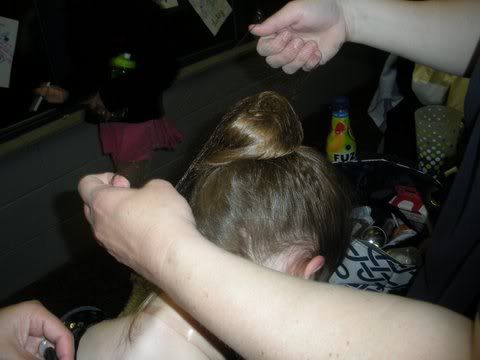
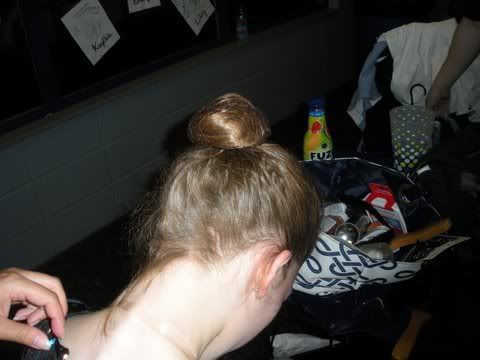
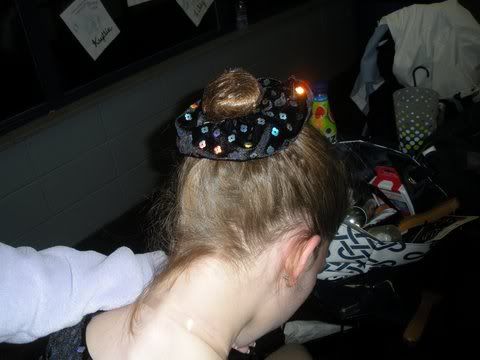
I agree. I am a member of the hair net club for sock buns. Here's my method (Ice Girl is in the photos, along with all of our skating stuff - in a disorderly heap.)

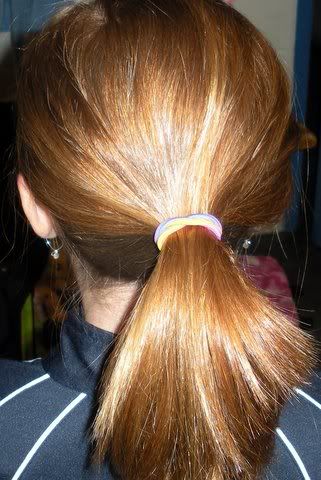
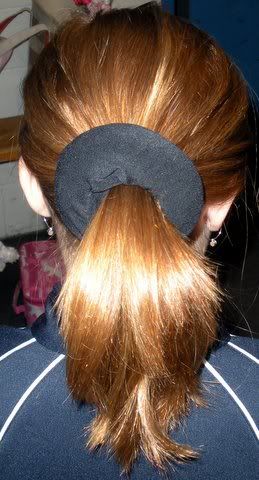
Step one: Start from the fountain stage. In other words, make the pony tail, put sock bun form around it, and then have your skater bend over so the hair falls over the sock bun form and covers it completely. If you have no idea what I'm talking about, read the earlier post.

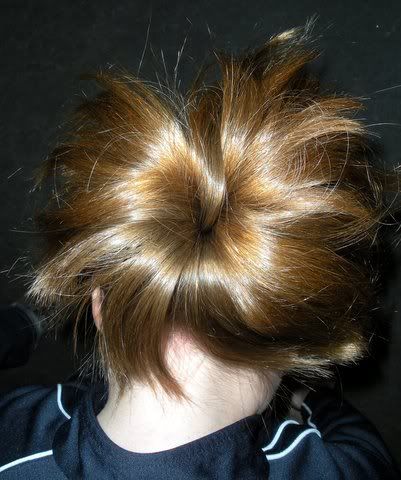
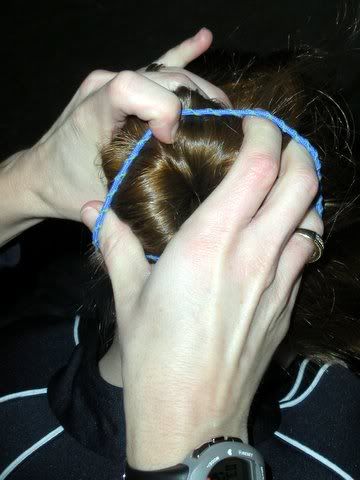
Then, wrangle the hair into a swirl using the hair net.
Step two: more wrangling. I pull the hairnet out and twist it over itself, then come back and cover the bun some more.


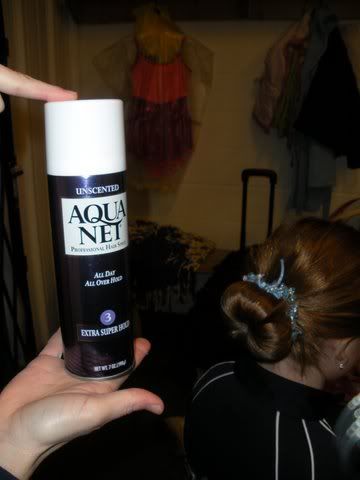
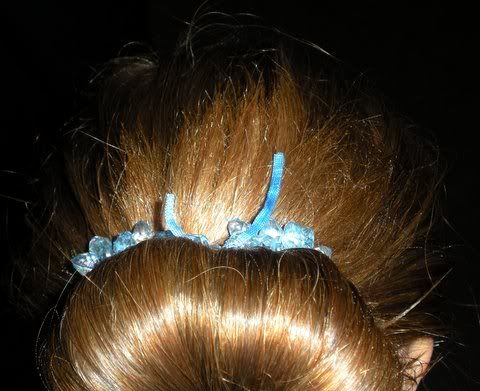
Step three: the bun. You can see it's kind of enclosed with a hair net. At this point, you can pin it down with bobby pins. Be sure to use two at each spot. Bobby pins should cross over one another to hold each other in place. In other words, make an X with two bobby pins. That way, your skater won't sprinkle bobby pins all over the ice. You can also secure the bun with just another pony tail rubber band.


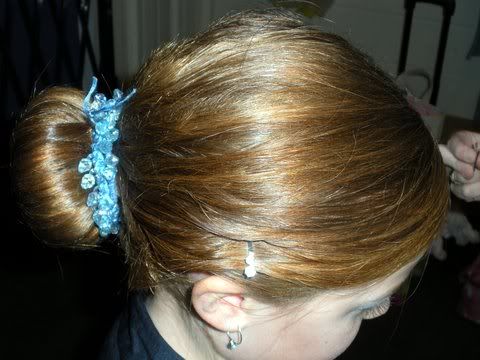
Step four: Hide the bobby pins with a scrunchie. By the way, this one is made from that sequin fabric that gave me fits. Pretty, isn't it?

Bonus: Using the hairnet not only holds your skater's bun in place, but she can serve lunch when the competition's over.


Thursday, June 25, 2009

What to say before your figure skater takes to the ice

If you’re the parent of a teen, you know that no matter what you say, your teen will twist your words and create pre-competition drama.

Maybe that’s just my teen, but I don’t think so.

Ideally, you leave your figure skater with her coach, grab a cup of hot cocoa or coffee and huddle under a blanket in the stands until your skater’s event. Leave the coach to handle the unpredictable hormones and angst.

But sometimes you are with the kid before she takes to the ice. What do you say?

What you say: Skate great! Yeah, it rhymes and looks good on a license plate (sk8gr8), but it’s loaded.
What teens think: What if I don’t skate great? What if I fall on my butt?

What you say: Good luck! It’s a good thing to say, right? Wrong.
What teens think: My mom thinks I’m a terrible skater and I need luck to succeed.

What you say: Have fun! This seems pretty positive, pretty harmless.
What teens think: This isn’t fun; I’m a wreck.

What Ice Dad says: Kill! Hello? Competitions are not your comedy stage, Ice Dad.
What teens think: I’m worried someone will notice that he’s my dad. Why does Mom let him out in public?

What you say: Be careful on that landing. Remember to keep your head up.
What your teens think: She’s not my coach. She doesn’t even know how to tie a skate. Why is she telling me this?

What you say: Now, listen to your coach, honey. We’ll be watching you from the stands. Everything’s going to be O.K. I’m sure you’ll do well. Hey, these words are reassuring to you as the parent, but not to your figure skater.
What teens think: Mom’s worried. I should worry.

Here’s what to do.

Say: I love you.
What teens think: My parents love me no matter how I skate.

Outwitted the little buggers, haven’t I? Now, if you could just tell me how to keep my husband from opening his mouth and we’ll all be fine. Muzzles haven’t worked. So far.

Monday, April 27, 2009

What to Wear to a Figure Skating Competition

I was reworking Ice Girl’s sock bun at last Saturday’s Basic Skills competition and teaching another mom the basics of the process when a coach I know overheard me.

Coach was judging at the little competition and my hair demonstration seemed to put a quarter in her. She started to talk in a loud voice and wave her arms a lot.

“You should teach a class,” she said.

I had no idea what she was talking about.

“We need to have a seminar for skating moms so that they know how to dress their kids for a skating competition,” Coach said.

Well, she said a lot more and made some comments about coaches who offer no instruction about what the skater should wear or how the skater’s hair should look.

“Neat,” she said. “I just want neat. Neat hair, neat dress, no laces dangling from the skates. I don’t want to be distracted when I judge.”

This makes sense to me, and I’m sure it makes sense to most readers: skaters should dress in a manner that calls attention to the skating, not to tangled hair.

Skating attire/grooming requirements:
Courtesy mostly of Coach (M.R.)

  1. Hair should be neat. A bun is best, but a close second is the ponytail. Don’t leave hair loose and unmanaged.
  2. Figure skating dresses only. Ice dance dresses are not figure skating dresses, Coach said. The extra fabric might look terrific in a spin, but it hides the skater’s leg positions and ticks off Coach when she judges. I’m sure it ticks off other judges, too.
  3. Laces should be tucked in. Boots should be tight, not floppy. Laces shouldn’t drag on the ice. Tuck them into the tights.
  4. Tights in good repair. Over-the-boot, footless, or footed: to a judge, it just doesn’t matter as long as the tights don’t have holes.
  5. Keep the undies hidden. “I don’t want Dora the Explorer underpants peeking out at me from under a skater’s dress,” Coach said. I don’t blame her.
  6. Crystals. I couldn’t help but interrupt Coach’s rant and ask: do crystals matter? She looked at me like maybe I wasn’t the person to teach her fictional new skating mom class. “Crystals?” she said in a shrill voice. “I don’t care about crystals.”
  7. No gloves, no jackets. They’re fine for warm-up, but leave them off the rink when you perform.
  8. Conservative makeup. “It’s not a beauty pageant,” Coach said. “Why are they sending these little girls out with so much eye makeup?” Well, she said a few other things, too, but the gist of this one was: keep makeup conservative and age-appropriate.


Feel free to add your attire/grooming requirements below. If you think Coach and I are off-base, you can write that, too. I might work up the courage to let her know…someday.

Tuesday, April 21, 2009

First Figure Skating Competition: Questions and Answers

A guest post, courtesy of reader Alexa and Ice Girl.

From Alexa:

Hi Ice Mom! I love your blog, and check frequently for updates. I am very soon being in my first skating competition and I have some questions I thought you might be able to answer.

From Ice Mom: Hi, Alexa. I'm not a skater, but I know one pretty well, so I passed your questions on to Ice Girl. Good luck with your first competition!
  1. What do I wear during my program, gloves, hat, etc?
    From Ice Girl: On practice ice: wear clothes that you would wear at a practice session (gloves, sweat shirt, practice skirt, obviously skates)
    On warm-up: wear your performance outfit, a light, zip-up sweatshirt with no hood (preferably black), and gloves (make sure you have your hair and make-up all done before you go on practice ice!)
    During performance: same thing as the warm-up ice, but without the jacket and gloves.


  2. Does my dress have to be a "competition dress"? I have a plain practice dress and I don't want to look weird.
    From Ice Girl: Um... most people have competition dresses, but I think it would be fine if you just wear your practice dress. In my opinion, if you feel comfortable in it and you don’t mind wearing it for your performance, go right ahead and wear it! If you have a coach, make sure he/she agrees with your decision.


  3. How do I skate on to the ice before my program and how do I bow or curtsy at the end of my program?
    From Ice Girl: Before: skate with your arms out and palms facing up (attracts the audience) with a big smile on your face. This makes you look strong, confident, and like you're ready to have fun, which is what it’s all about.
    After (bowing): after your finished, you can skate to the center if you wish, face the judges, and do a small bow with a smile and then turn around and do the same to the audience. If you have ever seen Olympians or professional performers, they do the same sorta thing.


  4. Is it strange that my coach hasn't told me any of this? I’m a newbie to this competition thing and she doesn't seem to understand that. We have not been informed on many things, which is very annoying.
    From Ice Girl: Hmm...I don’t know exactly. I always confront my coach if I’m concerned about something. I suggest you ask your coach about all the things you are asking us. The best answers about these kind of things would come from your coach.


  5. How do awards work?
    From Ice Girl: There are certain elements that a skater is required to perform in each level. You’re judged on how well you perform and how accurately you complete each element. Getting awards: smile for pictures and be very subtle if you get 1st place (at least until you are away from your competitors, then feel free to do a happy dance or squeal if you wish), but again ask your coach about these things if my answers are not answering your questions. I bet you'll do great!!!!!

    From Ice Mom: at the Basic Skills level, skaters are ranked in a group, from first to last. In the ISI judging levels, scoring is much more complicated. No way am I going to attempt an explanation here!


  6. Should I eat food before my program?
    From Ice Girl: It depends. Do you get sick easily? If you eat before going on a really fast spinney ride, do you come out of the ride almost puking? If this is the case, then don’t eat right before skating. Eat a good, healthy breakfast and drink lots of water, then give your stomach time to settle. Go to the bathroom before you go on warm-up ice.


  7. I am very nervous, what does Ice Girl do?
    From Ice Girl: I run through my program in my head while listening to my music. I take deep slow breaths (this may sound crazy, but it’s sort of like meditation) and think positive thoughts like:

    • I’m ready and I can do this

    • My family and friends are here for me right now and are here to support me

    • I know I’m a good skater


    I also look at competitions as practice where I can get suggestions from not just my coach.

    From Ice Mom: Away from the rink and well before competitions, I encourage Ice Girl to think about why she loves skating. I ask her to think about a time when she skated well. What went right? How did she feel? How did she create that situation? I call it her Happy Skate. On the drive to competitions, I ask her to visit her Happy Skate.

    Also, the only thing I ever tell Ice Girl before she competes is, “I love you.” Everything else (skate well, have fun, etc.) is too loaded and she’ll start to overthink my words.


Next, (sorry about all of this), some other generic questions.
no biggie


  1. Should I buy a spinner? What spins can you do on it; I just got into Freestyle 1.
    From Ice Girl: Yes, buy a spinner. Mine helped me center all of my spins
    almost all spins can be done on a spinner (I do camels on it) I don’t recommend laybacks or hair cutters on the spinner. Congratulations on getting into Freestyle 1!!!!!
    WARNING: SPINNER WILL NOT BE EASY FOR THE FIRST FEW WEEKS


  2. Maxiflex? My teacher has been stretching me for my spiral and it hurts very much; would the Maxiflex help?
    From Ice Girl: Yes, it helps, if you do it regularly. Don’t over do the stretching, though. Trust me, that hurts a lot!!!! I’m not that flexible but the Maxiflex is helping me a lot.


  3. Also, along with 2b, help with spiral, Ice Girl?
    From Ice Girl: Spirals...hmm...stretch often and even before practice. I’m still trying to get my spiral high enough. Just be patient; it will come. It does take a while. Realize that for a spiral to count, it has to be level, which means it has to look like a T.


Hope this helped! I bet you'll do great! Congratulations on being in advanced freestyle!

From Ice Mom: Do you have more tips for Alexa or other new skaters? Add 'em to the comments!

Monday, March 30, 2009

Crystals: Are They Necessary for Figure Skating Competition Dresses?

Be sure to read the comments for this post. Many are from judges and give great insight into the world of sparkle and dazzle.

Flip, an ice dad, left me a comment about the influence of crystal-encrusted dresses on figure skating judges.

From Flip:

I didn't realize that there was a sparkle section on the judges’ scorecard. In my opinion a kid can skate in a burlap sack and as long as the criteria is there and they skate better, then why shouldn’t they win?

Flip makes a good point and I’ve been asking everyone I see for their opinions.

Here’s the consensus: Flip, you’re right. Good skating rules the day.

However, you should follow your daughter’s coach’s recommendations because she has your daughter’s best interests at heart. Let me give you an example from my past teaching career:

I taught high school and advised the student newspaper. Every year the guys on the basketball team would complain because Coach wanted them all to have short hair. They whined all the way to the barber and then for days after the shearing. I asked Coach why he did it.

Here’s what Coach said: I don’t want my boys to be memorable except for scoring. No piercings, no tattoos, no long hair. I don’t want the ref looking at some kid’s hair, making a judgment, and penalizing the team. I don’t want one of them sticking out and the ref to think, “Oh, that kid again.”

It made sense to me, but I still encouraged the kids to stop whining and write an editorial about it. They refused. It turns out, none of them wanted to stick out for special treatment from Coach. Freedom of speech issues aside, that’s some beautiful irony, isn’t it?

Anyway, crystals are a figure skating dress expectation, not a requirement. So, you’re right, Flip, but I think you should pop for the crystals anyway. Here are the reasons I’ve gathered from rink parents and coaches:


  1. Ice is very, very white. Crystals help audiences see the skaters better against the bland surface.

  2. Performance. At higher levels, programs have a performance component. Dresses should reflect the music.

  3. Judgments. Judges who rank kids in Basic Skills competitions often make little notes so they can remember which kid is which. Maybe a judge writes ballerina or blue dress next to your daughter’s name. Just be sure the judge doesn’t write burlap sack.

  4. Crystals are fun. So is sparkly hairspray. So is skating. It’s all recreational spending.

  5. Confidence. Your daughter will see that her dress matches those of the other skaters. Minimize the distractions on competition day. You don’t want her worrying about how her dress looks; you want her to focus on her program.

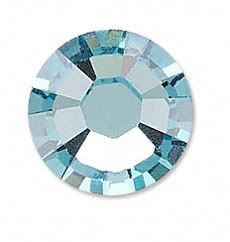
  6. Spend $30 or less. You can pick up some hotfix crystals cheap at JoAnn Fabrics – about $12 for a container of 200 or 300 Tulip brand crystals with glue on the backs (less if you have a coupon). You can use an iron to affix the flat back crystals to the figure skating dress, but I recommend using the hotfix tool (BeJeweler is best - $19) because you have less of a chance of ruining the dress with its focused heat.

  7. Coach said so. Part of the unspoken contract between parent and coach is that you will trust her judgment and allow her to guide you and your daughter through skating. You’ve paid her good money for her expert opinion; you should follow her advice.

I’m all for logic. I’m all for cutting costs. However, I’m also for spending money to make my daughter not just sparkle on the ice, but shine.

Best wishes for success, Flip!

Ice Mom

Update: Aaron over at Axels, Loops, and Spins wrote a great commentary: To Sequin...or Not to Sequin.

Sunday, March 15, 2009

How-to: Make a Hair Bun with the Sock Method

I want to thank C.L. and her daughter, E.L., for their help with this post.

My friend C.L. first introduced me to the sock method of doing hair in November. I'm terrible at hair, just terrible. But, if I can do this, I think almost anyone can be taught.

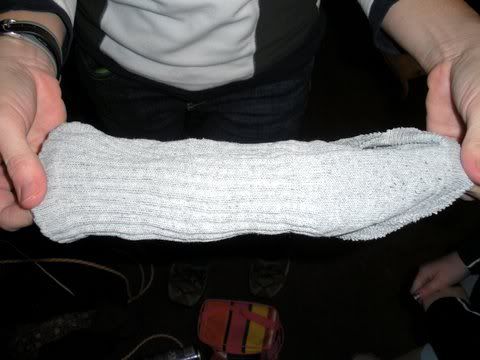
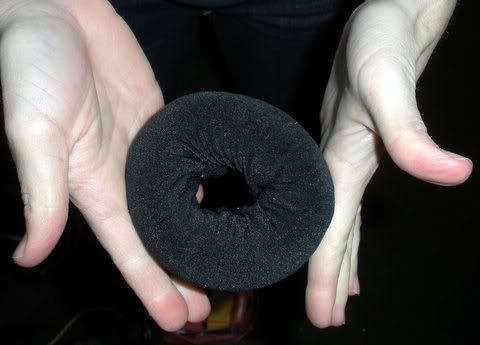
Photo one: Cut off the tube part of a large tube sock. Toss the foot part; keep the tube.


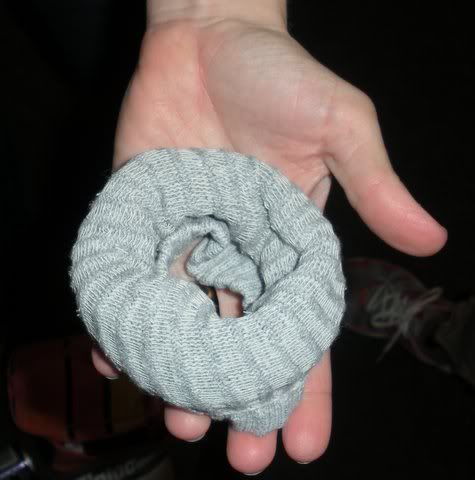
Photo two: Roll the sock into a donut shape.


Photo three: Cut off the top part of a nylon trouser sock and use it to encase your tube sock donut. This makes the donut smooth and easier to work with.


Photo four: Make a ponytail. Look at E.L.'s gorgeous hair. *sigh* C.L. finger-combed this ponytail into E.L.'s hair. No brush and it still looks great.


Photo five: Place the donut around the base of the ponytail.


Photo six: I call this move the fountain. C.L. has asked her daughter to bend over so the ponytail falls over her head and neck. You can already see the bun taking shape. I use a hairnet at this point to wrangle everything into a bun and catch stray hairs. C.L. works without a net, though, and gets great results.


Photo seven: Trap the hair with a hair tie to create a bun.


Photo eight: Industrial-strength hairspray needed - no bobby pins. Bobby pins, unless put in the hair so they cross, will fall out on the ice. You don't want to be the mom whose kid sprinkles bobby pins or coins on the ice. I know this from experience.


Photo nine: No bobby pins! C.L. just blends in her daughter's stray hair with the hairspray. You can hardly tell! Me, I jab those bobby pins in (cross ways) to catch stray hairs, but I might try this instead. You can see the decorative scrunchie that C.L. has put around the bun in this photo, too.


Photo ten: The final look. Isn't E.L. cute? Look how well those blended stray hairs look - no bobby pins! And that hair color is natural.

Update: More on the sock bun method can be found here: http://icemom.blogspot.com/2009/06/sock-bun-part-two-creative-use-of.html


Tuesday, March 3, 2009

Review: Chinese Figure Skating Dresses on eBay


Ice Girl’s friend, Ice Friend, has bought two figure skating dresses from China via eBay. Both were less than $50 each, including shipping, both arrived in about a week, and both fit well.

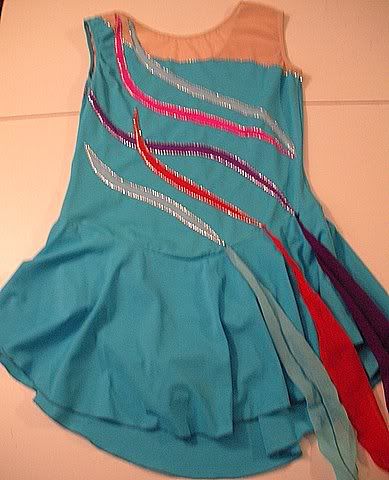
New Exclusive Figure Skating Dress (217-3). That’s the one in blue with the colorful appliqué and trailing ribbons. $24.99 plus $23.00 shipping. Includes a matching scrunchie. Sizes vary from tiny to big; use online size chart or send measurements according to instructions.

Seller: ice-dress0010, eBay member since December 2, 2004. As of this writing: 1448 sales, 99.8% positive feedback.

Fit: the dress fits Ice Friend well.

Quality: the dress is lined and well made with lots of crystals outlining each sewn-on applique. One of the bottom ribbons fell off last weekend, but a quick tack down with a needle and thread repaired it. It’s not the sort of problem that comes from poor construction, but rather it comes from use. The construction is good.

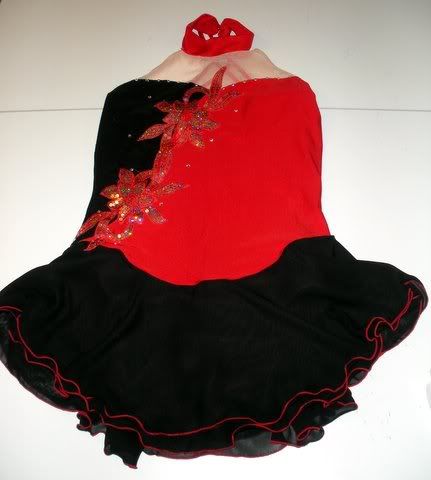
New custom figure skating/competition ice dress C04. That’s the red and black one with the appliqué. $8.00 plus $25 shipping. Sizes vary from tiny to big; use online size chart or send measurements according to instructions.

Seller: yibei_shop, eBay member since April 18, 2005. As of this writing: 431 sales, 100% positive feedback.

Fit: the dress fits Ice Friend well.

Quality: the appliqué started to separate from the rest of the dress, so Ice Friend used super glue on it. I know, I know. I offered to stitch it for her, but I don’t think my needle can make it through there anymore. The quality isn’t bad, but it’s not fabulous, either.

Bottom line: Would I buy one? Yep. You know me: I’m cheap. $50 for a dress with crystals? You can’t sew one at home and put crystals on it for that. By the time you purchase the fabric, pattern, and thread, you’re at $50 without crystals.

The quality that I saw was pretty good, with the exception of the separating appliqué. I tell you: I’ve seen worse sewing in a local dance/skate dress shop than these two dresses.
Don't worry: I'm still going to sew Ice Girl's competition dresses. But for a practice dress? You bet. And if you don't sew, this is a great option.

Update: From reader Skater's Mom: Ordered first dress. It was a little too small, but it was ok to wear one time for a competition. Ordered second dress a size bigger to make sure its not small -- and it was way too small. Emailed the seller, they asked if I could sell the dress and purchase another dress from them.


I will never buy from them again -- will still to American seller instead.

Update: A size problem from reader Cathy: We did try ordering a dress from China, but not a big success....the dress is on the small side (wearable, but not without a lot of complaining from my skater), even though we ordered 2 sizes larger than I thought my daughter needed based on size charts...and they are throwing up lots of excuses for why we should just keep it (ie the $25 shipping on the $25 dress), so I imagine that will end up being donated to the silent auction at the skate club!

Sunday, February 8, 2009

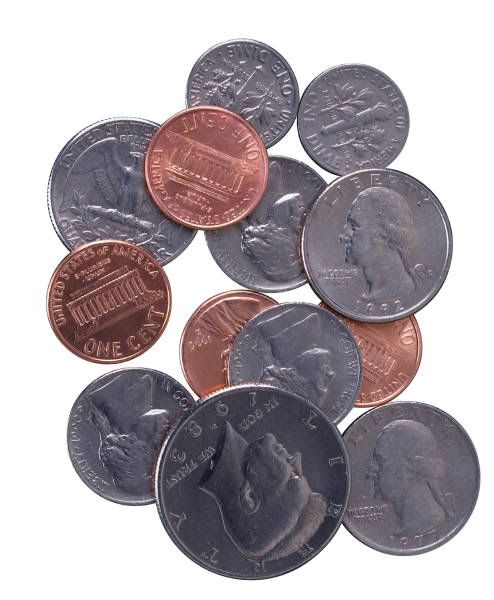
Pennies from Hell: Empty Pockets before Hitting the Ice

In our defense, let me state again that Ice Girl has been figure skating for just 14 months. We're new and this story happened last August, when she'd been skating for just eight months.

And, Ice Dad's the culprit, not me!

We were at a competition and Ice Girl hit Ice Dad up for some hot cocoa. He gave her, I don't know, two bucks. She put the change in her jacket, drank the hot cocoa down, and went out for her warm-up.

Skate, skate, skate. Spin, spin...scatter pennies on the ice. Ice Coach held her head as if she'd had brain freeze. Ice Girl scrambled to pick up the change and bring it to Ice Coach. I turned to that husband of mine and demanded an explanation. He pretended innocence.

Last weekend at Badger State Winter Games, some other kid (not mine, I swear), had a few tubes of lip gloss in her pockets. Skate, skate, skate, spin, spin...lip gloss tubes all over the ice. None of the skaters saw it, including Bonnie Bell. We parents in the stands were shouting and gesturing at our skaters to pick up what we thought were markers. Skaters and coaches were bewildered and several girls missed the tubes by inches. Finally a couple of girls realized that these objects were on the ice and collected them.

Bottom line:
This one seems pretty obvious, but since my family isn't the only one to have done it, I think telling new skating parents not to give kids small objects before going on the ice is a pretty good idea. Frisking the little buggers before they go on the ice isn't a bad idea, either. I'm not going so far as to sew Ice Girl's pockets closed, but I did consider it briefly. However, I chose to sew Ice Dad's wallet shut instead.

Monday, February 2, 2009

Quick tip: extra skate guards for competitions

This tip comes from Competitive Skater, who keeps two pairs of skate guards in her bag for competitions. One pair is her wet pair, the other is the dry pair.

At a competition, Competitive Skater wears the wet pair (dry at the time) to the rink, removes them, skates, and then puts them back on.

Competitive Skater returns to her skate bag, dries the guards, dries her boots and blades and puts on her dry guards for photos. No rust. Smart girl, that Competitive Skater.

Competitive Skater Dad is even smarter – he got Competitive Skater’s second pair of guards from the rink manager when the manager was getting rid of a year’s worth of lost-and-found stuff.

I scoured the lost-and-found last night: no dice. So, Ice Girl will be getting her second pair of guards at Badger State this weekend. Renee at Rainbo’s bringing them with her – we just have to pick the color. I’m hoping Ice Girl won’t pick purple, but I’m betting they’ll be sparkly.

Update: Ice Grandma popped for the new blade guards at Badger State Winter Games. When I buy guards, I shell out for the plain ol' guards that cost $9 - 13. Ice Girl has had her eye on these cool flashing guards for $25. You know me. I did the math and figured I could buy two pairs of guards instead of one pair of flashing guards. Or, I could buy one pair of plain ol' guards and one hour of ice. Choose, Ice Girl. She totally outwitted me and hit up Ice Grandma instead. Now Ice Girl has flashing guards (very cool) that require 8 watch-type batteries. They came with batteries, but I'm betting we'll need replacements soon. I did lobby hard for the orange flashing guards, but both Ice Girl and Ice Grandma looked at me as if I were nuts. She chose clear flashing guards - the better to see the cool lights.