Note from Ice Mom: The comments section for this post is awesome. Thanks, readers, for your advice and personal anecdotes. I'm sure you've helped a lot of frustrated figure skaters.
Hello, Readers. This post is courtesy of a reader who is having problems with higher-level figure skaters who are making her ice time miserable. Here’s the e-mail:
Icemom-
I regularly follow your blog and was wondering if maybe you or your readers could help me out with an issue I'm having. I'm 19 and started skating merely 6 months ago. I've come to skating from 15 years of dance training so I'm not struggling, and have a lot of family support in choosing skating over dance. I realise I've started far too late and am far too old to get anywhere besides competing in adult divisions- and that's the cause of my issue.
At my rink I have the earliest ice time, 4 a.m., with my coach. Straight after at 5.30 is an open figure session, where I work on what I've been assigned (at this point, edges, balance and jump preparation). However this is rather impossible as the 13-16 year old "senior" level skaters have taken it into their heads to taunt me and interrupt my practice by either stopping directly in my path, entering jumps or fast spins very close by. I've informed my coach, and she's seen this going on; however, she doesn't coach any of the girls and isn't ice marshal for that session, and so can't tell them off. She's spoken to their coaches who refuse to acknowledge their students are capable of such things. I don't want to move rinks because it would be far more travel and I would lose my coach.
It's at the point where I'm leaving the rink straight after my lesson to avoid these girls, because their actions and attitudes are too much to ignore.
I put this question out to my advisory board and here’s what we came up with:
Ice Mom: This problem happened to Ice Girl, too, especially when she was new. I think it has a lot to do with the culture of the rink. Fortunately for Ice Girl, the other coaches and the ice monitor were supportive of Ice Girl when an ice troll plowed into her and left Ice Girl sprawled on the ice. We were new to the club, so the other coaches and the ice monitor took the problem to the board and the board put the troll on probation.
However, it sounds like coaches and ice monitors aren’t supportive of you. Document a week or two’s worth of incidents and include details like the skater’s name, the problem, what you did to correct it, and the result. Approach your skating club’s board with your list. Point out how hard it is to grow a program if new skaters don’t feel welcome.
You pay the same amount of money as the mean skaters to be on that ice. You don’t get a discount if folks are mean to you. Fight for it.
(Ice Girl has since tried killing the ice troll with kindness and the troll has softened some and is nice back to Ice Girl. Ice Coach and I think that Ice Girl should leave the troll alone, but I.G. is a nice person. Nicer than I am, obviously.)
Ice Coach: I say: I feel her pain. Even if there isn't much her coach or the others will do about it, I would tell her not to give in. She has just as much of a right to be there as everyone else. Just because she is a lower level [skater] doesn't mean she has to be the one that moves out of the way all the time. She should stand her ground and make the others move out of her way sometimes, too. Or say something to them when they stop in her path like "excuse me." If she confronts it, in a nice way of course I bet the younger skaters will get the point.
Remember when [the ice troll] decided to jump on top of [Ice Girl and me] last year during a lesson? All I said was "excuse us." Of course, it wasn't the nicest voice, but guess what - she didn't do it again. I think she would just rather people ignore her while she stomped off.
C.L.: I think this gal should talk directly to the skaters in a non-confrontational tone. For example: "I just wanted to let you know that I'm uneasy if you get to close to me while I'm on the ice." "I'm not as experienced as you and I don't want to cause an accident." "I really enjoy skating but I'm concerned for my safety when you guys spin and jump very close to me." If that doesn't work then I would talk to the parents of the skaters.
PairsMom: If the coach has seen no change even after speaking to the other coaches about their student's behavior then it is time to set up a meeting with the Figure Skating director at the rink. This meeting should be brief (15 minutes) and if possible the coach should try to attend with the 19-year-old skater. Also, the figure skating director could post a list of Freestyle Rules and Guidelines on the rink website AND in the monitor booth. Each skater (and/or parent), regardless of age or level, needs to sign a freestyle contract stating that they will abide by the rules and regulations posted by the figure skating director, etc. Also, it might be helpful if the 19-year-old skater brought along some friends, other skaters her age/level to skate on the same sessions with her.
By the way: congratulations to PairsMom’s son and his partner, gold medal pairs winners at U.S. Junior Nationals in December 2009!
S.F.: I forwarded this problem to my daughter's ice coach and she suggested the following: This should be brought to management's attention. Coaches are supposed to be role models and teach more advanced skaters to be thoughtful of younger or lower level skaters. [Our rink] has rules posted and if they are not followed, we meet with the coach, skater & parent. If the skater doesn't want to cause issues, I would ask for the rink's freestyle rules first.
Bottom line: This is an issue of safety, etiquette, and money. No one should bully other figure skaters off the ice or jump so close that it's a safety issue. Take it up with the skaters, the coaches, the parents, and board/rink management. It’s not fair. Don’t let the ice trolls win.
The comments section is terrific for this post. Here's a sampling of what folks are saying:
Update: From Reader Heyfigureskate: This year, I have finally sucked in my pride and when [this skater] would perform a really nice move, I would say "Good job!" or when she would fall, I would ask, "Are you okay?" Since, when she comes to the rink (rarely) she compliments me as well. So a good turnout I suppose...
Update: From Reader Anonymous: All I can say is that you have every right to be out there and practicing. Believe me, they were beginners at some point. You don't need to be rude, but stand your ground.
Update: Terrific comment from Xan of Xanboni! (read it all in the comments section): If you are following basic practice ice protocol-- don't stand in the middle of the ice, keep moving, hold to standard jump and moves patterns, yield to program run throughs and lessons, etc.-- just hold your ground. They will pull back at the last minute. If you are called on it you can either plead ignorance, like they are doing, or say, "oh I thought the general protocol here was never yield to another skater, since that's what always happens to me" (a wide-eyed innocent, yet subtly sarcastic delivery would be called for here.)
Update: From reader TNT: Sometimes newer skaters are a hazard because they are either oblivious to other skaters, oblivious to the rules (lutz corner, spin areas, right of way goes to lessons and those doing their program) or unable to get out of anyone's way because they lack the skills to do so. Not sure if that is the case here, but if so the skater should seek a different session until they are no longer a safety hazard.
Sometimes newer skaters are not accustomed to how close other skaters may be on a freestyle session, and that can be scary. It's not always harrassment; sometimes a newer skater desires a wider "comfort zone" but on a high-powered or crowded freestyle session that's just not possible.
Update: From reader Season: I used to skate when I was younger and I'm also African American. Unfortunately, racism was and sometime is still a big problem in the skating community. My daughter and I have experienced skating trolls since we have been involved in skating because of racism. Many Caucasian skaters that are racist feel that African American skaters have no business being on their ice or involved in their sport. They feel that skaters of other race bring down the integrity of the sport and they doing anything possible to sabotage your chances of being successful. [...]
[...]It is important to remember that skating trolls are breed and created by parents and coaches that are not considerate of other skaters. These parents and coaches do not and sometimes refuse to teach their skaters respect and common curtiousy. Another problem is that most of the skaters that act this way are skating more than they are able to socialize with other people that are not skaters. Their whole life is skating and they have no balance in their lives. They loose their ability to socialize and act appropriatly around people who do not skate as much as they do. It is very sad. Because after skating is over they do not know how to be a normal happy person. I hope this is helpful. Adult skater and skating mom for 12 years, Season Williams
Update from the ice-troll victim: I thought I would give you an update on the Ice Trolls and the situation. Upon reading your entry (thanks to your panel!) I rang the Rink Director (who also arranges the Figure Club), my coach and the 5.30am Ice Marshal to schedule a meeting, which is in a week's time. I have both written evidence, other skaters who have witnessed the occurances and also some video footage- taping your routine can turn around to bite you!
I also had something to say about some of the comments given to the blog entry- a few people thought I was on practice ice above my level. At our club, if you've been in lessons for 6 or more months and are a member of the club, you can use practice ice. It's called 'Figure Ice' and the only requirement is the novice Aussie Skate levels, no jumps or spins if you don't want. I am well versed in where jumps, figures, spins, etc are to be executed, and being a dancer I don't have a large 'comfort zone'. These girls are using physical and verbal bullying.I just wanted to clarify that we don't use 'Freestyle Ice'- maybe it's an American thing? But all is in action to hopefully have them stopped.
If not, I'll try IG's route and kill them with kindness :)
Update: From reader Rosalie who gets an atta-girl award: I've had to deal with bullying, too, and it wasn't because I was new. The bullying didn't start until after I had been skating for a while. However, other coaches, the Skating Director, and the Ice Marshals were not helping (even contributing) to the problem. Eventually, I went with my now skating partner to general management (who mostly dealt with hockey and employees in the box office, etc.) to talk about my problems. I still get the cold shoulder, but the rest of the bullying stopped.
Do you have advice for this skater? Please share your thoughts or stories in the comments.
Do you have a question for Ice Mom? E-mail me at icemom.diane@gmail.com. I'll do my best.
Showing posts with label safety. Show all posts
Monday, December 28, 2009
Monday, October 12, 2009
Figure Skate Boots and Blades: Not the Place to Skimp
I’m thrifty, even cheap, but I don’t resort to home dentistry. Sure, I brush my teeth, and I even floss sometimes, but I leave the root canals and fillings to my dentist. My teeth’s good health is important to me: I don’t want rotten, misshapen teeth. I want to chew food without pain and I don’t know the first thing about giving myself Novocain. That’s why I see a professional.
I’m the same way with figure skates. I just don’t know how to fit them on my own; although, I would love a shot of Novocain when it comes to paying for them.
Let’s say, for instance, a person orders her daughter’s figure skating boots and blades online. Being a practical soul, she orders the figure skating boots one size larger for her daughter because the kid is still growing. Practical Mom wants the boot to fit her skater in a year. Practical Mom also bought a boot that’s a pretty high level because she expects her skater to advance quickly. She buys the figure skating blade online and mounts it herself at home. Then she takes the new skates to a local sporting goods store where they sharpen recreational blades.
Practical Mom wants to save money, but she’s doing it in the wrong way. Let’s see where she went wrong and how to make it right.
Ordering figure skating boots online. Sure, you can save money and order boots online, but you have to be cautious. You have to make sure that the foot measurements and foot tracings are done properly – many folks get it wrong. If you order your boots online, you don’t have the benefit of trying on several pairs from different manufacturers. You don’t know that one manufacturer’s boot has a narrow heel or that another has a wider toe box. However, ordering boots online can save you money, especially if the skater has stopped growing. In that case, order the same boot; it’s pretty simple.
How to make it right: Unless you’re very experienced with skate fittings, visit a reputable figure skate dealer for a good fit. If you must order online, call the place you’re ordering from and ask them to walk you through the measurement and foot tracing process. See if they can recommend a certain boot for you based on the measurements.
Ordering a boot that’s too big. Practical Mom knows her kid’s growing, but what she doesn’t know is that the sides of the figure skating boot are reinforced at points that correspond to a skater’s foot size. If a skater is too small for the boot, the non-reinforced areas will take the impact. Renee from Rainbo Sports said that this kind of wear actually makes the boot break down, or crease, faster than a boot that fits well. Practical Mom thinks she’s smart to order a size too big, but really, she’ll be buying new boots sooner.
Boots that are too big also cause foot problems, Renee said. A skater might compensate for the boot’s size by gripping the sole with her toes, which causes foot pain. Her heel might slip in the back and cause a bump on the heel. She could develop painful calluses, too.
How to make it right: Buy the boots that fit your skater’s feet. You can maybe go up a half size, but don’t go up any further than that. Remember that boot sizes don’t correspond to shoe sizes and every figure skating boot manufacturer has a different size chart. You must measure.
Ordering a figure skating boot that’s too advanced. Practical Mom dreams of doubles and thinks that the heavier the boot, the better her skater will perform. This is a lousy idea. Your skater will skate like she’s in cement shoes because the boot’s too tough for her. If you want your skater to quit, buy a boot that’s way too stiff.
How to make it right: Your skater needs to build up her legs and her feet in order to tolerate an advanced boot, Renee said. You’re better off increasing the boot incrementally than jumping from the rental skates your skater used in Basic 4 to a skate that kids doing triples require.
Skipping the heat molding step. I think Practical Mom skipped this step because she doesn’t have a convection oven at home. Few people do. You can’t heat mold a figure skating boot in a conventional oven, so don’t even try it. Heat molding figure skating boots is a fabulous thing. It molds the boot to the skater’s foot and smoothes the break-in process for the skater. Heat molding reduces painful blisters, rubbing, and even scars.
How to make it right: If you have ordered your boots online, take them (and your skater) to a skate shop. Dress your skater in her skate socks, too. Request that the shop heat mold the boot. They’ll probably charge you for it, but it’s worth it.
Mounting the figure skating blade herself. You’d think that mounting a figure skate blade to a boot is as simple as drawing a straight line down the center and screwing the blade down on top of the line. However, even a small variance in the mounting can make holding edges and spins difficult for your skater. If you try to adjust the mounting, you’ll weaken the sole and invite water damage. Better to get it right the first time.
How to make it right: Again, if you’ve ordered the boots online, take them into a reputable dealer for the mounting. Yeah, they’re going to charge you, but you’ll save your skater a lot of frustration in the long run and have a more solid boot.
Inexpert figure skate blade sharpening. Blades are pricey and have only so much life in them. An inexpert sharpening can ruin a blade by taking off way too much metal or rounding the blade à la hockey skates. Blades cost $150 on the cheap end and $500+ on the expensive end. For my money, I want the most life out of that bugger.
How to make it right: Take that blade to a reputable skate sharpener. I know – it’s hard to know who sharpens correctly. Ask around. People will tell you. (Someday I’ll write a post about how to know if a sharpening is good or not. Until then, ask around.) I drive Ice Girl’s skates to a shop 90 minutes away because I know that Renee at Rainbo Sports sharpens well. You know I’m cheap, but I’m also not willing to risk my daughter’s Vision blade on just anyone. That’s $500, people. O.K. I bought it used, but still. I’m not going to pay for the local used sporting goods store or hockey shop to ruin it.
The bottom line: scrimping on skates isn’t really saving you much. Look. I want to save money as much as the next person. Perhaps more than the next person: I adore bargains. But, I save money elsewhere: I sew dresses (you can buy them online), I make Ice Girl practice moves on cheap, empty public sessions, and I bought used blades (with Renee’s approval).
Update: From reader Anonymous: The recommendation charts are somewhat helpful, but as a skate tech who works with skaters for a living, I can tell you the charts are not always 100% on the money. The charts don't usually take into account the skaters body size, weight, hours per week he/she skates, how he/she breaks down boots, etc. I have customers who are 65 lbs. and working on Double Axels and the boot I recommend for them is not going to be the same as the boot for a 150 lb. man working on the same jump. Also, there is a major difference between a skater who is a "test" skater at, say, the Intermediate level, and an Intermediate lady who qualifies for Junior Nationals. So I always look at the "whole picture", not just the chart.
Update: From reader Helicopter Mom: Take the coach's advice too. They have WAY more knowledge about all kinds of skates than the other moms at the rink.
Update: From reader Ethelapple: Heat molding is great -- and so is "bumping out" the boot to get a little extra time before having to buy that next pair!
Update: From reader Anonymous: In general, I have found that an excellent pro-shop may have better boot and blade fit information than the coach.
What do you think? Let me know if you think I’m way off base with this one. Better yet, let me know if there’s a way to save money on figure skates that I don’t know about. Have a horror story? Share that, too!
I’m the same way with figure skates. I just don’t know how to fit them on my own; although, I would love a shot of Novocain when it comes to paying for them.
Let’s say, for instance, a person orders her daughter’s figure skating boots and blades online. Being a practical soul, she orders the figure skating boots one size larger for her daughter because the kid is still growing. Practical Mom wants the boot to fit her skater in a year. Practical Mom also bought a boot that’s a pretty high level because she expects her skater to advance quickly. She buys the figure skating blade online and mounts it herself at home. Then she takes the new skates to a local sporting goods store where they sharpen recreational blades.
Practical Mom wants to save money, but she’s doing it in the wrong way. Let’s see where she went wrong and how to make it right.
Ordering figure skating boots online. Sure, you can save money and order boots online, but you have to be cautious. You have to make sure that the foot measurements and foot tracings are done properly – many folks get it wrong. If you order your boots online, you don’t have the benefit of trying on several pairs from different manufacturers. You don’t know that one manufacturer’s boot has a narrow heel or that another has a wider toe box. However, ordering boots online can save you money, especially if the skater has stopped growing. In that case, order the same boot; it’s pretty simple.
How to make it right: Unless you’re very experienced with skate fittings, visit a reputable figure skate dealer for a good fit. If you must order online, call the place you’re ordering from and ask them to walk you through the measurement and foot tracing process. See if they can recommend a certain boot for you based on the measurements.
Ordering a boot that’s too big. Practical Mom knows her kid’s growing, but what she doesn’t know is that the sides of the figure skating boot are reinforced at points that correspond to a skater’s foot size. If a skater is too small for the boot, the non-reinforced areas will take the impact. Renee from Rainbo Sports said that this kind of wear actually makes the boot break down, or crease, faster than a boot that fits well. Practical Mom thinks she’s smart to order a size too big, but really, she’ll be buying new boots sooner.
Boots that are too big also cause foot problems, Renee said. A skater might compensate for the boot’s size by gripping the sole with her toes, which causes foot pain. Her heel might slip in the back and cause a bump on the heel. She could develop painful calluses, too.
How to make it right: Buy the boots that fit your skater’s feet. You can maybe go up a half size, but don’t go up any further than that. Remember that boot sizes don’t correspond to shoe sizes and every figure skating boot manufacturer has a different size chart. You must measure.
Ordering a figure skating boot that’s too advanced. Practical Mom dreams of doubles and thinks that the heavier the boot, the better her skater will perform. This is a lousy idea. Your skater will skate like she’s in cement shoes because the boot’s too tough for her. If you want your skater to quit, buy a boot that’s way too stiff.
How to make it right: Your skater needs to build up her legs and her feet in order to tolerate an advanced boot, Renee said. You’re better off increasing the boot incrementally than jumping from the rental skates your skater used in Basic 4 to a skate that kids doing triples require.
Skipping the heat molding step. I think Practical Mom skipped this step because she doesn’t have a convection oven at home. Few people do. You can’t heat mold a figure skating boot in a conventional oven, so don’t even try it. Heat molding figure skating boots is a fabulous thing. It molds the boot to the skater’s foot and smoothes the break-in process for the skater. Heat molding reduces painful blisters, rubbing, and even scars.
How to make it right: If you have ordered your boots online, take them (and your skater) to a skate shop. Dress your skater in her skate socks, too. Request that the shop heat mold the boot. They’ll probably charge you for it, but it’s worth it.
Mounting the figure skating blade herself. You’d think that mounting a figure skate blade to a boot is as simple as drawing a straight line down the center and screwing the blade down on top of the line. However, even a small variance in the mounting can make holding edges and spins difficult for your skater. If you try to adjust the mounting, you’ll weaken the sole and invite water damage. Better to get it right the first time.
How to make it right: Again, if you’ve ordered the boots online, take them into a reputable dealer for the mounting. Yeah, they’re going to charge you, but you’ll save your skater a lot of frustration in the long run and have a more solid boot.
Inexpert figure skate blade sharpening. Blades are pricey and have only so much life in them. An inexpert sharpening can ruin a blade by taking off way too much metal or rounding the blade à la hockey skates. Blades cost $150 on the cheap end and $500+ on the expensive end. For my money, I want the most life out of that bugger.
How to make it right: Take that blade to a reputable skate sharpener. I know – it’s hard to know who sharpens correctly. Ask around. People will tell you. (Someday I’ll write a post about how to know if a sharpening is good or not. Until then, ask around.) I drive Ice Girl’s skates to a shop 90 minutes away because I know that Renee at Rainbo Sports sharpens well. You know I’m cheap, but I’m also not willing to risk my daughter’s Vision blade on just anyone. That’s $500, people. O.K. I bought it used, but still. I’m not going to pay for the local used sporting goods store or hockey shop to ruin it.
The bottom line: scrimping on skates isn’t really saving you much. Look. I want to save money as much as the next person. Perhaps more than the next person: I adore bargains. But, I save money elsewhere: I sew dresses (you can buy them online), I make Ice Girl practice moves on cheap, empty public sessions, and I bought used blades (with Renee’s approval).
Update: From reader Anonymous: The recommendation charts are somewhat helpful, but as a skate tech who works with skaters for a living, I can tell you the charts are not always 100% on the money. The charts don't usually take into account the skaters body size, weight, hours per week he/she skates, how he/she breaks down boots, etc. I have customers who are 65 lbs. and working on Double Axels and the boot I recommend for them is not going to be the same as the boot for a 150 lb. man working on the same jump. Also, there is a major difference between a skater who is a "test" skater at, say, the Intermediate level, and an Intermediate lady who qualifies for Junior Nationals. So I always look at the "whole picture", not just the chart.
Update: From reader Helicopter Mom: Take the coach's advice too. They have WAY more knowledge about all kinds of skates than the other moms at the rink.
Update: From reader Ethelapple: Heat molding is great -- and so is "bumping out" the boot to get a little extra time before having to buy that next pair!
Update: From reader Anonymous: In general, I have found that an excellent pro-shop may have better boot and blade fit information than the coach.
What do you think? Let me know if you think I’m way off base with this one. Better yet, let me know if there’s a way to save money on figure skates that I don’t know about. Have a horror story? Share that, too!
Labels:
buying guide,
figure skates,
money,
safety,
skate care
Thursday, April 2, 2009
How Do You Get Your Figure Skater to Wear Butt Pads?
I’d love to tell you that they work wonderfully and Ice Girl wears them all the time, but I can’t.
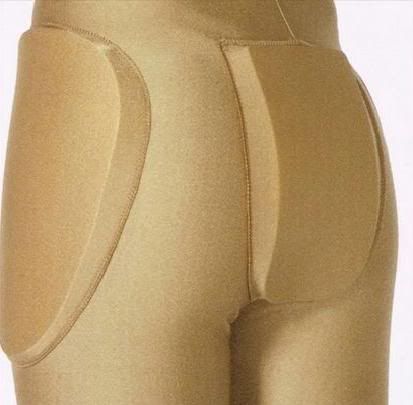
The panties with pads set me back $80 (I think I got ripped off). The individual waxel pads cost me $30 for two. All the pads are in our basement on a shelf. They don’t even ride around in the van with us.
Ice Girl complains that falls hurt. I don’t doubt it. However, when I remind her that she has pads, her bottom lip starts to quiver and her eyes get round. She tells me that she just can’t figure out how to wear them without them showing.
I tell her that the point isn’t that people will think she has a big butt. The point is to prevent that big bruise on her hip.
Last week at a test session, I called her attention to a senior-level skater who was shoving butt pads in her tights rink side.
“See?” I said. “Senior Skater wears them.”
“Mom. Mom. Moooo-oooom,” Ice Girl said. “I don’t want to talk about that right now. I’m about to test.”
Fine. But Ice Girl didn’t want to talk about it on the ride home. She didn’t want to talk about it this morning, either.
Update: From reader dazzleamore: did find those thinner GEL Ultra crash pads (about $35 -$40 each) is easier to convince my girls to wear them. Those pads are thinner so skaters don't feel self conscious (about the size of their butt) and supposedly, it supposed to protect them from the fall. Between, crash-pad-pants, waxel pads, and gel pads, my skaters used the get pads most... You can find these gel pads on many figure skating store websites that sells dresses or supplies.
So, folks, I’m looking for help here. Please comment and share what tricks, incentives, etc. you’ve used to get your kid to put in those stupid pads. Short of making them chocolate-scented and having Ice Girl wear M.C. Hammer pants, I’m stumped.
Saturday, November 22, 2008
One-sport athletes have a higher risk of injury
In the November 13 issue of the Wisconsin State Journal, the front-page article was about how youth who train rigorously in just one sport are at risk for more sports injuries than their multi-sport peers.
Local doctors from the University of Wisconsin Hospital and the UW Medical School said that injuries can occur from muscle overuse.
The article doesn’t site a study, and, in fact, one of the physicians said that there really isn’t one that proves one-sport athletes have more injuries. However, she said that if you were to ask sports physicians if they’re seeing more one-sport athletes with injuries, they’d say yes.
What does this mean for the figure skating parent? Well, I’m pretty uncomfortable about it, I tell you.
Ice Girl skates eight hours/week and more if she can. She loves to ride her bike, but I’m not sure that balances out the risk. If you’ve spent any time in the figure skating world, you know that eight hours is nothing. Most kids skate 12 + hours/week.
The doctors in the article said that chronic pain is a red flag and the cure is to take time off from the sport. "If you take a break now and you give your body a chance to recover and heal, then you're going to be healthier and happier later," said Dr. Alison Brooks, an assistant professor in the orthopedics department at the UW medical school. "But if you keep trying to push through pain and injury and never give your body a chance to recover, it's never going to recover. Most people, of course, don't want to hear, 'Part of your treatment is not playing your sport.”
Ice Girl’s not having pain and she’s having plenty of fun. I’m hoping recreational biking and swimming will balance out any one-sport injury risk.
Local doctors from the University of Wisconsin Hospital and the UW Medical School said that injuries can occur from muscle overuse.
The article doesn’t site a study, and, in fact, one of the physicians said that there really isn’t one that proves one-sport athletes have more injuries. However, she said that if you were to ask sports physicians if they’re seeing more one-sport athletes with injuries, they’d say yes.
What does this mean for the figure skating parent? Well, I’m pretty uncomfortable about it, I tell you.
Ice Girl skates eight hours/week and more if she can. She loves to ride her bike, but I’m not sure that balances out the risk. If you’ve spent any time in the figure skating world, you know that eight hours is nothing. Most kids skate 12 + hours/week.
The doctors in the article said that chronic pain is a red flag and the cure is to take time off from the sport. "If you take a break now and you give your body a chance to recover and heal, then you're going to be healthier and happier later," said Dr. Alison Brooks, an assistant professor in the orthopedics department at the UW medical school. "But if you keep trying to push through pain and injury and never give your body a chance to recover, it's never going to recover. Most people, of course, don't want to hear, 'Part of your treatment is not playing your sport.”
Ice Girl’s not having pain and she’s having plenty of fun. I’m hoping recreational biking and swimming will balance out any one-sport injury risk.
Subscribe to:
Posts (Atom)