Showing posts with label off-ice. Show all posts

Wednesday, March 24, 2010

Ask the Expert, Annette Thomas: Is Ballet for Figure Skaters Worth It?

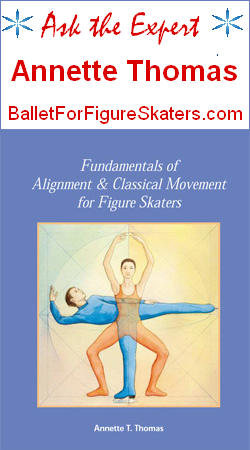
This guest post comes from Annette Thomas, classically trained dance teacher and choreographer. Thomas is also author of the book Fundamentals of Alignment & Classical Movement for Figure Skaters. You can also visit her Web site at BalletForFigureSkaters.com. Readers who would like to purchase her beautiful, thorough, well illustrated manual can buy it at MySkatingMall.com. Five percent of every purchase through My Skating Mall will be donated to the purchaser's figure skating club.


Ice Mom: Why should figure skaters take ballet?
Annette Thomas: There is no other single off-ice conditioning class that has as much to offer the figure skater as classical ballet lessons. Classical ballet lessons provide strength & flexibility training, body awareness, balance techniques, mental focus, discipline, musicality and aesthetics all wrapped into one lesson.

Ice Mom: Is it worthwhile for recreational skaters to take ballet?
Annette Thomas: It is always worth taking classical ballet no matter what level of commitment a skater has or what their ultimate goals may be as classical ballet enhances the quality of the experience of movement itself.

Ice Mom: If I have a skater who is a Regional competitor, how many hours of ballet should she take each week?
Annette Thomas: Normally Regional competitors take 2 to 3 ballet lessons per week (meaning technique lesson which are 1/ ½ hours long and not in conjunction with practicing dance recital pieces.)

Ice Mom: If a parent is watching the family budget carefully, would you recommend that she spend her figure skating money on ice and coaching or cut back on those two and include ballet?
Annette Thomas: It depends on the skater and the coach. If a skater has an aversion (or thinks they do!) to ballet obviously this will be a waste of money to try and force a skater into “doing ballet”. Many coaches are skilled at much more than just teaching skating technique and I believe that a lot of skaters miss the complete picture of what their own coach has to offer them aesthetically. Having said that, taking a regular classical ballet lesson can only help to improve the value of all that the skater does on-ice.

Ice Mom: How should figure skating parents choose a ballet instructor, or will any ballet instructor be a good fit for a figure skater?
Annette Thomas: Choosing a ballet instructor is just like choosing a coach. As a parent you should try to observe a class with your skater, discuss the lesson with the instructor afterwards and then privately discuss with your skater what you and she/he felt about the lesson and the teacher. Very importantly there should be a true curriculum based on a syllabus and no practicing of recital pieces during the lesson time.
Please see my web page for further answers to this question:
 http://www.balletforfigureskaters.com/book/exerpts/ch5.pdf

Ice Mom: Is there a question I should have asked, but didn't?
Annette Thomas: Yes: “Is all ballet created equal?” Note that I have used the phrase “Classical Ballet” throughout my answers. This is because all ballet is not created equal. Taking lessons at recreational studios which are geared toward recitals more often than not teach ballet as choreography not as a method of technique. Teachers who teach ballet by observation (meaning just as they were taught in class as opposed to having had lessons in pedagogy) will only have a minimum of positive effect. Lyrical ballet will not help the skater at all because there is very little if any refined technique to it and there is no emphasis on strength training. Classical ballet has a true methodology which takes into account the training of the entire body, head, eyes, hands, torso, etc. in incremental portions which ingrain movement and musicality into the muscle memory. It takes into account the importance of the lower back and core muscles as the “fulcrum” of the body which needs to be trained slowly and carefully for maximum potential in both strength and flexibility. Classical ballet technique forms the body from the inside out so that the technique is safe and the dancer/athlete can be secure and confident in their actual abilities.

Questions for Annette Thomas:
Readers are invited to write questions for Annette to answer in the Comments section of this post. Annette has agreed to reply to them there. Some readers have sent in questions in advance. Those questions appear here.


Reader: When a mid-level skater has limited funds, how should it be distributed between on-ice, off-ice, and dance?
Annette Thomas: Distribution is a very individual consideration which you and your primary coach would have the priority in deciding as you discuss your skater's particular needs and what is available in your area.  Also the distribution should take into account the temperament and age of the individual skater. On-ice practice is obviously the main priority for a figure skater, but people categorize off-ice in many different ways; most often it boils down to “sports oriented” (strength training, plyometics etc.) and “artistry oriented” (ballet and other dance forms). If you have an excellent classical ballet school in your area and the teacher is willing to work carefully with the skaters’ needs, I think this is the best off-ice training available in one package. If not, you may have to distribute your off-ice time and funds between something such as Pilates and a ballet or modern dance class at a local studio (just opt out of the recitals if at all possible, because that can get very expensive!)


Reader: Why is it that some ballet teachers dislike it when their students start skating? I see that a lot in my rink and often the teachers will ask the skater to stop skating or ballet. They are serious about ballet, but not to the extent of making it a career. What do you tell the ballet teacher?
Annette Thomas: Like most teachers and coaches, ballet instructors want students whose main interest is their “subject.” Children today are often involved in so many activities that long-term focus and commitment are hard to find. Skaters usually take ballet lessons for their own agenda (to improve their skating), which can cause the ballet instructor to feel as though they are not in control of the learning process. Plus, skaters often have a very different sensibility when it comes to timing and movement in general, so it can be difficult for the average ballet instructor to work with skaters in the same class as non-skaters (this is why it is so important to have a ballet program at the rink). And finally, since both ballet and figure skating require tremendous amounts of commitment, energy and hard work, a ballet instructor may feel that they do not want to invest all of the mental and emotional energy required if they know that the student is more devoted to skating. It may sound selfish, but it is just human nature. I know coaches who feel the same way; when one of their skaters’ decides she likes gymnastics and wants to take it  more often…it can be frustrating to the coach as they now not only feel like “second fiddle” they also know that their skaters energies and time will be divided making it much harder for them to teach. It is a difficult situation on both sides as the teacher wants to teach in what they feel is the most productive manner possible and yet the student should never be felt to be rejected or “wrong” for choosing other things. I always tell my students “pick one or two things in your life and try to achieve excellence in them.”


As to what to tell your ballet instructor, you might try to interest him/her into working more “one on one” with your skater (via choreography, working at the rink etc.) so that they feel as though they are more a part of the process. 


Reader: My daughter is a young skater, just starting out, but has been taking ballet/dance since she was two. What should, if anything, we do differently now that she's skating? Should we be paying more attention to certain parts of dance? Will certain moves help more than others? Also, between ballet and gymnastics, which do you think helps with skating most?

Annette Thomas: If you, your daughter and your primary coach are satisfied with your daughter’s progress, I’d say to just continue with what you are doing. Gymnastics can be extremely hard on the body and I never recommend it (to dancers or skaters). It loosens the lower back and can permanently damage joints. Classical ballet will help your daughter strengthen her body as well help her to progress more quickly in her skating endeavors. If you can find a classical ballet studio that also teaches Character Dance, this would really be ideal to include in her studies.


© 2010 by Annette T. Thomas all rights reserved. Annette T. Thomas's answers are used with permission. 

 Want to take ballet or movement classes with Annette Thomas? She'll be teaching at the Pettit National Ice Center in Milwaukee this summer. (Artistry & Movement classes are for learning character dance/music appreciation and style.)
Her schedule: 
Tuesdays: 9-10 am medium/high ballet JUNE/JULY only, 10:15-11:15 am medium/high movement June/July only, 9-10 am low ballet AUGUST only, 10:15-11:15 am medium/high ballet AUGUST only, 11:30-12:30 medium/high artistry and movement AUGUST only, 3-4 pm medium/high artistry and movement, 4:15-5:15 pm low artistry and movement
Wednesdays:
3-4 pm medium/high ballet, 4:15-5:15 low ballet
Thursdays:
9-10 am low artistry, 10:15-11:15 am medium/high ballet


Do you have a question for Annette Thomas? Take this opportunity to Ask the Expert! You'll find her replies in the comments.

Do you have a question for the Ice Moms? Have you been thinking of a post you'd really like to see? Are you an expert and would like to contribute to the Ask the Expert feature? That's great. I love e-mail, so please contact me at icemom.diane@gmail.com

Ice Mom's Summer Camp Survey

Wednesday, February 24, 2010

Accessory Review: Sk8Strong DVDs and Off-Ice Training Manual

Note from Ice Mom: All of my reviews are unpaid. All editorial content on Ice Mom is independent of advertising content.

Another note from Ice Mom: Lauren Downes, MSPT, and creator of Sk8Strong, has written a great response to this post. I've included it at the bottom of this post because I think all readers should see it. Thank you, Lauren.

If you’ve been reading this blog for any amount of time, you know I’m cheap. However, if you’ve been involved with skating for any length of time, you’ll also know that cheap people have limited opportunities for that thrifty feel-good experience.

In the spirit of saving money on off-ice training, I purchased both the Sk8Strong Off-Ice Training for Figure Skaters Manual and the Developing the Youth Skater DVD last year. Physical therapist, off-ice trainer, and professional figure skating coach Lauren Downes, MSPT, developed the Sk8Strong program to help figure skaters accomplish off-ice training without having to employ a personal trainer. The Professional Skaters Association (PSA), which is the professional organization that certifies USFSA coaches and offers them professional development, has endorsed the Sk8Strong products. That’s a pretty big endorsement.

I’ve waited to write this review because I am a mom, not a fitness expert. So, to help me with the fitness part, I enlisted my fellow ice mom, physical therapist J.H. (Thank you, J.H.!)

Please note that Sk8Strong offers other products like a video analysis of the skater, individual skater assessments, seminars for clubs, paid membership to an online resource bank, and free databases of local off-ice trainers and nutritionists. This review doesn’t cover any of those additional offerings because I haven’t used any of those services.

Developing the Youth Skater DVD - $39.95

I bought the DVD that’s for low-level skaters, ages seven and up, but preliminary and lower. Sk8Strong also has videos for The Competitive Skater, Adult Training, The Ultimate Dynamic Warmup, and Core Stability Training.

The Developing the Youth Skater DVD comes with an insert that lists the exercises, repetitions and sets, and progression for a young or low-level skater. The video has three circuits of exercises, 25-40 minutes each. Each of the 27 exercise demonstrations lasts about a half minute, more or less.

Physical therapist J.H. said that overall the video had a good variety of exercises and the exercises were some of her own daughters’ favorites.

J.H. had some favorites, too, especially the demonstration of the advanced version of the lunge. She also liked the ITY exercise, the single leg bridge, the reach pull, the diagonal ball reach, the toe taps, the push up, the lateral step down, the single leg dead lift, the plyo off box, and the 2-foot squat jumps. The reach-pull, she said, would be great to work on jump rotation.

“Very good form is demonstrated on the video,” J.H. said. “The demonstrator is spine-neutral with good ab control, good alignment of leg, which means that the knee is in line with the hip or ankle.”

However, J.H. cautions users that some of the exercises like the crab walk, the crab alternating leg, and the crab bridge wouldn’t be for skaters with shoulder laxity or problems. She also said that the hip abduction exercises were very basic and that skaters could skip them, especially if they’re short on time.

She also wants skaters to make sure that they move from the shoulder blade first when they do the ITY and Rowing exercises.

“It’s a good beginner program,” J.H. said. “But I’d like to see more plyometrics. It would probably be helpful to the skater to have a professional watch them complete the program to give feedback on proper form.”

From a mom’s point of view, I have to say I’m disappointed in the video. I mean, I know the exercises and the circuits are helpful and the demonstrator is terrific, but the video isn’t user friendly.

Here’s what I mean: the video demonstrator performs the exercises in each circuit in sequence, but the demonstrations don’t last as long as it takes for a skater to do the number of repetitions and sets.

In other words, it’s not like a regular exercise video where the living room athlete can sweat with the professionals on TV in real time. Instead, skaters need to find the circuit they’re working on, watch the demonstration of the exercise, pause the DVD, and then complete the reps. When skaters are done with that exercise, they grab the remote, push Play again, watch the next demonstration, pause the DVD, and complete the reps.

That’s not 7-year-old, beginner skater friendly. If your skater is that young, you’ll have to sit next to her the entire time and run the remote for her. My 14-year-old doesn’t like the DVD for that reason. The first time we went through it, she and I were really frustrated that we couldn’t do the exercises in the same time as the demonstrator – until we realized that we were supposed to do the watch-and-pause thing. Ice Girl would rather put on some aerobics or dance workout video where she can bop along with the folks in the studio instead of pause the player every 30 seconds.

Bottom line: The DVD is full of very sound information and practice; however, I don’t think I would buy the next video in the series. We just don’t use this one very much.

Sk8Strong Off-Ice Training for Figure Skaters Manual - $28.95 (downloadable version: $24.95)

I’ll tell you right off the bat: this one’s worth the $30 or so. Ice Girl uses the manual all the time.

The 38-page manual contains photos, descriptions, and progressions for each exercise in all of the Sk8Strong DVDs. It has articles about the importance of stretching, functional training vs. gym machines, what a skater needs to be successful, exercise circuits for each skater’s level, blank training logs, and a periodization chart. It also includes the breakdown of an Axel.

The exercise chapters are:
  • Dynamic Warmup Exercises (includes muscle activation, mobility, traveling mobility, dynamic mobility, static stretching, and foam roll warm-ups.)
  • Core Exercises
  • Upper Body Exercises
  • Lower Body Exercises
  • Plyometrics
Physical therapist J.H. likes the binder, too. “The exercises with the foam roller are good and the periodization is very good,” she said. “You have to have different training all year round because you want to peak [in performance] when your competition is coming around.”

J.H. is a stickler for form, though. When we looked over the plank positions, she went to the floor and demonstrated how it’s supposed to look. J.H. is very fit. The top of her body was in a straight line from her toes to her neck.

“The plank position photos [in the manual] show a rounded back,” J.H. said. “But the shoulder blades should be set, not shrugged. They should make a straight line from ankle to shoulders to hips. The butt shouldn’t be up and the arms are way up too high.”

She went on about butt position in the push-up photos, too, with more floor examples. “See?” she said as she demonstrated a push-up. “You have to keep on your toes. If you can’t keep that position on your toes, be on your knees. No butt up; that’s a cheat.”

J.H. did like the exercises that Downes chose for the manual. She thinks that skaters will find them fun and not at all boring. Many of the exercises use affordable gym equipment like the foam roller, medicine ball, phisio ball, and sport cords. At first I was put off about buying the extra equipment, but Ice Girl really likes using it. No idea why equipment makes off-ice more fun, but it does.

The manual includes several reports at the end and are included as examples of what membership Sk8Strong on the Web contains.

You know, I’m a good reader. I read all the time. I taught English and journalism for 10 years and I’m a professional writer. However, the one-page Skill Analysis, “The Breakdown of an Axel,” mystified me. I couldn’t figure out what I was reading, why I was reading it, and what use it would be to Ice Girl (although she did put a star at the top of the page).

The report contains sentences like: The iliopsoas lifts the thigh to achieve a proper ‘step-up,’ and the quadriceps assists with hip flexion and control of the knee.

Um. If you say so.

J.H. read it and said that the report made perfect sense to her, but she’s a physical therapist. She said that her daughters wouldn’t know what to do with the report and most coaches wouldn’t, either.

I did like the Sk8Strong Injury Report sample (again, something you’d receive as a paying member). “Ankle Sprains vs. Tendonitis” describes what each injury is and what to expect during recovery. I also liked “The Importance of Stretching.” The report explains why and where skaters should warm up before skating, what the muscles do, what can happen if skaters don’t warm up, what kind of stretching is the best, and how much a skater needs to stretch. Both reports were readable and useful.

The manual’s material is copyrighted and the photos are made up of very fine dots. I had thought about photocopying the manual for Ice Girl to use and lose so I’d be able to have a master copy. Photocopying doesn’t work well with the photos: they become muddy and hard to view. You shouldn’t photocopy it, anyway, beyond using it as a back-up.

Bottom line: This manual was definitely worth the $28-something. Ice Girl keeps it in the van (most of the time) and refers to it. The photos are small, but the positions are well documented and obvious. I like the text description of each exercise, the recommendations for skating ages/levels, and the periodization.

Recommendation from physical therapist J.H.: “It would be more helpful to the skater to use a professional trainer for an hour and then use the video and manual as a reference during home training. A trainer costs typically $60 – 90 per hour. The trainer will design a program and evaluate the skater so the trainer knows what the skater’s strengths and weaknesses are and can create a program that fits the individual.”

-----RESPONSE FROM LAUREN DOWNES OF SK8STRONG:-----

Hello, this is Lauren from Sk8Strong. Thank you icemom and JH for taking the time for the thorough review! I would like to address a few points you have made, as we expected these type of comments when creating the programs.

The DVDs were meant to be instructional, and not a workout video that you could follow along the reps and sets of each exercise. Each skater is different and progresses at a different pace, and may progress one exercise faster than another. Therefore, a 'follow along' video would not do justice to every skater; it would possibly lead a skater to doing exercise progressions that he or she is not ready for. Yes, it is more boring for the skater, yet it is safer. Initially, the skater will follow along and pause each exercise; as time goes on, he or she will become more comfortable with the program and be able to do it by memory to their own music, or whatever keeps their interest!

At the beginning of each DVD, Sk8Strong states that it is highly recommended that a skater meet with a qualified health professional to assure that the exercises are being performed correctly. Not everyone will listen to that advice, yet it is very important. Yes, a DVD cannot take place of a set of trained eyes. They were created as a reference for fitness professionals, parents and coaches to use as a guideline for an appropriate exercise program. We have received many positive and thankful comments from athletic trainers, personal trainers, and physical therapists around the globe. I have seen many coaches without fitness credentials holding off-ice classes that are not appropriate for skaters, and if they are going to hold these classes, my goal was to give them the proper education. Nothing will take place of a physical therapist or certified strength and conditioning specialist, but if everyone becomes more educated, that is my goal :).

Regarding specific exercises such as hip abduction, that is actually one of the most important exercises for a young skater to do! The hip abductors play a large role in single leg stability, which is necessary in the majority of skating moves. In about 75% of skaters I have evaluated, there is a very large weakness of this muscle groups. Weakness can lead to knee problems, and will also affect the forementioned skating moves. A young skater needs to master technique of the basic exercises first, and then move along to more difficult ones. The Compeititive Skater DVD significantly addresses this muscle group with advanced exercises. In the ITY exercise, we do instruct to lead the motion with the shoulder blades. The point made about the crab bridge exercises is right on point. Also, regarding the pictures in the manual of the prone plank; yes, the buttocks is a little too high. I did that to assure that skaters don't dip down too low and cause an arch in the lower back.

Regarding plyometrics, we include a full plyometric progression in the Competitive Skater DVD. We only include the 2 foot squat jumps and beginning plyos in the Youth DVD, because skaters that young don't have the strength and stability to do single leg and more advanced plyos with the correct stability and body mechanics. This is why they are included in the higher level DVD.

Again, thanks for taking the time to write a review. We listen to all criticism, positive or negative, and use that feedback to better our programs. Our goal was to provide the skating community with safe, effective programs to better skaters' ability and performance, prevent injury, and educate everyone involved with a skaters' training.

Lauren Downes MSPT

Sk8Strong Inc.

Have you bought any Sk8Strong materials? What did you think of the program? Please add your experiences in the comments so everyone can benefit.

Update: From reader Anonymous/Sk8rmom who is a trainer and a mom (good, long, informative comment - you should read the whole thing): I have to agree with JH. Thank you for promoting the idea of actually going to a person rather than to learn ONLY from the manual or DVDs. As a Personal Trainer who works with skaters, I can't emphasize enough how much getting expert advice specific to your child's age, maturity, physical and mental needs, and their athletic goals and stage is priceless! Our children are growing and changing daily, it's important to take that into consideration. [...] I have not seen the DVDs, but had considered purchasing them as a resource. I probably will, but as a mom, I would not let the TV be my child's trainer. I could see recreational adults or older teens using them as such. No doubt they are good resources. However, there is no substitute for the personal touch.

Update: From reader Anonymous: I agree 100 % that the hip abductors are one of the MOST important muscle groups for any athlete, and weakness contributes to a variety of overuse injuries of the lower extremity. However, I feel there are more functional ways to get at the hip abductors than the side lying exercise described. This may be a good way in the beginning to isolate the muscle so that the skater knows what the contraction of this muscle feel like, but it does not integrate it into a weight bearing activity and simulate how the muscle is used in skating. I prefer exercises such as step downs and lunges that incorporate the entire LE.

Update: From reader C.D. via e-mail to icemom.diane@gmail.com: We ordered Sk8strong because my daughter wanted to start doing some off-ice conditioning, and our rink doesn't offer anything geared towards lower level skaters (and the classes they do offer happen at times when my daughter is in school). I wanted to be sure she got some instruction as to proper form, but wasn't willing to commit to private conditioning training (yet), so Sk8strong (the beginning skater version) seemed to fit the bill. Having reviewed it with my daughter a few times, the exercises are, indeed, appropriate and to my non-expert eye, appear to model good form. But the pacing is not quite right--they jump right from exercise to exercise, and run through them a bit too quickly. Maybe my daughter will be able to keep up after gets used to the exercises and the sequence, but for now, we have been using the pause button on the DVD player to let her watch the example, then do the exercise at her own pace. (IceMom suggested that we should get the book/binder that goes along with the set, which probably would have been helpful, but my husband placed the order and thought that was too expensive, so at least for now the watch/pause system will work for us.) Overall, I am not sorry I spent the money to order this as an educational piece to teach my daughter some new exercises and proper form, but I am not sure how well it will hold my daughter's attention long term.

Do you have a question for Ice Mom and/or the Advisory Board? Do you have an idea for a post? Are you an expert and you want to write a guest post? Great! E-mail Ice Mom at icemom.diane@gmail.com