Wednesday, March 31, 2010

Ask the Expert: Jenny Hall, Former Ice Show Figure Skater

This guest post comes from Jenny Hall, former show skater and author of Ice Charades: Penguins Behaving Badly and Other Follies From the Road (use discount code CLFZ9MCH  to save 10%). You can also visit her popular blog, Ice Charades. If you'd like to read reviews of her book you can visit Ice Mom's review of Ice Charades or About.com's Jo Ann Schneider Farris and her review.

So your son or daughter wants to join an ice show.  They are turning 18 pretty soon and you’re wondering if you’re crazy to let them do it.

I don’t think so.

Perhaps you’re thinking that your kid needs to go to college first because they will never get ahead in life without a college degree.  That’s probably true.  But the cool thing is you don’t have to pick one at the expense of the other – your son or daughter can do both.  Although usually not at the same time.
The most important concept I thought of when writing this post for Ice Mom is that parents may feel by joining an ice show their son or daughter will be exposed to all things evil:  weigh-ins, promiscuity, drinking and/or drugs, lack of safety, backstage cattiness, insufficient funds, injuries, or insecurity in themselves.  Yes, they’ll probably face all of that and worse.

But it won’t be because they joined an ice show as much as a result of turning 18.  It’s part of what happens when they leave home.  They can face the same challenges in college, the office, or if they become a coach at a rink.  Granted, dealing with all of those evils at one time in a far-flung location can be overwhelming, but in my case, it forced me to mature on my own and later I was glad for the challenge.

So, let them give it a try, tell them they can always return if they don’t like it, and tell yourself that you may get to visit them in an exciting, exotic spot of the world.  One mother I spoke with spent two weeks on a beautiful Scandinavian cruise for free.

Another plus is your kid will be earning money for skating instead of you paying for it.  Not bad.

So, let’s walk through some of the basics for your son or daughter:

  • For their best success in ice shows, they may want to join right out of high school at their physical peak.  But they don’t have to.  I had two years of college before I joined a show at 20.  While it was true, I lost the conditioning of my senior freestyle program in my legs and in my lungs that I had at 18, I was still okay for the show.  I rose to the occasion, skated on a lot of practice ice and improved my skating in other ways.  And I was more mature than I would have been right out of high school.  I continued to go in and out of ice shows and college for the next thirteen years and stayed in good shape until I was 35.  I also think I was a better performer because I mixed office work with the skating world and tried to enjoy the best of what each environment had to offer.  So it is not too late to start somewhere in their 20s.
  • Do your homework – talk to show skaters if you can.  No two ice shows are the same but certain shows will have certain set environments.  Let’s just say that Holiday On Ice gives the skaters more independence – which also means less supervision.  Disney On Ice has more hand-holding.  Touring shows will have more variety than a park show, but also more uncertainty.  I was drawn to traveling, so starting with a big touring show was the right choice for me, but someone who is more interested in their skating should look at the show’s caliber of skating first.  That may be the Royal Caribbean cruise ship show or Disney.  If a skater plans on making this their career for a while, a long-term show is best for steady income.  Stick with a touring show or a cruise ship show that’s going to be around for a while.  If it is more about having fun, try a summer amusement park show.  They are several of them in countries besides the U.S. 
The nice thing is ice shows are still a small world and once a skater finds work in one, they will find it pretty easy to get the scoop on others.  The Professional Figure Skaters Cooperative (PFSC) has made it even easier to get all the casting notices in one place and they even have a seminar in beautiful Sun Valley, Idaho open to younger skaters to hear first-hand what ice shows can be like.
  • Don’t play down the physical attributes of skating in ice shows.  I took it for granted until I was retired how beneficial it was to have a job that required movement rather than sitting at a desk or standing by the boards.  If a skater can stay away from injuries and eating disorders and stay healthy, their skating will pay dividends long after they put away the false eyelashes.  There will be plenty of time for more sedentary jobs, but move when and while you can.  I firmly believe having skated in my twenties and thirties will keep me healthier when I face my fifties.
  • While college is largely about planning (as in planning to graduate and cash in on that expensive degree), ice shows are more about living in the moment.  When you are performing, that is the only thing going at that very moment.  You’re not stopping during the pinwheel to check your Blackberry.  You don’t leave during intermission to pick up your sick child at daycare (well, if you did, you probably wouldn’t be allowed back).  From the time you walk into the dressing room at half-hour to the time the curtain goes down in Finale, you have one purpose – to skate the show.  Maybe you have the goal to skate it well.  (But maybe it’s a Saturday matinee and you’re only putting in a C performance – ask someone from Ice Capades).  The flipside is when the show’s done, you’re done for the day.  It is not to say skaters don’t have goals in ice shows, but they can have the freedom not to.
  • Realize that ice shows won’t be in their life forever.  The reality is few in the chorus in Capades, Holiday or Disney went on to have careers in ice shows.  There are jobs in production, choreography, costumes or sets to move into once your legs stop moving, but they are few and far between.  Luckily, I think most chorus skaters want to move on from ice shows and into permanent housing, relationships, and jobs anyway.  Hopefully the skater will enjoy the traveling, the costumes and the performing while they can.
So if you’re still nervous about your son or daughter running away to join the circus an ice show or have any questions, please send me a comment.

Tuesday, March 30, 2010

Synchro: No Way. We Need Ice Dance, Too?

This guest post comes courtesy of Synchro Mom, who will be blogging at SynchroMom.net starting this Saturday, April 3.
 
Mom decided one day her daughter needed to try a sport! Not having any sports ability, we just decided to put it out there. First we tried softball, no good: Mom took a ball to the face.

O.K. let’s try volleyball, no good: Daughter took a ball to her face.

Much dental work and many oral surgeon visits later, Mom with her swollen face decided that Daughter would try ice skating. Off to the rink, which, lucky for us, is almost in our backyard, to begin our journey. At our rink, Daughter loved the ice and the sport! YAY!

At our rink, synchronized skating is HUGE and I mean HUGE! We have several teams at different levels and skaters with competitive spirits that skate daily to win! Synchro Girl watched in awe as the skaters linked together and covered all areas of the ice.

She wanted to join immediately; that was not to be the case. First, she had to participate in a three-week synchronized training session in the spring and then tryout. She was placed on a preliminary team and we were off and skating sync.

Through the years, she has skated her way up to different team levels and is having fun and working hard. Please join us in our journey to see what the synchro world has to offer. It will be fun-filled and I hope useful. I’ll also explain the use of white bobby pins for competitions! (Please Ice Mom: let me keep blogging, I promise to be good!)

Many of us Synchro Moms sit in the stands at the end of each night, frozen, yet smiling merrily as our skaters glide by. We’re just waiting for the Zamboni buzzer to go off and our skaters to exit the rink until tomorrow. Isn’t it funny, how even frozen to the core, you still have some of your senses? I can pick up a conversation, down three rows, from one end of the bleachers to the other.

I’m sitting all alone, trying to read, when I hear something I haven’t heard in the four years I’ve been warming that stupid bench.

I looked up from my book and shouted, “What? You need ice dance, too?”

After four years of synchro-skating where did that come from?

I moved down the bleachers. O.K., I ran down the bleachers so I could listen to the other Synchro Moms discuss the benefits of synchro-scholarships and how ice dancing is a requirement for many of the college teams.

So we will now add ice dance to Synchro Girl’s lessons and I will explore the requirements a synchronized skater would need to be eligible for college synchro-scholarship. (Should we just say watch for this blog posting as I want to list all or many of the colleges that offer scholarships?) Thoughts?

What do you think, Synchro Moms? Should Synchro Skaters take Ice Dance? Do you recommend anything else? Heard any rumors about Synchro-Scholarships? Let's share our knowledge!

As always, if you have some brilliant idea for a post, please let me know! If you have any questions for me, the Ice Moms, Ice Coach, Ice Girl, Synchro Mom, or anyone else, I'll try to lend you a hand. If you're an expert, you can be my new best friend if you consider posting for the Wednesday Ask the Expert feature. Just send me an e-mail! icemom.diane@gmail.com

Ice Mom's Summer Camp Survey

Monday, March 29, 2010

How-to: Make Your Own Figure Skate Deodorizer

I’ve spent $25 in the past on cute Stinkeez odor absorbing thingies. They’re made of colorful fleece and come in fun shapes like sharks and lizards. The idea is to stuff the Stinkeez in the figure skating boot to absorb foot odors and moisture.

The Stinkeez is filled with silica gel, which is a desiccant. You know those little paper packets that come in purses or shoe boxes? Those are filled with silica gel. You can find silica gel in bulk at craft stores. Crafters use it to dry flowers.

You can make a home-made Stinkeez very cheaply using single socks and cheap ingredients.

Materials:
  • Two clean, mismatched socks - with tops (not little ankle socks)
  • A desiccant: baking soda or white rice or cornmeal and borax or silica gel (You just need one of these, not all of them. So, if you choose baking soda, you don't need rice, etc. You'll get the best results with silica gel.)
  • Wide-mouthed funnel or a rolled-up piece of paper or  a narrow drinking glass
  • Optional: scented oil (peppermint, etc.)
I'm sure you see where this is going. Using the funnel or a piece of paper that's been rolled up into a funnel shape, fill each sock with the desiccant, stopping about three inches from the top. You can also use a narrow drinking glass for this purpose. Put the sock inside the glass and fold the sock's top over the edge to hold the sock open. Spoon in the desiccant.

Add a couple of drops of scented oil and tie off the sock's top with an overhand knot.

See? Cheap and simple. If you want to go fancy, buy some funky toe socks or holiday socks.

Update: From Advisory Board member S.F.: One of the best ways to combat stinky skates is to remove them from the skate bag so they can dry out. It also  prevents them from rotting. My daughter had a pair of skates rot last year because we never took them out of the bag when we got home. We have been removing them religiously every day and they no longer are smelly.

I also would like to comment about laces. I change laces frequently because white laces get dirty pretty fast. My daughter's ice coach likes clean skates and laces on test days and competition days.


Do you have a good idea for keeping boots dry and socially acceptable? Let us all know!

Have a question for Ice Mom or the Advisory Board? Do you have an idea for a post? Would you like to write a guest post? Awesome! E-mail me at icemom.diane@gmail.com. 

Ice Mom's Summer Camp Survey

Friday, March 26, 2010

Ask the Ice Moms: Where Can I Find an Adult-Friendly Figure Skating Club?

Today's question comes from a frustrated adult figure skater. Here's what she wrote:

I am an adult skater who started skating about a year ago. However, I am really into it and want to compete eventually. I am finding it hard to find a coach who takes me seriously! It seems to be all about the younger skaters. I mean, I understand that they are the ones with "potential," but I am giving them money too. And I want to give MORE money. Every time I try to join a class or get an extra lesson in, the younger skaters come first. Three times the adult classes have been canceled because "not enough signed up." I don't understand why I cannot just skate around with the 13 year olds. Are there any rinks that are more adult friendly? I just graduated college and I'm willing to try to find a job near better rinks (as long as I like the area, etc). Or is there some way I can be taken more seriously?
From PairsMom, the mother of a pairs skater. She lives in USFSA's Southwestern Region.
Maybe get on the USFSA website and contact the Adult Skating rep. for her region (area) and they can put her in touch with a coach that is teaching adults or at least be able to tell her which rinks offer adult classes. This would be a relatively simple thing to do and probably a good starting place.  
From Ice Coach, who is in the Upper Great Lakes Region.
This tends to be the case with a lot of rinks/coaches. I know specific coaches that will only take younger kids because they feel older ones are not going anywhere. As in a lot of cases you have to find a coach who will work with your goals. There are some coaches out there that have their own goals & agendas (getting kids to Regionals/Sectionals or higher) that they don’t really bother with adults or people that don’t fit with that goal.

 I think our rink is the most adult friendly I have seen. It seems like if you get a couple of adult skaters and then more will gravitate towards that rink. J.C.U had the adult only session Thursday nights last year and that was very nice. The only problem was filling the ice, but I know the adults really appreciated it. As far as Learn to Skate, I never have a full adult class, but I also will never cancel a class if one person signs up. What usually happens is the one adult will tell another and then next session I will have 4 or 5 adults in class. Plus many of them like to learn along w/ their kid. I hope that helps.
From Xan, a figure skating coach who started as an adult. She blogs at Xanboni! and lives in the Upper Great Lakes Region.
Absolutely a rink should be friendly to adults, and if an adult class gets canceled, most rinks will  let you skate around with the kids. I have never heard of a rink that cancels an adult class and then just tells the adults they can't skate. Every day I hear some new insanity. Some rinks manage to develop better adult programs than others, usually because there's a coach that's into them. This skater should just start skating at every rink she can reach, during any adult skate time (often noon public skates) and just start talking up the adult skaters she sees. She'll soon find the rink with the great program.  As far as relocating, the Chicago area has lots and lots of adult skaters. Come join us! :)
From S.F., who also lives in the Upper Great Lakes Region.


I forwarded this to my ice coach. This was her advice: 
LTS classes may be canceled due to low attendance at any level.  Interview coaches and talk to them about your goals. Choose one that wants to help you. 

I personally see quite a few adults on ice at our rink. They work on MIF/Freestyle and dance. They usually aren't on the ice after school gets out but usually skate in the early afternoon or during the adult freestyle that we have at our rink. Adult freestyle ice is Sat am 7 to 8 and Sun pm 5:30 to 6:30pm. 
 We recently had a test session where a club member took her adult pre-bronze MIF test and she is in her late 70's early 80's. We also have an ice dancer in her late 40's that has been skating about 4-5 years and is working on Pre-gold dances and just tested her prepre and prelim MIF. So I believe that ice coach is right. Interview coaches and talk to them about what the skater wants to accomplish and see if they are willing to help the adult skater achieve their goals.
From Kel, who lives in the Upper Great Lakes Region.

I really feel for this skater. It is difficult to "break in" as a new skater as an adult. I would strongly ask around and find a coach that is interested in taking on an adult student. This will allow her to advance more quickly, as I'm sure she's willing and interested in making the extra effort to practice the skills she's learned.  Finding the right coach is key -- I'd suggest she ask around. Once she finds the right coach, she'll fly. 
From J.C.U., a competitive adult figure skater who won a silver medal at last year's Adult Championships. She is also a figure skating coach who lives in the Upper Great Lakes Region.

Certain clubs and rinks have more opportunities for adults than others. A few that come to mind are Cincinnati OH, Grand Rapids, MI, Minneapolis/St Paul MN and most of the clubs in the Skating Council of Illinois. The adult figure skating population is the second fastest growing group, second only to synchro. I think adults are often not taken as seriously as the youngsters because of the demand careers and families make. Adults tend to take breaks from skating more often than the kids. Instead of looking for group lessons, I'd encourage you to find a private coach who is coaching or who has coached other adults. Ask the potential coach if they've had any students compete at Adult Championships. Your money will be well spent in one-on-one lessons with the right person. Be sure to have "trial lessons" with any coach before you commit. Good Luck! 

These responses are heavily weighted to the Upper Great Lakes Region, but only three are from the same rink area.

Readers? Can you help this skater? Do you have a vibrant adult program at your rink? Please share the knowledge in the comments. Naming rinks or clubs is a very nice thing to do.


Do you have a question for the Ice Moms? Do you have an idea for a post you'd like to see? Are you an expert and want to share your knowledge? That's terrific! E-mail me at icemom.diane@gmail.com!

Ice Mom's Summer Camp Survey

Thursday, March 25, 2010

Announcement: MySkatingMall.com's Grand Opening on Friday

Please note: Ice Mom does not accept funding for posts like these. All advertising is separate from editorial content.  I'm posting this because I think that Ryan Jahnke's MySkatingMall.com is a great idea that benefits buyers, sellers, and clubs.
 
I’ve written it countless times: figure skating is expensive. I’ve also written that Learn to Skate is the only bargain in figure skating.

Turns out, I’m wrong.

U.S. World Team Member (2008) and PSA Master Rated Coach Ryan Jahnke launches MySkatingMall.com on Friday, April 26. It’s an online figure skating bargain hunter’s paradise. You’ll be able to shop for used figure skating items and see listings from all over the world. Jahnke has also partnered with some vendors who will sell new skating items.

You benefit because you save money on figure skating purchases. Your figure skating club can benefit, too. If your club registers with MySkatingMall.com, a percentage of every purchase you make will go to your club. Click here to read my complete review of MySkatingMall.com.

Save even more. As an Ice Mom reader, you can receive a 50% off of all listing upgrades if you list items for sale on MySkatingMall.com in the next week. Basic listings are completely free, but listings can be upgraded to show on the front page and at the top of the item's category for enhanced visibility.

Just type this code in the discount box provided at the end of the selling listing form: MSM

Ask your figure skating club to register. Clubs can benefit from sales at MySkatingMall.com. It’s an easy process and a painless fundraiser. Five to 90 percent of every purchase raises money for the skating club or team of the buyer and seller. Skating groups can benefit from every purchase and sale their members make! It is completely free for skating clubs and teams to register at http://www.myskatingmall.com/clubs!


Good luck with your site, Ryan!

Have any of you tried MySkatingMall.com? What did you think? Did you stop over there to browse? What was your impression? Share your thoughts and suggestions about how to make that site better in the comments. (I'll forward them to Ryan.)

Do you have a question for the Ice Moms? Are you a figure skating expert who would like to appear on the Wednesday Ask the Expert feature? Do you have a marvelous idea for a post? Excellent. Please e-mail me at icemom.diane@gmail.com.

Ice Mom's Summer Camp Survey

Ice Mom’s Guide to Sewing: All about Cutting

This post is part of Ice Mom's Sewing Guide.
Other posts in this series: All about Patterns, All about Fabrics, How to Dye Silk for Fabric Skating Skirts, Altering Your Growing Skater's Figure Skating Dress, Laying out the Pattern.

Like adjusting the pattern and laying it out, cutting is one of those unglamorous steps that you shouldn’t rush.  I have my cutting table in the center of my front room, a movie in the DVD player, two stools, one on either side of the table, and plenty of good light.

If you haven’t copied, adjusted and laid out your pattern yet, you need to do that first. Instructions assume that you’ve done that.

Make sure your shears or rotary cutter is sharp. Never let your kids or husband run off with your sewing scissors to cut paper, plastic, or sheet metal. I buy a ton of cheap scissors and plant them in every room of the house, sometimes two pair. This prevents anyone getting the ridiculous idea of using my good Ginghers for anything. I even keep those cheap scissors in my sewing room's scissor drawer, just in case anyone gets the very dumb idea of grabbing my Ginghers for something. I buy the scissors at the back-to-school sales in August, when they're at a deep discount. Ginghers, however, are never cheap.

If you don't remember the last time you've had your scissors sharpened, it's time to take them in. Call your sewing store to find out who does them and how long you'll have to be parted from your scissors.

Materials:
  • Sharp shears
  • Rotary cutter and cutting mat (optional)
  • Sharp snips
  • Tailor’s chalk or disappearing fabric marker

Method:
  1. Make sure everything's flat. Fabric and pattern pieces need to be as flat as possible against the table. If they’re not, unpin, re-adjust, and re-pin. You’ll be wasting your time if the fabric is lumpy. It won’t fit right.
  2. Cut along the pattern cut lines. If you’re using shears, keep the bottom blade as flat against the table as practical. Try to cut very smoothly and do not lift up the fabric as you cut. If you’re using a rotary cutter, make sure your mat is under your pattern pieces. Roll the blade like a pizza cutter along the pattern’s cut lines.
  3. Cut notches. When you arrive at a notch, stop. Using your snips, snip along the triangle and up past the triangle’s point. The idea here is that you’ll extend the triangle’s side to about double its size. Come from the other direction to cut the other side of the triangle. You’ll be making a big X in the fabric. The reason you’re doing this is so that you won’t have to lift the fabric. If you need room for your shears to cut along the rest of the cutting line, use your snips to cut a few inches. Those inches will give you room to use your shears. (Note: sometimes seamstresses will cut through the notch and make a little snip into the seamline at the center of the notch. I do this in regular garment sewing where I have a more generous 5/8-inch seam allowance. With skating dresses, I rarely have that much of a seam allowance, so I just cut the triangles instead of risking cutting past the seam allowance.)
  4. Leave it on the table. When you have your piece cut, don't move it yet. Remember those marking holes you reinforced with paper tape when you adjusted and traced your pattern? This is a great time to use your tailor’s chalk or disappearing fabric marker to mark the spot. If you’re using the marker, remember that you can’t iron over the mark because it will become permanent.
  5. Unpin the pattern piece. I usually fold the piece and the fabric in half and stack them in order according to the pattern piece’s number or letter. That way, they’ll be in order when I want to sew them and I can refer to the pattern piece if I have questions.
  6. Finish cutting all pieces. Mark, unpin, fold, and stack.
  7. Keep some of your scraps. You’ll want them to practice on when it comes to sewing seams. If you have a serger, they’re great for running through the machine to make sure that your loops aren’t too loopy. I keep just a few scraps and throw the rest away - unless I so much fabric that I might be able to cut out a skirt panty, skirt, or extra pattern piece if I mess something up.
It’s pretty straightforward, but I want to encourage you to take your time. Rushing this or the other preparation steps will make for a poorly fitting garment.

Next time: sewing seams.

I have many talented seamstresses among my readers. Double-check me, please! Did I miss something? Do you do it better? Please comment so we can all benefit!
New seamstresses: leave your questions in the comments, too!

Do you have a question for Ice Mom or the Advisory Board? Terrific! Send me your questions! 
Are you a better seamstress than I am? Wonderful! Please e-mail me about writing a guest post.
Do you have some other question or concern? Great!
E-mail me at icemom.diane@gmail.com

Ice Mom's Summer Camp Survey

Wednesday, March 24, 2010

Ask the Expert, Annette Thomas: Is Ballet for Figure Skaters Worth It?

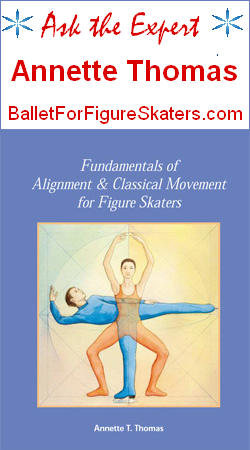
This guest post comes from Annette Thomas, classically trained dance teacher and choreographer. Thomas is also author of the book Fundamentals of Alignment & Classical Movement for Figure Skaters. You can also visit her Web site at BalletForFigureSkaters.com. Readers who would like to purchase her beautiful, thorough, well illustrated manual can buy it at MySkatingMall.com. Five percent of every purchase through My Skating Mall will be donated to the purchaser's figure skating club.


Ice Mom: Why should figure skaters take ballet?
Annette Thomas: There is no other single off-ice conditioning class that has as much to offer the figure skater as classical ballet lessons. Classical ballet lessons provide strength & flexibility training, body awareness, balance techniques, mental focus, discipline, musicality and aesthetics all wrapped into one lesson.

Ice Mom: Is it worthwhile for recreational skaters to take ballet?
Annette Thomas: It is always worth taking classical ballet no matter what level of commitment a skater has or what their ultimate goals may be as classical ballet enhances the quality of the experience of movement itself.

Ice Mom: If I have a skater who is a Regional competitor, how many hours of ballet should she take each week?
Annette Thomas: Normally Regional competitors take 2 to 3 ballet lessons per week (meaning technique lesson which are 1/ ½ hours long and not in conjunction with practicing dance recital pieces.)

Ice Mom: If a parent is watching the family budget carefully, would you recommend that she spend her figure skating money on ice and coaching or cut back on those two and include ballet?
Annette Thomas: It depends on the skater and the coach. If a skater has an aversion (or thinks they do!) to ballet obviously this will be a waste of money to try and force a skater into “doing ballet”. Many coaches are skilled at much more than just teaching skating technique and I believe that a lot of skaters miss the complete picture of what their own coach has to offer them aesthetically. Having said that, taking a regular classical ballet lesson can only help to improve the value of all that the skater does on-ice.

Ice Mom: How should figure skating parents choose a ballet instructor, or will any ballet instructor be a good fit for a figure skater?
Annette Thomas: Choosing a ballet instructor is just like choosing a coach. As a parent you should try to observe a class with your skater, discuss the lesson with the instructor afterwards and then privately discuss with your skater what you and she/he felt about the lesson and the teacher. Very importantly there should be a true curriculum based on a syllabus and no practicing of recital pieces during the lesson time.
Please see my web page for further answers to this question:
 http://www.balletforfigureskaters.com/book/exerpts/ch5.pdf

Ice Mom: Is there a question I should have asked, but didn't?
Annette Thomas: Yes: “Is all ballet created equal?” Note that I have used the phrase “Classical Ballet” throughout my answers. This is because all ballet is not created equal. Taking lessons at recreational studios which are geared toward recitals more often than not teach ballet as choreography not as a method of technique. Teachers who teach ballet by observation (meaning just as they were taught in class as opposed to having had lessons in pedagogy) will only have a minimum of positive effect. Lyrical ballet will not help the skater at all because there is very little if any refined technique to it and there is no emphasis on strength training. Classical ballet has a true methodology which takes into account the training of the entire body, head, eyes, hands, torso, etc. in incremental portions which ingrain movement and musicality into the muscle memory. It takes into account the importance of the lower back and core muscles as the “fulcrum” of the body which needs to be trained slowly and carefully for maximum potential in both strength and flexibility. Classical ballet technique forms the body from the inside out so that the technique is safe and the dancer/athlete can be secure and confident in their actual abilities.

Questions for Annette Thomas:
Readers are invited to write questions for Annette to answer in the Comments section of this post. Annette has agreed to reply to them there. Some readers have sent in questions in advance. Those questions appear here.


Reader: When a mid-level skater has limited funds, how should it be distributed between on-ice, off-ice, and dance?
Annette Thomas: Distribution is a very individual consideration which you and your primary coach would have the priority in deciding as you discuss your skater's particular needs and what is available in your area.  Also the distribution should take into account the temperament and age of the individual skater. On-ice practice is obviously the main priority for a figure skater, but people categorize off-ice in many different ways; most often it boils down to “sports oriented” (strength training, plyometics etc.) and “artistry oriented” (ballet and other dance forms). If you have an excellent classical ballet school in your area and the teacher is willing to work carefully with the skaters’ needs, I think this is the best off-ice training available in one package. If not, you may have to distribute your off-ice time and funds between something such as Pilates and a ballet or modern dance class at a local studio (just opt out of the recitals if at all possible, because that can get very expensive!)


Reader: Why is it that some ballet teachers dislike it when their students start skating? I see that a lot in my rink and often the teachers will ask the skater to stop skating or ballet. They are serious about ballet, but not to the extent of making it a career. What do you tell the ballet teacher?
Annette Thomas: Like most teachers and coaches, ballet instructors want students whose main interest is their “subject.” Children today are often involved in so many activities that long-term focus and commitment are hard to find. Skaters usually take ballet lessons for their own agenda (to improve their skating), which can cause the ballet instructor to feel as though they are not in control of the learning process. Plus, skaters often have a very different sensibility when it comes to timing and movement in general, so it can be difficult for the average ballet instructor to work with skaters in the same class as non-skaters (this is why it is so important to have a ballet program at the rink). And finally, since both ballet and figure skating require tremendous amounts of commitment, energy and hard work, a ballet instructor may feel that they do not want to invest all of the mental and emotional energy required if they know that the student is more devoted to skating. It may sound selfish, but it is just human nature. I know coaches who feel the same way; when one of their skaters’ decides she likes gymnastics and wants to take it  more often…it can be frustrating to the coach as they now not only feel like “second fiddle” they also know that their skaters energies and time will be divided making it much harder for them to teach. It is a difficult situation on both sides as the teacher wants to teach in what they feel is the most productive manner possible and yet the student should never be felt to be rejected or “wrong” for choosing other things. I always tell my students “pick one or two things in your life and try to achieve excellence in them.”


As to what to tell your ballet instructor, you might try to interest him/her into working more “one on one” with your skater (via choreography, working at the rink etc.) so that they feel as though they are more a part of the process. 


Reader: My daughter is a young skater, just starting out, but has been taking ballet/dance since she was two. What should, if anything, we do differently now that she's skating? Should we be paying more attention to certain parts of dance? Will certain moves help more than others? Also, between ballet and gymnastics, which do you think helps with skating most?

Annette Thomas: If you, your daughter and your primary coach are satisfied with your daughter’s progress, I’d say to just continue with what you are doing. Gymnastics can be extremely hard on the body and I never recommend it (to dancers or skaters). It loosens the lower back and can permanently damage joints. Classical ballet will help your daughter strengthen her body as well help her to progress more quickly in her skating endeavors. If you can find a classical ballet studio that also teaches Character Dance, this would really be ideal to include in her studies.


© 2010 by Annette T. Thomas all rights reserved. Annette T. Thomas's answers are used with permission. 

 Want to take ballet or movement classes with Annette Thomas? She'll be teaching at the Pettit National Ice Center in Milwaukee this summer. (Artistry & Movement classes are for learning character dance/music appreciation and style.)
Her schedule: 
Tuesdays: 9-10 am medium/high ballet JUNE/JULY only, 10:15-11:15 am medium/high movement June/July only, 9-10 am low ballet AUGUST only, 10:15-11:15 am medium/high ballet AUGUST only, 11:30-12:30 medium/high artistry and movement AUGUST only, 3-4 pm medium/high artistry and movement, 4:15-5:15 pm low artistry and movement
Wednesdays:
3-4 pm medium/high ballet, 4:15-5:15 low ballet
Thursdays:
9-10 am low artistry, 10:15-11:15 am medium/high ballet


Do you have a question for Annette Thomas? Take this opportunity to Ask the Expert! You'll find her replies in the comments.

Do you have a question for the Ice Moms? Have you been thinking of a post you'd really like to see? Are you an expert and would like to contribute to the Ask the Expert feature? That's great. I love e-mail, so please contact me at icemom.diane@gmail.com. 

Ice Mom's Summer Camp Survey