Monday, September 28, 2009

Would You Keep This Figure Skating Coach?


Thanks to my unofficial editorial advisory board: Ice Coach, Ice Dad, Ice Girl, Ice Friend, K.R. and C.L.

Please note: all e-mails below have been edited for length and usage.

A couple of weeks ago I received this question from reader L.L. in my InBox that said three things:
  1. L.L. likes her daughter’s figure skating coach.
  2. Competition problem #1: Skater and coach never practiced the compulsory at both ends of the rink. Skater was distressed at a competition when she had to skate at the other end of the rink.
  3. Competition problem #2: Weird problem where Skater was signed up for an interpretive figure skating event and thought it would be her normal program.
L.L. wanted to know: So why didn't our coach know about these things and what do I do now? Do I fire her or give her another chance? Isn’t that one of the reasons you have a coach and don't do it yourself?

I conducted a poll of my informal advisory board and it came out 6 to 1 in favor of keeping the coach on.

Here’s what some of us said:

K.R.:
  1. Yes, it's the coach's responsibility to know the rules – she should have known them.
  2. Is this a new coach? It sounds like she must be. Learning is hard, and that kind of mistake is likely only made once.
  3. I, personally, would give the coach one more chance assuming all else is good in the skater-coach relationship. If not, I would say that's a good reason to leave.

C.L: I think that the parent should have a heart-to-heart with the coach if she likes her. These seem like honest mistakes that maybe a newer coach would not be aware of. For the next competition, the parent and coach should review the rules together and schedule practice ice on the rink beforehand.

Ice Friend: I would say fire her, unless the kid wants to keep the coach. I know if it were me, I would not be happy, because it would make me feel like I’m not skating to my fullest. The coach should know about the competition’s rules, because they’re written in the competitions packets that they sign. It has all of the information, so maybe the coach read it, but she didn’t pay very much attention to the details.

Ice Mom: For me, the coaching relationship is more complicated than competition results. I look for a coach who loves to be on the ice, has good skating skills, is a good teacher, is nice to me and my kid, and is easy to communicate with. I want Ice Girl to do well at competitions and I sign her up for a lot of them. But at this level, I think that the competition thing is really about getting kids to understand what a competition is and how to mentally prepare for them. If your daughter freaked out or was thrown for a loop, that really didn't happen. It's obvious your coach let you down in the competition area, but you wrote that you really like her. Maybe the other criteria outweigh the competition fiascos. Maybe you're willing to take another chance with her because you believe she's a good coach and a good fit for your daughter and your family.

Ice Girl: Maybe the coach has really good skills and works well with the skater. I would sit down and talk with the coach, but I wouldn’t let her go just over this.

Most of us are willing to give this coach another chance, and that’s just what L.L. did.

Update: From Anonymous in the comments: I'm all for giving people a second chance, as long as you're confident that you're not being taken advantage of. If you think it was the kind of mistake you only make once, than give her another try. If, however, there are repeated missed details, then you should consider whether she is really serious about being a good coach. You need to be an advocate for your kids as well as a partner with the coach. Skating is too expensive not to be concerned about the details.

From reader Season: The main point of my post is that open communication with the coach is very important and if your coach is young and new to the profession she may need some time to get used to being a coach.

From reader Rosalie: One or two mistakes is fine, as long as they don't happen again, but you are paying your coach to help you/your skater progress, not to be your buddy.

What do you think? What would you recommend a parent do in this situation?


Monday, September 21, 2009

Book Review: On Edge: Backroom Dealing, Cocktail Scheming, Triple Axels, and How Top Skaters Get Screwed

I picked up Jon Jackson’s book, On Edge: Backroom Dealing, Cocktail Scheming, Triple Axels, and How Top Skaters Get Screwed, to understand the backroom drama that happened around the 2002 Winter Olympic Games and the figure skating pairs judging. I’m just not in the know.

Full disclosure: I’m a writing snob.

That’s what I’ve been told, anyway. In my defense, I’ll accept all kinds of misspellings, subject/verb disagreements, and dangling participles. I used to teach English: I’ve read it all.

My one requirement: respect your reader.*

Jackson delivers his insider’s view of the 2002 Olympic Figure Skating judging scandal – starting on page 190. That’s not respecting my time – that’s just narcissism. Jackson assumes that I’m interested in what he wore to his first competition, why he dropped his coaches, or what events he judged. Honestly, Jon: if you’re going to give your book a bombshell title, you’d better bring in the bomb way before chapter 9.

Part of the book’s problem is that Jackson framed his book as a memoir, but titled it as an exposé. It just doesn’t live up to that title. Eventually, Jackson writes about the scandals he witnessed. He names the folks involved and the ways they manipulated the system to protect their petty fiefdoms.

But, he also talks about what he ate, what he wore, and what others ate and wore. Much of the book doesn’t further the premise: high-level skating is corrupt. Much of the book, unfortunately, reads like a manual to Jackson’s life. Pereira, Jackson’s co-author, is a technical writer. The book’s not quite as dry as a technical manual, but the pair leave in too many details and not enough storyline.

To Jackson’s credit, he seems like a stand-up guy with a lot of integrity and a lot of courage. He recognized injustice and crusaded against it. There’s a lot of good stuff in chapters 9, 10, and 11.

I can’t speak intelligently about the judging scandal, Jackson’s alternative skating federation, or the ISU’s current judging system. I can tell you that I put this book down three times until I finally finished it.

Folks, that’s the kiss of death for a book review.

If you want to know about Jackson’s take on the scandal, follow my advice: start reading at page 190.

Let me catch you up to speed: Jon Jackson grew up in a non-practicing Mormon family in Utah. He came to skating late, but did well in it anyway, even with unqualified judges and spotty coaching. Skating’s expensive and time-consuming: Jackson’s parents’ marriage didn’t survive the strain. (They also don’t get another mention for the rest of the book.) Jackson went to college, struggled with his homosexuality, attended law school, and became a successful lawyer. While in college, he took steps to become a figure skating judge, despite a network of entrenched, inaccurate, luxury-loving, homophobic judges. Eventually, he started judging at a national and world level.

There. I just saved you three to five hours of your life you’d never get back. Ice Mom respects her readers.

Update: It's like our own book club in the comments! Readers Helicopter Mom, Season, Nancy, and nashvilledancer recommend The Second Mark by Joy Goodwin. I just ordered a used copy from Amazon.

*Respecting your reader means understanding your audience and its needs. Respecting your reader means keeping a tight focus on your subject and minimizing distractions.

Disagree with me? You know, I thought this review was pretty harsh when I wrote it, but a kind soul (A.H.) read it for me and said to go with it. If you read the book or have an opinion about the 2002 Winter Olympic Games and the judging scandal, feel free to share!

Tuesday, September 15, 2009

Thank You, Axels, Loops, and Spins!


Thank you, Aaron, of Axels, Loops, and Spins,  for the $100 Dick’s Sporting Goods gift card. Ice Girl won the $100 Labor Day weekend in an Axels, Loops, and Spins contest and she went shopping on Sunday.

As you can see from the mock Charlie’s Angels photo (left), Ice Girl bought a super warm zip-up fleece jacket from The North Face and the pair of Under Armour gloves she’s had her heart set on.

Ice Girl plans to wear the fleece jacket for teaching Learn to Skate. She says she’ll wear the gloves all the time.

I tell you, the gloves are nice: they’re that same ColdGear dry fabric that UA uses for their Cold Gear running tights. However, I’ve resisted buying them: they’re $30. It’s not bad, but think about it: $30 for one glove? Sure, they’re a pair now, but Ice Girl’s going to lose one of them soon… I’m resisting starting a betting pool on the date that she’ll lose one of the gloves. Don’t tempt me. Well, if I were running a pool, which I’m not, my money’s on September 25, the first day of the Madison Open.

Anyway, if you haven’t checked out Aaron’s fantastic blog, Axels, Loops, and Spins, you should. He’s my go-to guy for all that’s happening in haute figure skating.

Update, 9/29/09: I so lost the non-bet. Ice Girl still has her fabulous Under Armour gloves. She waved them at me in a taunting fashion yesterday at the rink. Very smug, Ice Girl.

Wednesday, September 9, 2009

Sewing review: Jalie figure skating practice skirt #2215

I sewed Jalie #2215, just the figure skating practice skirt pattern, for one of Ice Girl’s young friends. The gal in the photo on the left looks angry, but I assure you: this is a great pattern. I don't know what she's all ticked off about.

Most of you know that I’m a big fan of Jalie because the patterns include 22 sizes and the instructions and diagrams are usually accurate and detailed. Jalie patterns are pricey: $12.99 for this one, plus shipping. But the heavy paper and the multiple sizes make up for it, I think.

I always download and print the .pdf instructions for the Jalie patterns in advance because the company prints them alongside the pattern pieces. Those big sheets of paper are difficult to use when I'm sewing. You can find the printable instructions on the company's site.

In the past, I’ve sewn Kwik Sew #3051 for Ice Girl’s figure skating practice skirts, but I’m not a big fan of the waistband on that pattern.

The Jalie waistband is very clever and easy. There’s no waistband to cut – the skirt and panty make their own waistband.

The instructions explain that sewers should pin the skirt and panty top together with the wrong side of the panty to the right side of the skirt. That just didn’t seem right, but it is.

Here’s the genius of it: the top seam forms the top of the casing. Once the panty is back inside the skirt, Jalie instructs sewers to topstitch the casing and stitch a straight seam an inch or so under the topstitching, leaving about a 2” opening. Sewers insert the elastic between the panty and the skirt, sew the ends, and finish the seam.

Smart, hey?

If you have no idea what I’m talking about, you can see the online pattern instructions and diagrams here: http://www.jalie.com/product_printing_guide/2215.pdf

Anyway, this practice skirt went together very quickly: about one afternoon, start to finish. I had to take in the panty and hike up the skirt hem for the little munchkin, but this is my new go-to practice skirt pattern.

Monday, August 31, 2009

Coping with figure skating burn out

It’s corny, but true: you can’t burn out if you were never on fire.

Ice Girl is burning out a bit on figure skating. She’s still interested, but she’s cutting back, at least for the coming month.

We’ve been very careful to allow Ice Girl to decide her own level of participation, so why is she feeling burnt out? And why am I not worried?

  • The struggle for success. Progress through the lower skating levels was quick and easy for Ice Girl. Sure, she had to work at some things, but she quickly overcame obstacles. Not so with the axel. Ice Coach tells me Ice Girl is landing it inconsistently, which is good. But Ice Girl is frustrated with that jump and is tiring from the struggle.
  • Our solution? She’s working on other things in her lessons and building on those successes. She is working on a flying sit spin and just got a camel – back sit spin that wasn’t half bad.

  • Pain. Ice Girl has worked so much on her axel that her hamstring is bothering her. We’ve bought The Stick to massage the muscle and I took her to her doctor for evaluation. The hammy’s fine for normal use, but hurts when she steps up into that jump. 
  • Our solution? A physical therapist friend gave Ice Girl an exercise to try. I made an appointment with the sports medicine doctor, too. We’ll see.

  • Too much of a good thing. Ice Girl skated 13 – 15 hours a week this summer. That’s a lot. 
  • Our solution? Ice Girl cut back on her ice time for September without any prodding from me. She’s in control of that contract. I’m not pushing her.

  • Pushing herself too hard. Ice Girl is new to figure skating: she’s been on the ice for just under two years. Her peers are higher-level skaters and she pushes herself to reach their level. That kid has drive, which is good, but she’s running out of gas. 
  • Our solution? Again, it’s the ice time control. She can tone down the ice time for a bit and ramp it up once she gets her energy back.

  • Blurry vision. Why is Ice Girl doing this whole figure skating thing, anyway? She's having a hard time focusing on what she loves about figure skating because her hamstring hurts and she's overtrained. Losing sight of the vision makes it hard to stay motivated. 
  • Our solution? Talk it out. We are talking about what Ice Girl loves about figure skating and why she took to it in the first place. I'm asking her to write it down, too, but she's pretty resistant.

Kids burn out for other reasons, too. Some parents push their kids, some kids stress about the money factor, and some kids can’t take the discipline that a sport requires.

I’m honestly not worried if Ice Girl burns out (she cut back ice time from 13 to 9 hours a week). If she cuts back even more, then it’s just another lesson that she’s learned from figure skating: everything in moderation.

Update (9/1/09): I have been informed this morning that Ice Girl is not burning out. Ice Girl is amazed at my overreaction to her relief that she'll have only 9 hours of ice a week, not 13. "Mom. Mom. Mo-om. Stop being so dramatic. I'm not burning out. Geez. We're buying new boots this weekend."

Isn't that something? Me, getting a lecture about drama from Ice Girl. :)

Have you or your skater experienced burn out? How did you rekindle your passion for the sport? Share!

Wednesday, August 26, 2009

Sewing a figure skating undergarment from a swimsuit pattern

If you read this, I have to swear you to silence. Ice Girl won’t like the idea that people are reading about her undergarment. Swear? Good.

I had such trouble finding Ice Girl a leotard-like undergarment for underneath her figure skating dresses. She’s a modest girl and likes to be covered. I get it. But, she’s tried on every flesh-colored undergarment between here and Milwaukee with no success.

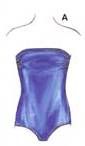
After searching patterns, I decided that the closest thing to what Ice Girl wanted was Kwik Sew 3503, view A. View A is a strapless swimsuit, but I added strap loops and clear straps to it. I offered to lower the back into a deep scoop or replace a bunch of the fabric in the back with flesh-colored athletic mesh, but she didn’t want that. Whatever. You could modify the pattern very easily to accomplish both of those suggestions.

The pattern includes a front lining with a shelf bra and it sews together in an afternoon or less (just five pattern pieces). I was worried about the gathers on the side and in the front lining, but they’re virtually unnoticeable and disappear under a figure skating dress.

Ice Girl loves her undergarment. Here’s what I did:


  1. Fabric. Flesh-colored spandex that matches her skin color.
    High-cut legs. The pattern has options for both low-cut and high cut leg openings. I used the high-cut option because I didn’t want the garment sticking out Ice Girl’s figure skating dress’s leg openings.


  2. Straps. Clear straps made from clear plastic elastic, clear swimsuit hooks on both ends, and a clear slider. I melted the two layers of elastic together instead of sewing them (I used my BeJeweler with the nailhead attachment.) You can buy clear straps, too, but Ice Girl loses them so often that I thought it would be good to have the replacement parts on hand.


  3. Strap loops. I added flesh-colored ribbon loops, spaced evenly around the top of the garment to accommodate the straps in all sorts of configurations.


  4. Fortuitous mistake. I didn’t have the 3/4” elastic for the top of the garment. I used my standard 3/8” elastic instead and zig-zagged the lining close to the elastic. This worked great, actually, because I eventually removed the lining’s top stitching to add a bra insert.


  5. Sew-in bra. Ice Girl didn’t like the minimal support from the shelf bra, so I used my mistake to my advantage. I.G. tried on the undergarment over a clean, but worn, flesh-colored bra. I used my tailor’s chalk to outline the bra on the outside of the garment, pinned it, cut off the bra’s straps and back, tore out the lining’s stitching, repinned the bra, and then basted it all in place. One more fitting before I stitched it permanently and ripped out the basting. It looks good and the bra and stitching are hidden in the lining. We had investigated the bra inserts at the fabric store, but they’re weird. Some models are gel-filled, some are push-up, and some are paper cones. I think using her own bra makes her feel more confident, too.
I was really worried about making this undergarment because Ice Girl is notoriously picky about them – she tried on dozens and didn’t find one she liked. The garment went together quickly, and fit well, so I didn’t end up wasting my Saturday afternoon at the sewing machine for nothing. When Ice Girl needs another undergarment, this is what I’m going to make – with 3/8” elastic at the top, too!

But, we've never had this conversation. You don't know anything about what Ice Girl might or might not be wearing under her figure skating dress. Silence, folks. Remember, you promised.

Is it O.K. to let the undergarment show or not? Let's discuss. How does your teen/preteen feel or how do you feel about flesh-colored garments showing through keyhole openings in figure skating dresses? You know - the kinds of dresses that show a lot in the back or front? Is it O.K. or is it tacky?

Monday, August 24, 2009

How-to: Break in New Figure Skating Boots

Oh, how I love this tip.

My favorite skate tech, Renee at Rainbo Sports, recommends that skaters break in their new figure skating boots by vacuuming the house.

This isn’t just a cheap ploy to encourage your kid to work off the cost of the new boots; it’s legit. It also has the bonus of making me smile when I have to blast the TV’s volume to drown out the Hoover. *Bliss*

Vacuuming helps break in the skates, Renee said, because the movements are similar to ice skating. The figure skater walks forward and backward while vacuuming. She bends her knees to vacuum under the sofa. These steps help to break in the new boots – and the carpet’s clean, too.

Here’s how to do it:
  1. Put hard skate guards on the blades.

  2. Lace the boots up to the third hook, not all the way up to the top or fourth hook.

  3. Set the timer for 10 – 15 minutes.

  4. Vacuum.

  5. Stop when the timer rings.

  6. Unlace the skates and take them off.

  7. Wiggle toes and feet.

  8. Lace ’em back up and drag the vacuum into the family room.

  9. Set the timer.

  10. Vacuum.

  11. Repeat until the house is clean!
The lacing/unlacing/wiggling steps are really important. These steps will help the skater break in the new boot and prevent blisters, too. Renee recommends that skaters who are breaking their boots in on the ice do lots of stroking and spinning. Hold off on jumping until the third or fourth day with the new boots. When skaters start to jump, they should focus on waltz jumps first. Again, when breaking in the boots, the lacing/unlacing/wiggling steps every 10 – 15 minutes are not a waste of ice time – they’re necessary to breaking in the boot and preventing blisters.

Renee cautions against other methods of breaking-in skates. I hesitate to list the rites and rituals skaters perform when they buy new boots because I’m worried folks will try these methods on their own boots. Let’s just say this: new figure skating boots are a huge purchase for most of us. Talk to your skate tech before you put anything in the boot besides a foot or a sock.

In other posts, I’ve also recommended Silipos Gel Sleeves to help figure skaters with the break-in process. A pair will set you back $30, but I’d rather pay the $30 than a) hear my skater whine and b) waste $500 or more on boots she’ll never use.

What works for you? Feel free to fill the comments area with ideas that figure skaters can use to break-in their boots.