Monday, March 1, 2010

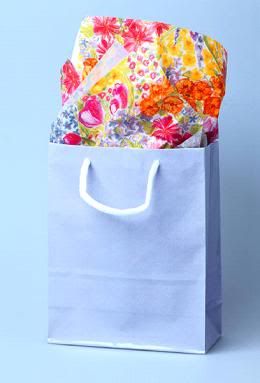
Figure Skating Competiton Goodie Bags: What's Cool?

This post is courtesy of Ice Coach, who is pretty much a one-person force behind her Learn to Skate's Basic Skills competition. If any of you has ever put together a competition, you know what a big job it is.

Ice Coach does a great job with it. The competition is known for two things: super cool medals and amazing gift bags.

She's got the medals down pat: they're these neat plexiglass skates with boot details and the competition name etched into them. As I said: super cool.

It's the gift bags she's struggling with this year. She included a figure skating book last year and the obligatory gloves, but she's running out of ideas and the competition's coming up soon. She needs to start ordering this stuff!

Update: From reader PrettyBowtie: At my last fun skate, all the "beginner" skaters (as in, this was their first solo skate in public) were given a brooch for their jacket. Gold skater doing a layback for the older skaters and something sparkly with diamontes for the younger ones. Everyone proudly shoved their badge straight onto their jacket.

Update: From reader Cathy: My girl got some leg warmers from mondor in her last competition bag.

Update: From reader Denise: Just a suggestion for the medals--an address label with the event name applied to the back of the medal (or perhaps the ribbon in the case of a plexiglass medal). We have dozens of medals without identification on them. At the time you receive them you think you'll remember what events your kid skated, but you don't. I have tried to go back and mark them but by the time I get around to it, I've forgotten what she skated. Love medals from the competitions that engrave the event on the back of the medal (I know it's pricey but they're permanent). My daughter's synchro team skated at ISI Nationals last year and even their medals weren't marked. Annoying. In 5 years who's going to remember what division and event they skated?

Update: From reader Becky Wright: One of My favorites was a fleece blanket with the club name embroidered on it. My daughters favorite is every Year at the Atlantic City "Sun, Sand and Skate" competition the goodie bag is a sand pail and shovel for the beach. They also go to the casinos for donations so the pail is filled with decks of cards,mints,hand lotions, tissues etc... The girls love it!

Update: From reader Sk8nLane: My daughter was at a basic skills competition and the bag included all the necessities such as lip balm, hand cream, band aids with a holder and, hair tie, tissues etc. In today's economy I think the families may appreciate useful items. I loved having that to replenish her skate bag.

Update: From reader Kate: If somebody has a monogramming sewing machine, you can get fleece blankets at Ikea for like $2. I've done them for wedding favors before. They're darling.

Update: From reader Anonymous. It's clear Anony understands competition chaos: Mini sharpie markers so that the kids can make sure their hard guards have their names (and label bottoms of trophies or backs of medals), coupons for restaurants close to the rink, and zipper pulls are some of the things I've seen that have been handy.

Update: From reader DramaQueen: TISSUES!!!!! I know this sounds weird, but trust me, during practice ice, someones going to get a runny nose.

Update: From reader Anonymous: Towels for drying your skate blades. These, too, can be picked up at a low price and get someone you know or a business to monogram them at a reduced price or for free!

Update: From Advisory Board member Jillybean (Ice Girl agrees: candy!): I just asked my daughter what her favorite goodie bag items have been, she first answered "candy!" She did say that she likes it when they give her a bottled water. We've seen granola bars, hair stuff and lip balm. One competition we went to gave the kids a small photo album with the name of the competition on it. 

Update: From reader Anonymous: Blister band aids. A disposable camera so the skater can have pictures to remember the day! 

Update: From reader Anonymous who wants us all to remember that boys figure skate, too:
LOL, I would say please don't forget the boys :) DS has gotten M & M lip balm, purses, pink things, I could go on and on LOL. Nothing is more disappointing than getting a goodie bag that nothing in there is appropriate. He's now at the age that he can laugh, but I think it still makes him a little sad. 

Update: It's official. Reader bethalice is a genius. How about a screw driver? DD once had screws in her skates that came loose, so I stuck a screwdriver in her bag. Several times other skaters needed to use it to tighten their screws. Now we just leave it in there. I bet you can get some inexpensive ones from a dollar store. 

What is the coolest thing you've found in a goody bag? Have you ever put one together? What do you include? How about unusual ideas for goodies as well as sources to buy items?

As always, if you have a question for Ice Mom or the Advisory Board, please send it in! If you have an idea for a post or you would like to write a guest post, that's cool, too! E-mail me at icemom.diane@gmail.com.

Ice Mom's Summer Camp Survey

The Talk: How Much Does Figure Skating Cost? You’re Kidding, Right?

Note from Ice Mom: The comments for this post are amazing! Thanks, readers!

Last week Ice Dad and I had the talk. You know the one: it involves budgets and numbers and bills and holy cow! We spend how much on figure skating?

Yeah, that’s the one - the one with the raised voices and red faces.

I’ll be honest with you: figure skating isn’t cheap. In fact, it’s expensive. I try hard to keep Ice Girl’s total figure skating expenditures to $800/month. If you’re new to figure skating your reaction will be: no way – that’s insane. If you’ve been smelling the Zamboni fumes and shivering in the stands for more than a year your reaction will be: wow – that’s not much.

I know good people, sane people, who spend easily twice what I spend. Three times, even.

Ice Dad’s struggling with the amount of money we spend on it, and I’m in denial.

As you know from a previous post, Ice Dad and I love what the sport has taught Ice Girl. She has drive, ambition, and goals. She is fit, active, and strong. She has a champion attitude and knows how to win and lose with grace. These aren’t just skating skills, these are life skills.

But it’s hard to ignore the fact that we pay $10k/year for those skills.

To that end, you’re going to see a few changes around here. I’ve changed my posting frequency from just once a week to Mondays, Wednesdays, and Fridays. I’m working on moving my blog to icemom.net and I’ll be selling some ads, too. (If you’d like to advertise here, let me know!) My goal is to move the site in early April.

I hope you stick with me through the changes. I hope I don’t have to buy ramen noodles by the case.

So, ice parents, here’s the awkward question: have you and your significant other sat down for the talk? Well? How’d it go? I know plenty of gals at the rink who keep their husbands in the dark about their figure skating spending. Are you one of them? How do you justify your ice spending?

Update: From reader Ateam On The Edge, who is an ice mom of an Olympian, and a blogger, too: On the Edge of Skating. You really don't want to know the expense at the elite level. Suffice it to say that we're mortgaged three times, something I do NOT recommend unless you are relatively sure your skater is committed. Be aware that finances is one of the biggest reasons for marriage problems, so tread carefully here.

There is no great amount of support until your skater gets to the medal levels at JNs or Nats in Intermediate or Novice. More financial assistance is opening up now, but it is scarce. Check the USFS site for information.

If your skater has started to have a track record of medaling at the non qualifying level, start to explore the New England Amateur Figure Skating Foundation. They don't have a website, but many skaters (including ours) have been benefiting from this source for years. It requires a lot of proactive work on your part.

Write them for a brochure to see how it works:
NEASF P.O. Box 6881; Providence, RI 02940. NOTE: You do NOT need to live in the Northeast.

Update: From reader Helicopter Mom, whose husband did a double-take. Helicopter Mom has a blog, too: The Life and Times of a Helicopter Mom. Once, at a family function, my cousin told us how much they spend on "club soccer" and I countered with something like "That's nothing, we spend over $100 a week on skating" and my husband spins around and says "What?!" to which I responded "Approximately..." or something equally inane. To be honest, I think we spend about half of what you do, but with the economy the way it is now, even that is a struggle. And money we probably shouldn't be spending. But how do you stop spending it when you see the results?

Update: From reader Anonymous who homeschools her figure skater and has found the only bargain ice time I have ever heard of: [...] our figure skater would not be able to skate if she went to school because the cost would skyrocket. We are able to take her to public skating from 11-1 every weekday at a cost of $2 a day...we get 10hrs. of ice time for $10!!

Update: From reader Sk8nLane who avoids talking about expenses with other people: My biggest challenge is when I am asked by people outside the family about the expenses. I want to give an honest response, but also do not want to share details. We have 3 very dedicated skaters in our club and each family travels to get what they need when it is not available here. We have all chose to do this for our children, but many do not understand why we would make this choice if we are not raising an Olympian. So rather than discuss why I usually try to avoid the conversations.

Update: From reader Xan, who is a figure skating parent, coach, and adult skater. Xan's blog is Xanboni!: I'm not sure to this day (3 years after the competitive career ended) that DH is aware what figure skating cost. I still feel kind of guilty about it. The year she went to Jr Nats, we did in fact end up taking out a home equity loan. But I cringe when I hear about parents who do that BEFORE the competitive success comes.

Update: From reader Jozet at Halushki: The hard part for us is that with three children - all extremely talented and amazing, of course ;-) - we don't always spread the money around evenly, just as we can't always spread our time among them evenly. Sometimes one gets a little more for a while, and then another gets put on hold while the other sibling gets resources of time, money, and attention. It's a balancing act, and we're hoping more than counting on the fact that we're getting it right

Update: From reader Barbara, a new skating mom: My husband is "Ice Dad." He takes the girls to practice and classes, so he is very aware of the cost. We discuss, frequently right now, how far to go with this. They are both preparing for their FS1 test, so I expect they will be FS2 by the end of the month. We hope that they will want to continue to move forward (one is a bit more inclined than the other), and more than that, I hope we can continue to afford the cost of skating. [...] We are at about a $100 a week. Each. Not counting skates. Or dresses. Uh, oh.

Update: From reader PrettyBowtie: A coach I know competed at nationals/worlds/winter olympics with her brother when she was a teenager. They had no idea how much the sport cost their parents- including their marriage. She had the "aha" moment in her 20's and is still trying to work off the guilt that the sport she loves cost her mum so much (she's in her 40's now and is still going).

Update: From reader Mike McGuire who seems to be channeling my husband. I'm telling you, I thought it was Ice Dad at first: Wow - I am somewhat in shock at the people that haven't had a true discussion about expenses with their spouse. My first question would be "How would you feel if you found out he had a $10k per year habit?"

Update: From reader Renee: The best advice I ever heard from a skating mom who has seen it all and done it all in this sport: "Skating is a wonderful sport, but no gold medal is worth it if you as a parent end up in either bankruptcy court or divorce court." That thought put skating in perspective for me and my parents and it's advice I dole out to skating parents often!  

Update: From Advisory Board member and parent of a Junior Nationals gold medal winner, PairsMom: Here are some ways that our figure skating "family" at the rink saves money because we all know that this sport is outrageously expensive, although I've talked to some hockey moms and in most cases, they have us beat as far as cost, so we press on. Here is my list and if this is not going on at your rink among your child's coaches or other kids your child's age then YOU could probably get it started.

1. Travel together to share costs; hotel, rent cars, you CAN make it work. For longer competitions (3 nights or more) - get the kitchen and split between 2 families it's worth it!
2. We pass down skating practice wear and competition dresses, trade dresses if you have one that your skater is not wearing.
3. Become an ice monitor if your rink allows you to get a credit for your ice time.
4. Resell the skates and if that is not possible, resell the blades.
5. Volunteer on the club board, some clubs offer a discount on club membership for volunteer hours.
6. Have your skater save their money from birthdays, holidays, or small jobs to help pay for competition "goodies" like the tshirt/sweatshirt or maybe they could pay for a portion of their practice clothes or new skates.


Update: From reader jumpingbeanmom: My hubby hates what it costs- I keep a fund for sports from my paycheck into a separate account to pay, so he is not completely (but somewhat) aware of the cost. I also travel for my job, so am fortunate enough to get many free hotel rooms for competitions from my points. We don't eat out, drive old cars, and I pack lunch and dinner almost ALL the time. All our extra money goes to this sport. I am sure we pay close to $1000 a month for the youngest competitive skater.

Update: From reader Alice in Wonderland who wants to leave the amount she spends on skating down the rabbit hole: Never saw so many comments so quickly! I'm getting a good chuckle out of it all. I'm a numbers person, and just finished producing all my quicken reports for annual tax time, and guess what annual cost I avoided...yes, skating.

Update: From StupidDad, who sounds so much like Ice Dad that I wet myself: I am proud of what my daughter has accomplished in Figure Skating. She is talented and works very hard. However, I am not proud of this Sports at all. I feel ASHAMED and STUPID when I mentioned to people that I spent $800/month for a Sport/Hobby!

Update: From Kates, a former skater and current coach: My dad always knew how much we were paying, but I always knew that I'd get less guilt if I asked my mom to write the checks.[...] Ultimately, the final word from my mom was that it was worth it for my mental health. She remembers how miserable I'd be on Sundays before going back to school, and how going to ice dance in the afternoon would bring me back cheerful and happy. 

Update: From reader Anonymous who paid her way through skating: From my experiences currently and as a teenager I would highly recommend making your skater financially responsible for their skating. Having to pay for it myself made me realize how precious my lessons and ice time were and are, and make me use them wisely. I also realize what I am/was sacrificing in order to skate.

Update: From reader Jumpingbeanmom: I know college is important, but can you really put a price on something that gives you confidence, perseverence and all the other experiences of skating? There is nothing wrong with going to a less expensive local college since the money was spent on skating

Let us know in the comments how the talk went. Really, it’s O.K. We’re all friends here and it’s perfectly fine to comment as Anonymous. You might even feel good about admitting just how much you spend and how much you hide under the rug. I promise that your husband won’t hear about your spending from me.

Have a question for Ice Mom or the Advisory Board? Are you an expert and would love to share what you know? Is there a post you want to suggest? Great! E-mail me at icemom.diane@gmail.com.

Ice Mom's Summer Camp Survey

Thursday, February 25, 2010

Figure Skating Summer Camp Survey

It's nearly spring and time to start looking at figure skating summer camps.

The trouble, as I'm sure you've noticed, is that parents have no idea which figure skating summer camp would be the best fit for their child.

To end the confusion and to lend some order to the chaos I've created a camp survey.

Please consider this an invitation to take the survey and help other ice parents choose a summer camp intelligently. To my skater readers - yes, you can fill out the survey, too!


Thanks in advance for your help! I'll keep the survey open until the end of March and share the results with everyone in April.

Had a good camp experience? Had a lousy one? Please fill out the survey and leave a comment here, too. Let's share our knowledge!

Update: Reader, coach, figure skating parent, and adult skater Xan of Xanboni! makes an excellent point. So excellent, in fact, that I'm going make it big and change the wording on the survey to include her suggestion:

Don't forget to check out the many excellent day camp-style figure skating camps run by many local and municipal ice rinks, as well. Cheaper, closer, less intense.

Update/Note from Ice Mom: A survey taker wrote that she (?) was a skater, not a parent. Awesome! Thanks for filling out the survey!

Have a question for Ice Mom and the Advisory Board? Have a great idea for a post? Are you an expert in something that figure skating parents care about! Fabulous! Please e-mail me at icemom.diane@gmail.com.


Ice Mom's Summer Camp Survey

Wednesday, February 24, 2010

Accessory Review: Sk8Strong DVDs and Off-Ice Training Manual

Note from Ice Mom: All of my reviews are unpaid. All editorial content on Ice Mom is independent of advertising content.

Another note from Ice Mom: Lauren Downes, MSPT, and creator of Sk8Strong, has written a great response to this post. I've included it at the bottom of this post because I think all readers should see it. Thank you, Lauren.

If you’ve been reading this blog for any amount of time, you know I’m cheap. However, if you’ve been involved with skating for any length of time, you’ll also know that cheap people have limited opportunities for that thrifty feel-good experience.

In the spirit of saving money on off-ice training, I purchased both the Sk8Strong Off-Ice Training for Figure Skaters Manual and the Developing the Youth Skater DVD last year. Physical therapist, off-ice trainer, and professional figure skating coach Lauren Downes, MSPT, developed the Sk8Strong program to help figure skaters accomplish off-ice training without having to employ a personal trainer. The Professional Skaters Association (PSA), which is the professional organization that certifies USFSA coaches and offers them professional development, has endorsed the Sk8Strong products. That’s a pretty big endorsement.

I’ve waited to write this review because I am a mom, not a fitness expert. So, to help me with the fitness part, I enlisted my fellow ice mom, physical therapist J.H. (Thank you, J.H.!)

Please note that Sk8Strong offers other products like a video analysis of the skater, individual skater assessments, seminars for clubs, paid membership to an online resource bank, and free databases of local off-ice trainers and nutritionists. This review doesn’t cover any of those additional offerings because I haven’t used any of those services.

Developing the Youth Skater DVD - $39.95

I bought the DVD that’s for low-level skaters, ages seven and up, but preliminary and lower. Sk8Strong also has videos for The Competitive Skater, Adult Training, The Ultimate Dynamic Warmup, and Core Stability Training.

The Developing the Youth Skater DVD comes with an insert that lists the exercises, repetitions and sets, and progression for a young or low-level skater. The video has three circuits of exercises, 25-40 minutes each. Each of the 27 exercise demonstrations lasts about a half minute, more or less.

Physical therapist J.H. said that overall the video had a good variety of exercises and the exercises were some of her own daughters’ favorites.

J.H. had some favorites, too, especially the demonstration of the advanced version of the lunge. She also liked the ITY exercise, the single leg bridge, the reach pull, the diagonal ball reach, the toe taps, the push up, the lateral step down, the single leg dead lift, the plyo off box, and the 2-foot squat jumps. The reach-pull, she said, would be great to work on jump rotation.

“Very good form is demonstrated on the video,” J.H. said. “The demonstrator is spine-neutral with good ab control, good alignment of leg, which means that the knee is in line with the hip or ankle.”

However, J.H. cautions users that some of the exercises like the crab walk, the crab alternating leg, and the crab bridge wouldn’t be for skaters with shoulder laxity or problems. She also said that the hip abduction exercises were very basic and that skaters could skip them, especially if they’re short on time.

She also wants skaters to make sure that they move from the shoulder blade first when they do the ITY and Rowing exercises.

“It’s a good beginner program,” J.H. said. “But I’d like to see more plyometrics. It would probably be helpful to the skater to have a professional watch them complete the program to give feedback on proper form.”

From a mom’s point of view, I have to say I’m disappointed in the video. I mean, I know the exercises and the circuits are helpful and the demonstrator is terrific, but the video isn’t user friendly.

Here’s what I mean: the video demonstrator performs the exercises in each circuit in sequence, but the demonstrations don’t last as long as it takes for a skater to do the number of repetitions and sets.

In other words, it’s not like a regular exercise video where the living room athlete can sweat with the professionals on TV in real time. Instead, skaters need to find the circuit they’re working on, watch the demonstration of the exercise, pause the DVD, and then complete the reps. When skaters are done with that exercise, they grab the remote, push Play again, watch the next demonstration, pause the DVD, and complete the reps.

That’s not 7-year-old, beginner skater friendly. If your skater is that young, you’ll have to sit next to her the entire time and run the remote for her. My 14-year-old doesn’t like the DVD for that reason. The first time we went through it, she and I were really frustrated that we couldn’t do the exercises in the same time as the demonstrator – until we realized that we were supposed to do the watch-and-pause thing. Ice Girl would rather put on some aerobics or dance workout video where she can bop along with the folks in the studio instead of pause the player every 30 seconds.

Bottom line: The DVD is full of very sound information and practice; however, I don’t think I would buy the next video in the series. We just don’t use this one very much.

Sk8Strong Off-Ice Training for Figure Skaters Manual - $28.95 (downloadable version: $24.95)

I’ll tell you right off the bat: this one’s worth the $30 or so. Ice Girl uses the manual all the time.

The 38-page manual contains photos, descriptions, and progressions for each exercise in all of the Sk8Strong DVDs. It has articles about the importance of stretching, functional training vs. gym machines, what a skater needs to be successful, exercise circuits for each skater’s level, blank training logs, and a periodization chart. It also includes the breakdown of an Axel.

The exercise chapters are:
  • Dynamic Warmup Exercises (includes muscle activation, mobility, traveling mobility, dynamic mobility, static stretching, and foam roll warm-ups.)
  • Core Exercises
  • Upper Body Exercises
  • Lower Body Exercises
  • Plyometrics
Physical therapist J.H. likes the binder, too. “The exercises with the foam roller are good and the periodization is very good,” she said. “You have to have different training all year round because you want to peak [in performance] when your competition is coming around.”

J.H. is a stickler for form, though. When we looked over the plank positions, she went to the floor and demonstrated how it’s supposed to look. J.H. is very fit. The top of her body was in a straight line from her toes to her neck.

“The plank position photos [in the manual] show a rounded back,” J.H. said. “But the shoulder blades should be set, not shrugged. They should make a straight line from ankle to shoulders to hips. The butt shouldn’t be up and the arms are way up too high.”

She went on about butt position in the push-up photos, too, with more floor examples. “See?” she said as she demonstrated a push-up. “You have to keep on your toes. If you can’t keep that position on your toes, be on your knees. No butt up; that’s a cheat.”

J.H. did like the exercises that Downes chose for the manual. She thinks that skaters will find them fun and not at all boring. Many of the exercises use affordable gym equipment like the foam roller, medicine ball, phisio ball, and sport cords. At first I was put off about buying the extra equipment, but Ice Girl really likes using it. No idea why equipment makes off-ice more fun, but it does.

The manual includes several reports at the end and are included as examples of what membership Sk8Strong on the Web contains.

You know, I’m a good reader. I read all the time. I taught English and journalism for 10 years and I’m a professional writer. However, the one-page Skill Analysis, “The Breakdown of an Axel,” mystified me. I couldn’t figure out what I was reading, why I was reading it, and what use it would be to Ice Girl (although she did put a star at the top of the page).

The report contains sentences like: The iliopsoas lifts the thigh to achieve a proper ‘step-up,’ and the quadriceps assists with hip flexion and control of the knee.

Um. If you say so.

J.H. read it and said that the report made perfect sense to her, but she’s a physical therapist. She said that her daughters wouldn’t know what to do with the report and most coaches wouldn’t, either.

I did like the Sk8Strong Injury Report sample (again, something you’d receive as a paying member). “Ankle Sprains vs. Tendonitis” describes what each injury is and what to expect during recovery. I also liked “The Importance of Stretching.” The report explains why and where skaters should warm up before skating, what the muscles do, what can happen if skaters don’t warm up, what kind of stretching is the best, and how much a skater needs to stretch. Both reports were readable and useful.

The manual’s material is copyrighted and the photos are made up of very fine dots. I had thought about photocopying the manual for Ice Girl to use and lose so I’d be able to have a master copy. Photocopying doesn’t work well with the photos: they become muddy and hard to view. You shouldn’t photocopy it, anyway, beyond using it as a back-up.

Bottom line: This manual was definitely worth the $28-something. Ice Girl keeps it in the van (most of the time) and refers to it. The photos are small, but the positions are well documented and obvious. I like the text description of each exercise, the recommendations for skating ages/levels, and the periodization.

Recommendation from physical therapist J.H.: “It would be more helpful to the skater to use a professional trainer for an hour and then use the video and manual as a reference during home training. A trainer costs typically $60 – 90 per hour. The trainer will design a program and evaluate the skater so the trainer knows what the skater’s strengths and weaknesses are and can create a program that fits the individual.”

-----RESPONSE FROM LAUREN DOWNES OF SK8STRONG:-----

Hello, this is Lauren from Sk8Strong. Thank you icemom and JH for taking the time for the thorough review! I would like to address a few points you have made, as we expected these type of comments when creating the programs.

The DVDs were meant to be instructional, and not a workout video that you could follow along the reps and sets of each exercise. Each skater is different and progresses at a different pace, and may progress one exercise faster than another. Therefore, a 'follow along' video would not do justice to every skater; it would possibly lead a skater to doing exercise progressions that he or she is not ready for. Yes, it is more boring for the skater, yet it is safer. Initially, the skater will follow along and pause each exercise; as time goes on, he or she will become more comfortable with the program and be able to do it by memory to their own music, or whatever keeps their interest!

At the beginning of each DVD, Sk8Strong states that it is highly recommended that a skater meet with a qualified health professional to assure that the exercises are being performed correctly. Not everyone will listen to that advice, yet it is very important. Yes, a DVD cannot take place of a set of trained eyes. They were created as a reference for fitness professionals, parents and coaches to use as a guideline for an appropriate exercise program. We have received many positive and thankful comments from athletic trainers, personal trainers, and physical therapists around the globe. I have seen many coaches without fitness credentials holding off-ice classes that are not appropriate for skaters, and if they are going to hold these classes, my goal was to give them the proper education. Nothing will take place of a physical therapist or certified strength and conditioning specialist, but if everyone becomes more educated, that is my goal :).

Regarding specific exercises such as hip abduction, that is actually one of the most important exercises for a young skater to do! The hip abductors play a large role in single leg stability, which is necessary in the majority of skating moves. In about 75% of skaters I have evaluated, there is a very large weakness of this muscle groups. Weakness can lead to knee problems, and will also affect the forementioned skating moves. A young skater needs to master technique of the basic exercises first, and then move along to more difficult ones. The Compeititive Skater DVD significantly addresses this muscle group with advanced exercises. In the ITY exercise, we do instruct to lead the motion with the shoulder blades. The point made about the crab bridge exercises is right on point. Also, regarding the pictures in the manual of the prone plank; yes, the buttocks is a little too high. I did that to assure that skaters don't dip down too low and cause an arch in the lower back.

Regarding plyometrics, we include a full plyometric progression in the Competitive Skater DVD. We only include the 2 foot squat jumps and beginning plyos in the Youth DVD, because skaters that young don't have the strength and stability to do single leg and more advanced plyos with the correct stability and body mechanics. This is why they are included in the higher level DVD.

Again, thanks for taking the time to write a review. We listen to all criticism, positive or negative, and use that feedback to better our programs. Our goal was to provide the skating community with safe, effective programs to better skaters' ability and performance, prevent injury, and educate everyone involved with a skaters' training.

Lauren Downes MSPT

Sk8Strong Inc.

Have you bought any Sk8Strong materials? What did you think of the program? Please add your experiences in the comments so everyone can benefit.

Update: From reader Anonymous/Sk8rmom who is a trainer and a mom (good, long, informative comment - you should read the whole thing): I have to agree with JH. Thank you for promoting the idea of actually going to a person rather than to learn ONLY from the manual or DVDs. As a Personal Trainer who works with skaters, I can't emphasize enough how much getting expert advice specific to your child's age, maturity, physical and mental needs, and their athletic goals and stage is priceless! Our children are growing and changing daily, it's important to take that into consideration. [...] I have not seen the DVDs, but had considered purchasing them as a resource. I probably will, but as a mom, I would not let the TV be my child's trainer. I could see recreational adults or older teens using them as such. No doubt they are good resources. However, there is no substitute for the personal touch.

Update: From reader Anonymous: I agree 100 % that the hip abductors are one of the MOST important muscle groups for any athlete, and weakness contributes to a variety of overuse injuries of the lower extremity. However, I feel there are more functional ways to get at the hip abductors than the side lying exercise described. This may be a good way in the beginning to isolate the muscle so that the skater knows what the contraction of this muscle feel like, but it does not integrate it into a weight bearing activity and simulate how the muscle is used in skating. I prefer exercises such as step downs and lunges that incorporate the entire LE.

Update: From reader C.D. via e-mail to icemom.diane@gmail.com: We ordered Sk8strong because my daughter wanted to start doing some off-ice conditioning, and our rink doesn't offer anything geared towards lower level skaters (and the classes they do offer happen at times when my daughter is in school). I wanted to be sure she got some instruction as to proper form, but wasn't willing to commit to private conditioning training (yet), so Sk8strong (the beginning skater version) seemed to fit the bill. Having reviewed it with my daughter a few times, the exercises are, indeed, appropriate and to my non-expert eye, appear to model good form. But the pacing is not quite right--they jump right from exercise to exercise, and run through them a bit too quickly. Maybe my daughter will be able to keep up after gets used to the exercises and the sequence, but for now, we have been using the pause button on the DVD player to let her watch the example, then do the exercise at her own pace. (IceMom suggested that we should get the book/binder that goes along with the set, which probably would have been helpful, but my husband placed the order and thought that was too expensive, so at least for now the watch/pause system will work for us.) Overall, I am not sorry I spent the money to order this as an educational piece to teach my daughter some new exercises and proper form, but I am not sure how well it will hold my daughter's attention long term.

Do you have a question for Ice Mom and/or the Advisory Board? Do you have an idea for a post? Are you an expert and you want to write a guest post? Great! E-mail Ice Mom at icemom.diane@gmail.com
Monday, February 22, 2010

How-to: Find Professional Figure Skating Boot Fitters


This guest post is courtesy of my friend and master skate technician, R.H.

Question from a reader: I've been searching on the Internet for a certified skate technician or professional to advise us on new boots with little luck. We have a gentleman who visits our rink monthly and is excellent, but seems to bring a very limited supply of skates due to the nature of traveling. Is there a Website or resource that lists professionals by geographic location?

R.H.: This is a very good question! I'm not sure who is coming to your rink for fittings and what brand or brands of skates he carries, but ideally you should work with a skate fitter who represents several brands of skates and is (relatively, at least!) impartial. Skates are like jeans - Levis may fit your waist/hip/thigh ratio perfectly, whereas I can't find a pair of Levis that fit my frame to save my life! Every skate brand fits slightly different and offers features that may work better for certain foot types, so to have a fitter who only sells one brand of skate or who is very partial to one particular brand can be a hindrance to finding the boot that is best for you! An experienced fitter will measure you for several different brands (as each brand runs different in sizing and width) and then steer you in what he or she feels will work best for you, your foot type and your skate needs.

Unfortunately there is not a Website that offers this information. Each and every boot company has a list of retailers in your area that carry their brand of skates, but this is not a guarantee that you'll be fitted properly by someone who has adequate experience. The best method for finding a shop/person who does an excellent job is to first ask your coach. Most coaches do have an opinion as to the skate shop he/she prefers and trusts, and this advice is worth considering. If the coach doesn't have an opinion or you dislike the shop he/she mentions, then my recommendation would be to ask AT LEAST 5-10 people actively involved in the sport WHOSE OPINION YOU RESPECT (if you are willing to travel, even ask around at competitions, skaters who are novice, junior and senior most likely didn't get to that level in consistently poor fitting boots, so their opinion will be worth a shot). The key is to ask a variety of people, and if necessary, you may have to travel a good distance.

How far you may ask? Well, many of my customers come from within an hour's drive of my store, but we do have several customers who drive 4-6 hours each way for fittings and sharpenings. That may seem like a long drive (and to me it is), but considering that the skate is the foundation of everything the skater does, it is important that the equipment be fitted by technicians who are experienced and can give you the benefit of their knowledge.

Question from a reader: Does anyone know of any formal training courses offered for this?

R.H.: Another awesome question! I wish there was...unfortunately there is none. The skate companies do offer some educational support to their retailers, but the training mainly comes from working with a highly experienced boot fitter on a daily basis for at least several years. Best of luck in finding the skates you deserve!

Thanks, R.H.!

Update: From reader Anonymous who thinks driving to a good skate shop is worth it: It is so important to get skates that fit properly! The last time my skater was complaining about the fit of her skates, I assumed that she had just grown - again. We took her to a different skate shop (based on recommendations) and discovered that her feet had not grown. Not only were her boots the wrong size but the boots were just plain wrong for what she was doing (also based on her height and weight). My skater was well on her way to serious foot problems. [...] We are several hours away from our closest skate shop (and the new shop is even further) but the trip is worth it! I like to save money wherever possible and skates are definitely the place to apply those other savings!

Update: From skate coach, skate parent, skate blogger, and Advisory Board member Xan of Xanboni!:  Just another word from a coach--when you buy your first "real" skates, please go to a reputable dealer, not to SportMart, or the bike shop, or that hockey guy, or the used skate store, or grandma's garage. Get the tech or the salesperson to give you a primer in skate technology and don't PLEASE don't lie about the skater's tested level.

So many people quit skating because they think they're incompetent, when really they just have the wrong skates.

Update: From reader Jillybean: Remember that just because someone works at the rink, it doesn't mean that they know how to properly fit a skating boot. I had a bad experience with my first pair of "real"skates. I was fit by the guy at the rink, and I ended up with a pair of boots that were too big, and much too strong for my skating level at the time. I ended up with some serious foot problems. My doctor wanted to operate on my foot to fix one of the problems and told me that after I healed, I would need to get custom made skates. I decided to skip the surgery and go straight to the custom boots, and the problems that I had just went away!

It's worth it to spend a little more to get the right boot.


Update: From reader poorer but wiser, who had a bad fitting experience: [...] sometimes even an experienced pro can screw up. Do as much homework as you can before hand, read reviews from other skaters using various boots and try to be as educated a consumer as you can possibly be. And don't let the fitter strong-arm you into buying something you're not comfortable with ...


Have a question for Ice Mom? Want to write a guest post? E-mail Ice Mom at icemom.diane@gmail.com.

Friday, February 19, 2010

Figure Skating Competition Nerves: How Do You Prepare?

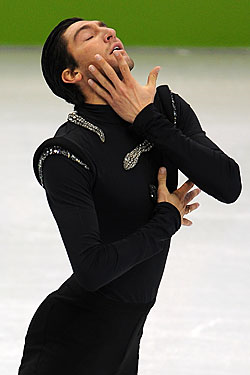
It's Winter Olympic season and Evan Lysacek just won the gold medal in mens figure skating. We watch his performance on the ice, but how did he keep it all together? How did he have the mental toughness to skate so flawlessly during the biggest moment of his life?

Lysacek told New York Magazine:
“When I'm getting ready in my room, I drink the same thing, I light the same good-luck candle I have — it's a brand from England called Cire Trudon — I listen to the same playlist, with songs from Jay-Z to the Virgins or the Killers, happy music that will keep my emotions even and not get my heart wildly pumping. I'm engaging all my senses, telling my body, 'Okay, it's time to go to that place.' When I get to the rink, I go through pretty much the same warm-up off the ice every time, so my body is continuing to get into that super-focused mentality. About twenty minutes before I go on, I put my suit and my skates on — that's my alone time — and I talk to myself. Self-talk is very important to me…I try to conjure really difficult days, days when I was sick or jet-lagged and felt horrible, and then think, If I can get through that, I can get through anything."
Aromatherapy is popular among top-level skaters. Instead of an imported candle, though, figure skater Johnny Weir uses Lemon Pledge for his calming ritual.

"I was nervous last night. So I Pledged [as in Lemon Pledge] everything in my room," Weir told People Magazine. "Some people eat, some people drink – but I Pledge everything."
Skater Jeremy Abbott had a disappointing Olympics, but his off-ice mental preparation is positive self-talk. Abbott told The Associated Press:

"Everyone has doubt in themselves, but I used to believe it," Abbott said. "That little nagging voice in the back of my head that told me I couldn't do it, I'd believe it. I'm learning I can quiet that voice and tell it to shut up."
As for Ice Girl, I have no idea how she prepares to skate at a figure skating competition. I tell her I love her, leave her with Ice Coach, and head for the stands. Believe me, my presence would only make her nerves worse.

What preparation tips from the champions can we pass on to our own figure skating sons and daughters?

  1. Aromatherapy. I prefer the Lemon Pledge myself, especially the whole Pledging process.
  2. Nervous energy. Worried about tomorrow? Clean your room, Ice Girl! That's what the champions do.
  3. Happy music
  4. Positive thoughts
  5. Comforting rituals
I've always said that the difference between practice and competition isn't in the crowds, the pressure, or the drama. The difference is in the mind.

This should be fun! How do you prepare yourself or your figure skater for a competition?

Monday, February 15, 2010

Ice Mom's Sewing Guide: Altering Your Growing Skater's Figure Skating Dress

This post is part of Ice Mom's Sewing Guide.
Other posts in this series: All about Patterns, All about Fabrics, How to Dye Silk for Fabric Skating Skirts, Altering Your Growing Skater's Figure Skating Dress, Laying out the Pattern.

Ice Girl eats like a horse. I swear that kid already measures 16 hands. And she’s still growing. She's all arms and legs and skinny, skinny, skinny. Even so, it’s tough to hide the fact that she’s growing when her butt cheeks peek out from behind her figure skate dress panties.

That’s why I found myself frantically sewing the disco ball dress and the Greek goddess dress before a competition in the beginning of February. Ice Girl had grown so much that she was popping out of the pop can dress and the white-panty purple-painted dress was more indecent than ever.

Believe it or not, I sewed two new dresses in two weeks because I’m lazy. Yep. Adjusting a figure skating dress that a skater has outgrown can be done, but it involves ripping out stitches (which I hate) and other surgical procedures. If you're new to sewing, do yourself a favor and take the figure skating dress to a good alterations shop. Bring along whatever fabric you'd like the alterations gal to use. It's much more fun to pay someone else to curse at the dress than to curse at it yourself, I tell you.

However, if you insist upon altering the figure skating dress, here’s how to go about it:

WHEN THE DRESS IS TOO SHORT

The leotard method. Readers of Ice Mom’s Sewing Guide know that I favor the leotard method for fitting because it eliminates the seam line between the panty and the bodice, which makes alterations for length a walk in the park. For information about the method, you’ll have to click on the link in the previous sentence. I’m going to write assuming you know what the leotard method is.

If you have a dress made with the leotard method, adjusting for the skater’s growing body is pretty easy. Rip out those zig-zag stitches you used to attach the skirt. Set the skirt aside to make scrunchies or as practice material for your serger. You can also add a line of Spandex to the skirt, but if you’re that advanced, you know how to do it. New sewers should cut a new skirt with a generous length. Rip out the crotch seam. Cut a new crotch insert and baste it to the crotch panty back and panty front. Have the skater try it on. Does it fit? Adjust it or sew it in pemanantly and then insert elastic like you normally would do (I’ll be writing more about elastic in a future Sewing Guide). Have the skater try on the leotard and gently pin the skirt in place so it hangs over the panty and is straight. Measure up for the hemline, too, and mark the length. Have the skater take off the leo. Mark the skirt placement line and unpin the skirt. Pin the skirt to the placement line, right sides together, with the hemline pointing in the same direction as the neckline. Attach with a zig-zag stitch. At the hemline mark, machine baste all the way around at whatever measurement you’ve decided on. For example, if the skirt’s an inch-and-a-half too long, I’d run a line of machine basting 1.5 inches from the hem’s cut edge. Cut it with scissors and finish the hem with nothing (spandex, netting), a rolled hem (any fabric), or a small folded hem (any fabric).

The pain-in-the-rear method. Better you than me, people. I just make a new dress and sell the old one in a club resale. However, if you and your skater just love, love, love the small dress and it’s not made with the leotard method, here’s what you do. You'll never catch me doing this: it's a lot like work.

On the inside of the dress, rip out the skirt/panty/bodice seam line. If the dress is lined, this is going to complicate matters. Somehow, you’ve got to get to that skirt/panty/bodice seam line, though.

Once the dress is in pieces, set the old skirt aside for scrunchies or serger scrap. You can also add a line of Spandex to the skirt; attempt it only if you already know how to do it. Cut a new skirt with a generous length instead. There are more worthwhile things to do with your life than mess with the old skirt.

Cut a perfect rectangle of fabric that’s the length you’ll need to make the dress fit, plus 1/2 inch. You can sew it in two ways.

Less bulk, uglier seam: 1) Machine baste along the top raw edge of the insert fabric, 1/4 inch from the raw edge. Lay the insert fabric right side up. Place the raw edge of the panty fabric along the basting line and pin. Sew with a cover stitch (if you have a cover stitch machine), a double needle in a standard machine, or a zig-zag that catches the raw edge of the panty fabric. Baste the new skirt to the top of the insert (I use a wide zig-zag). Attach to the bodice with whatever seam treatment you use for stretch fabrics.

More bulk, prettier seam: 2) Pin insert and panty edges, right sides together. Stitch as you would any Spandex seam with a 1/4-inch seam allowance. Baste the new skirt to the top of the insert (I use a wide zig-zag). Attach to the bodice with whatever seam treatment you use for stretch fabrics.

Have the skater try on the dress and mark the hemline. Have the skater take off the dress. At the hemline mark, machine baste all the way around at whatever measurement you’ve decided on. For example, if the skirt’s an inch-and-a-half too long, I’d run a line of machine basting 1.5 inches from the hem’s cut edge. Cut it with scissors and finish the hem with nothing (spandex, netting), a rolled hem (any fabric), or a small folded hem (any fabric).

The stripe method. An easier way to do this is to add a stripe around the entire bodice. This isn’t as ugly as you might think. Consider how a stripe of athletic mesh or a complementary spandex color might look on the dress. Would it look good? Fabulous. You’re in luck. You don’t have to mess with the panty or the skirt at all. Cut a perfect rectangle of fabric that’s the length you’ll need to make the dress fit, plus 1/2 inch. Machine baste along the top and bottom raw edges of the insert fabric, 1/4 inch from the raw edge. Draw the line where you’ll be inserting your fabric on the bodice and back with chalk or a water soluble marker. Zig zag close to the line on both sides of it, but not on top of it. Sewing very straight is crucial. If you can’t sew straight, don’t use this method. Cut the dress along the chalk/marker line so you have the bodice in two pieces. Lay the insert fabric right side up. Place one raw edge of the bodice fabric, right side up, along the basting line and pin. Sew with a cover stitch (if you have a cover stitch machine), a double needle in a standard machine, or a zig-zag that catches the raw edge of the panty fabric. Do the same with the other side of the insert fabric and the other bodice half. You can continually expand a dress with this stripe method. (Which I might do to Ice Girl’s Disco Ball dress.)

WHEN THE DRESS IS TOO NARROW

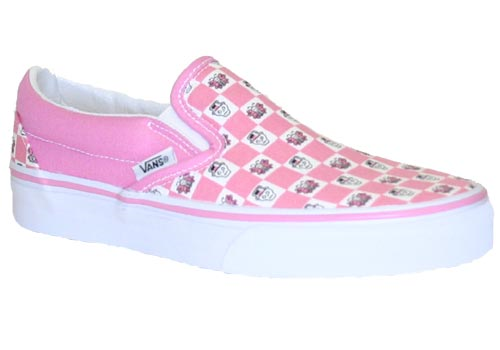
Welcome to the world of the gusset. A gusset is a triangular piece of fabric that you slip into the side seams of any garment. You might be familiar with the gusset from the crotch area of some tights, especially athletic tights or long underwear. You might be familiar with gussets if you’re a knitter. If you have expensive, tall leather boots, you might have an elastic gusset at the top to accommodate your calf. The photo of the slip-on canvas shoe (above) has an elastic gusset at the tongue. If you have a suitcase or a briefcase that has an accordion fold, those folds are gussets, too.

Beware: this is not a universal fix. Slip too much fabric in at the arm hole and you’ll mess up the sleeve. That, readers, is major surgery. I try to leave sleeves alone. However, if you are a master seamstress and are willing to share your sleeve gusset techniques, please consider this your invitation!

Let’s face it, folks: this is down-and-dirty sewing. From the stands, no one’s going to see the gussets. If they’re small, they’ll even be hard to spot up close, but they won’t be invisible. Do not accentuate these gusset seam lines with crystals or sequins.

Too narrow at the hip: About how much wider do you want the area to be? Divide that measurement by two and add 1/2 inch (that’s for the seam allowance). That’s the base of the gusset triangle. You’ve got a decision to make here: How tall do you want the triangle? The taller the triangle, the more it’s going to show. For a big-based gusset, make it tall. For a small-based gusset, make it short .Cut six triangles for a standard construction dress (bodice, panties, skirt) and two diamonds and two triangles for a leotard construction dress. If you’re cutting diamonds, they should be as if you’re putting two triangles together at the bases. Be sure to add a seam allowance at the base, too.

Rip the skirt seams, the dress’s side seams, and the dress’s bodice-waist seams, if any.

Insert the triangles or diamonds into the side seams with the tiny points pointing away from the waistline and the bases along the waistline. Sew in place, right sides together. Yes, it’s a pain, especially at those points. It helps if you think that you’re sewing them like a standard dart. In other words, sew the sides until you can’t sew anymore. Then take it off your machine, fold in half through the point, pull on the point, and sew like a dart. If sewing a standard dart means nothing to you, do not attempt the gusset. You can also hand sew it. Again, this is why I just go ahead and make a new dress. Finish this step for all triangles or diamonds. You should have gussets in the side seams for the panty, bodice, and skirt. Reattach all.

Too narrow at the bust: This is the same procedure as for the waist gussets, so you should read that procedure (above) first. You can open the side seam and slip in a triangle in both the side seam and the arm. The danger is that the sleeve will become so large that it will hang down way past the skater’s armpit. However, you can use gussets in this area in small amounts.

You can also open up the bodice at the bust line, if the skater has had a dramatic development in that area. Have her try on the dress and, yes, mark the pointy part. I know. Ice Girl would hate it, too. Again, you can see the appeal of making a new dress. When your skater takes off the dress, Draw a straight line from your mark to the seam line. Zig zag on both sides of the line you drew and cut straight down the line.

Draw a line on the back bodice, opposite the cut on the front. You want this line to be very short so the triangle insert will be very squatty. I'd go with maybe 1" to 1 1/2" tall. Zig zag on both sides of the line and slice the dress open.

Cut four triangles and add a 1/4-inch seam allowance to all sides. All four triangles will have the same base width, but a different height (the back ones are squatty, remeber?). The triangles for the front and back bodice pieces should match up to the cut line, plus 1/4 inch. Sew the triangles to the bodice pieces following the instructions for inserting triangles in the too narrow at the hip section.

See? I skip this whole nightmare and make a new dress. It’s much more satisfying and I curse a lot less.

Update: From reader, blogger, coach, advisory board member, and skating parent Xan of Xanboni! (visit her comment for links to photos): You can also grow a complex, jeweled dress using the leotard method. If you're making a really elaborate dress like the ones linked below, make a double leotard lining with a flesh toned fabric, and a third leotard to which you affix the design elements. When you want to alter it, simple remake or alter the undertard (as I always called them), and carefully refit the design elements to it.

Update: From reader Anonymous who outwits the growing process in a very clever way: I will add 2 inches extra to the leotard in the hip area and then sew it in a tuck with the fabric to the inside. The seamline is about two inches below where I'm going to put the skirt (leotard method). Once they grow, let out the tuck, and depending on where the skirt then sits, move the skirt. It can sit lower on the hip and still cover the bum and there is enough play in the waist of the skirt if spandex. If it's chiffon, carefully cut the waist a touch bigger, probably only 1/4 inch, or again, plan ahead and make it a front overlap style.

What do you do when your skater outgrows his or her favorite outfit? Please share your rites and rituals in the comments! No need to share your curse words. I've got that part down.

Have a question for Ice Mom? Please consider this an invitation to e-mail me at icemom.diane@gmail.com.