Showing posts with label skate care. Show all posts

Monday, March 22, 2010

How-to: Tie Figure Skates

This guest post comes to you from Ice Coach. My blog, Ice Mom's Adventures in Figure Skating will move to IceMom.net on Saturday, April 3. Joining me in blogging will be Ice Coach, Ice Girl, and Synchro Mom. Together, we'll try to give you honest answers and occasional laughs as we look at figure skating from different perspectives. This guest post will give you a little introduction to what you might find on Ice Coach's blog.

Tying figure skates correctly is important because improperly tying skates could lead to injury and bad habits. The biggest issue of tying skates is making them tight. I have repeatedly seen new skating parents not tie skates tight enough. Their child gets on the ice; his or her ankles are falling inward and not supported at all. I also know of parents who thought they needed new skates or blades remounted because their child was having difficulty skating. When it came down to it, the solution was simply tying the skates tighter.

No socks. If you’re a competitive skater you should not be wearing socks in your skates. Socks can lead to blisters, which are no fun. What’s worse than socks? Bare feet. Bare feet lead to blisters and smelly skates. Skates should fit as snug to your foot as possible leaving little room for your foot to slide around. I recommend trouser socks; they are form- fitting and thick enough to wear multiple times without getting numerous holes. You can even get moisture wicking trouser socks.


Untie your skate all the way. (See photo above.) I have seen many people untie the first couple holes only. Make sure the laces are loose enough to easily slip your foot inside the boot. Start tightening the laces at the toe and work your way up the boot. Tie the skates tight, but not so tight they cut off your circulation. I always tie my skates as tight as I can pull and never have an issue with numb feet, and I always have enough bending room. New skates are a different story. You might want to only lace the top three hooks on new skates so you have room to bend.

No skate lace tighteners. Does anyone like these things? They seem like more of a hassle.  You can tie your skates faster and tighter by using your fingers.


Cris-cross the laces and wrap them around the fourth hook, the one closest to the lace holes. (See photo above.) I prefer wrapping them over the hook rather than under it, but you can go under to over, too.


Wrap the laces. (See photo above.) On the third hook, when you cross your laces, wrap them around each other a couple of times to keep them from slipping. Do this on the first hook as well.

Bunny ears. (See photo above) On the first hook, tie a bow. Take the bow’s right “bunny ear” and hook it around the first hook again and tighten it; do the same with the left “bunny ear.” Your skates should not slip.

Never wrap extra laces around your ankle or boot. If your laces are long enough to do this, they are too long. Buy a shorter pair. Skates should bend at the ankle; if you wrap laces around the top part of the boot it will prevent this.

Lace materials. If your laces still slip and you’re using 100% cotton blends, try a nylon/cotton blend. I personally prefer them and think they slip less. But I have others tell me that the cotton ones slip less. It just depends on what you like.

Tying your skates well will help prevent injury and is the first step to proper skating technique.

Do you have a suggestion about tying skates? Do you have problems with it? Let Ice Coach know what you're thinking in the comments! If you have other questions for Ice Coach, you can put them in the comments or e-mail her at IceCoach@IceCoach.net

As always, if you have a question for Ice Mom or the Advisory Board, please send it to me. If you have an idea for a post you'd like to see, let me know that, too. Are you an expert? Wonderful. I'm looking for figure skating experts. E-mail me if you'd like to write a guest post. icemom.diane@gmail.com 

Ice Mom's Summer Camp Survey

Monday, February 22, 2010

How-to: Find Professional Figure Skating Boot Fitters


This guest post is courtesy of my friend and master skate technician, R.H.

Question from a reader: I've been searching on the Internet for a certified skate technician or professional to advise us on new boots with little luck. We have a gentleman who visits our rink monthly and is excellent, but seems to bring a very limited supply of skates due to the nature of traveling. Is there a Website or resource that lists professionals by geographic location?

R.H.: This is a very good question! I'm not sure who is coming to your rink for fittings and what brand or brands of skates he carries, but ideally you should work with a skate fitter who represents several brands of skates and is (relatively, at least!) impartial. Skates are like jeans - Levis may fit your waist/hip/thigh ratio perfectly, whereas I can't find a pair of Levis that fit my frame to save my life! Every skate brand fits slightly different and offers features that may work better for certain foot types, so to have a fitter who only sells one brand of skate or who is very partial to one particular brand can be a hindrance to finding the boot that is best for you! An experienced fitter will measure you for several different brands (as each brand runs different in sizing and width) and then steer you in what he or she feels will work best for you, your foot type and your skate needs.

Unfortunately there is not a Website that offers this information. Each and every boot company has a list of retailers in your area that carry their brand of skates, but this is not a guarantee that you'll be fitted properly by someone who has adequate experience. The best method for finding a shop/person who does an excellent job is to first ask your coach. Most coaches do have an opinion as to the skate shop he/she prefers and trusts, and this advice is worth considering. If the coach doesn't have an opinion or you dislike the shop he/she mentions, then my recommendation would be to ask AT LEAST 5-10 people actively involved in the sport WHOSE OPINION YOU RESPECT (if you are willing to travel, even ask around at competitions, skaters who are novice, junior and senior most likely didn't get to that level in consistently poor fitting boots, so their opinion will be worth a shot). The key is to ask a variety of people, and if necessary, you may have to travel a good distance.

How far you may ask? Well, many of my customers come from within an hour's drive of my store, but we do have several customers who drive 4-6 hours each way for fittings and sharpenings. That may seem like a long drive (and to me it is), but considering that the skate is the foundation of everything the skater does, it is important that the equipment be fitted by technicians who are experienced and can give you the benefit of their knowledge.

Question from a reader: Does anyone know of any formal training courses offered for this?

R.H.: Another awesome question! I wish there was...unfortunately there is none. The skate companies do offer some educational support to their retailers, but the training mainly comes from working with a highly experienced boot fitter on a daily basis for at least several years. Best of luck in finding the skates you deserve!

Thanks, R.H.!

Update: From reader Anonymous who thinks driving to a good skate shop is worth it: It is so important to get skates that fit properly! The last time my skater was complaining about the fit of her skates, I assumed that she had just grown - again. We took her to a different skate shop (based on recommendations) and discovered that her feet had not grown. Not only were her boots the wrong size but the boots were just plain wrong for what she was doing (also based on her height and weight). My skater was well on her way to serious foot problems. [...] We are several hours away from our closest skate shop (and the new shop is even further) but the trip is worth it! I like to save money wherever possible and skates are definitely the place to apply those other savings!

Update: From skate coach, skate parent, skate blogger, and Advisory Board member Xan of Xanboni!:  Just another word from a coach--when you buy your first "real" skates, please go to a reputable dealer, not to SportMart, or the bike shop, or that hockey guy, or the used skate store, or grandma's garage. Get the tech or the salesperson to give you a primer in skate technology and don't PLEASE don't lie about the skater's tested level.

So many people quit skating because they think they're incompetent, when really they just have the wrong skates.

Update: From reader Jillybean: Remember that just because someone works at the rink, it doesn't mean that they know how to properly fit a skating boot. I had a bad experience with my first pair of "real"skates. I was fit by the guy at the rink, and I ended up with a pair of boots that were too big, and much too strong for my skating level at the time. I ended up with some serious foot problems. My doctor wanted to operate on my foot to fix one of the problems and told me that after I healed, I would need to get custom made skates. I decided to skip the surgery and go straight to the custom boots, and the problems that I had just went away!

It's worth it to spend a little more to get the right boot.


Update: From reader poorer but wiser, who had a bad fitting experience: [...] sometimes even an experienced pro can screw up. Do as much homework as you can before hand, read reviews from other skaters using various boots and try to be as educated a consumer as you can possibly be. And don't let the fitter strong-arm you into buying something you're not comfortable with ...


Have a question for Ice Mom? Want to write a guest post? E-mail Ice Mom at icemom.diane@gmail.com.

Monday, October 12, 2009

Figure Skate Boots and Blades: Not the Place to Skimp


I’m thrifty, even cheap, but I don’t resort to home dentistry. Sure, I brush my teeth, and I even floss sometimes, but I leave the root canals and fillings to my dentist. My teeth’s good health is important to me: I don’t want rotten, misshapen teeth. I want to chew food without pain and I don’t know the first thing about giving myself Novocain. That’s why I see a professional.

I’m the same way with figure skates. I just don’t know how to fit them on my own; although, I would love a shot of Novocain when it comes to paying for them.

Let’s say, for instance, a person orders her daughter’s figure skating boots and blades online. Being a practical soul, she orders the figure skating boots one size larger for her daughter because the kid is still growing. Practical Mom wants the boot to fit her skater in a year. Practical Mom also bought a boot that’s a pretty high level because she expects her skater to advance quickly. She buys the figure skating blade online and mounts it herself at home. Then she takes the new skates to a local sporting goods store where they sharpen recreational blades.

Practical Mom wants to save money, but she’s doing it in the wrong way. Let’s see where she went wrong and how to make it right.

Ordering figure skating boots online. Sure, you can save money and order boots online, but you have to be cautious. You have to make sure that the foot measurements and foot tracings are done properly – many folks get it wrong. If you order your boots online, you don’t have the benefit of trying on several pairs from different manufacturers. You don’t know that one manufacturer’s boot has a narrow heel or that another has a wider toe box. However, ordering boots online can save you money, especially if the skater has stopped growing. In that case, order the same boot; it’s pretty simple.

How to make it right: Unless you’re very experienced with skate fittings, visit a reputable figure skate dealer for a good fit. If you must order online, call the place you’re ordering from and ask them to walk you through the measurement and foot tracing process. See if they can recommend a certain boot for you based on the measurements.


Ordering a boot that’s too big. Practical Mom knows her kid’s growing, but what she doesn’t know is that the sides of the figure skating boot are reinforced at points that correspond to a skater’s foot size. If a skater is too small for the boot, the non-reinforced areas will take the impact. Renee from Rainbo Sports said that this kind of wear actually makes the boot break down, or crease, faster than a boot that fits well. Practical Mom thinks she’s smart to order a size too big, but really, she’ll be buying new boots sooner.

Boots that are too big also cause foot problems, Renee said. A skater might compensate for the boot’s size by gripping the sole with her toes, which causes foot pain. Her heel might slip in the back and cause a bump on the heel. She could develop painful calluses, too.

How to make it right: Buy the boots that fit your skater’s feet. You can maybe go up a half size, but don’t go up any further than that. Remember that boot sizes don’t correspond to shoe sizes and every figure skating boot manufacturer has a different size chart. You must measure.


Ordering a figure skating boot that’s too advanced. Practical Mom dreams of doubles and thinks that the heavier the boot, the better her skater will perform. This is a lousy idea. Your skater will skate like she’s in cement shoes because the boot’s too tough for her. If you want your skater to quit, buy a boot that’s way too stiff.

How to make it right: Your skater needs to build up her legs and her feet in order to tolerate an advanced boot, Renee said. You’re better off increasing the boot incrementally than jumping from the rental skates your skater used in Basic 4 to a skate that kids doing triples require.


Skipping the heat molding step. I think Practical Mom skipped this step because she doesn’t have a convection oven at home. Few people do. You can’t heat mold a figure skating boot in a conventional oven, so don’t even try it. Heat molding figure skating boots is a fabulous thing. It molds the boot to the skater’s foot and smoothes the break-in process for the skater. Heat molding reduces painful blisters, rubbing, and even scars.

How to make it right: If you have ordered your boots online, take them (and your skater) to a skate shop. Dress your skater in her skate socks, too. Request that the shop heat mold the boot. They’ll probably charge you for it, but it’s worth it.


Mounting the figure skating blade herself. You’d think that mounting a figure skate blade to a boot is as simple as drawing a straight line down the center and screwing the blade down on top of the line. However, even a small variance in the mounting can make holding edges and spins difficult for your skater. If you try to adjust the mounting, you’ll weaken the sole and invite water damage. Better to get it right the first time.

How to make it right: Again, if you’ve ordered the boots online, take them into a reputable dealer for the mounting. Yeah, they’re going to charge you, but you’ll save your skater a lot of frustration in the long run and have a more solid boot.


Inexpert figure skate blade sharpening. Blades are pricey and have only so much life in them. An inexpert sharpening can ruin a blade by taking off way too much metal or rounding the blade à la hockey skates. Blades cost $150 on the cheap end and $500+ on the expensive end. For my money, I want the most life out of that bugger.

How to make it right: Take that blade to a reputable skate sharpener. I know – it’s hard to know who sharpens correctly. Ask around. People will tell you. (Someday I’ll write a post about how to know if a sharpening is good or not. Until then, ask around.) I drive Ice Girl’s skates to a shop 90 minutes away because I know that Renee at Rainbo Sports sharpens well. You know I’m cheap, but I’m also not willing to risk my daughter’s Vision blade on just anyone. That’s $500, people. O.K. I bought it used, but still. I’m not going to pay for the local used sporting goods store or hockey shop to ruin it.


The bottom line: scrimping on skates isn’t really saving you much. Look. I want to save money as much as the next person. Perhaps more than the next person: I adore bargains. But, I save money elsewhere: I sew dresses (you can buy them online), I make Ice Girl practice moves on cheap, empty public sessions, and I bought used blades (with Renee’s approval).

Update: From reader Anonymous: The recommendation charts are somewhat helpful, but as a skate tech who works with skaters for a living, I can tell you the charts are not always 100% on the money. The charts don't usually take into account the skaters body size, weight, hours per week he/she skates, how he/she breaks down boots, etc. I have customers who are 65 lbs. and working on Double Axels and the boot I recommend for them is not going to be the same as the boot for a 150 lb. man working on the same jump. Also, there is a major difference between a skater who is a "test" skater at, say, the Intermediate level, and an Intermediate lady who qualifies for Junior Nationals. So I always look at the "whole picture", not just the chart.

Update: From reader Helicopter Mom: Take the coach's advice too. They have WAY more knowledge about all kinds of skates than the other moms at the rink.

Update: From reader Ethelapple: Heat molding is great -- and so is "bumping out" the boot to get a little extra time before having to buy that next pair!

Update: From reader Anonymous: In general, I have found that an excellent pro-shop may have better boot and blade fit information than the coach.

What do you think? Let me know if you think I’m way off base with this one. Better yet, let me know if there’s a way to save money on figure skates that I don’t know about. Have a horror story? Share that, too!

Monday, August 24, 2009

How-to: Break in New Figure Skating Boots

Oh, how I love this tip.

My favorite skate tech, Renee at Rainbo Sports, recommends that skaters break in their new figure skating boots by vacuuming the house.

This isn’t just a cheap ploy to encourage your kid to work off the cost of the new boots; it’s legit. It also has the bonus of making me smile when I have to blast the TV’s volume to drown out the Hoover. *Bliss*

Vacuuming helps break in the skates, Renee said, because the movements are similar to ice skating. The figure skater walks forward and backward while vacuuming. She bends her knees to vacuum under the sofa. These steps help to break in the new boots – and the carpet’s clean, too.

Here’s how to do it:
  1. Put hard skate guards on the blades.

  2. Lace the boots up to the third hook, not all the way up to the top or fourth hook.

  3. Set the timer for 10 – 15 minutes.

  4. Vacuum.

  5. Stop when the timer rings.

  6. Unlace the skates and take them off.

  7. Wiggle toes and feet.

  8. Lace ’em back up and drag the vacuum into the family room.

  9. Set the timer.

  10. Vacuum.

  11. Repeat until the house is clean!
The lacing/unlacing/wiggling steps are really important. These steps will help the skater break in the new boot and prevent blisters, too. Renee recommends that skaters who are breaking their boots in on the ice do lots of stroking and spinning. Hold off on jumping until the third or fourth day with the new boots. When skaters start to jump, they should focus on waltz jumps first. Again, when breaking in the boots, the lacing/unlacing/wiggling steps every 10 – 15 minutes are not a waste of ice time – they’re necessary to breaking in the boot and preventing blisters.

Renee cautions against other methods of breaking-in skates. I hesitate to list the rites and rituals skaters perform when they buy new boots because I’m worried folks will try these methods on their own boots. Let’s just say this: new figure skating boots are a huge purchase for most of us. Talk to your skate tech before you put anything in the boot besides a foot or a sock.

In other posts, I’ve also recommended Silipos Gel Sleeves to help figure skaters with the break-in process. A pair will set you back $30, but I’d rather pay the $30 than a) hear my skater whine and b) waste $500 or more on boots she’ll never use.

What works for you? Feel free to fill the comments area with ideas that figure skaters can use to break-in their boots.

Thursday, March 5, 2009

Review: Blinkerz hard blade guards


You like the look of this beauty? Try buying eight of them for those darn Blinkerz blade guards – you know the ones: they have flashing LED lights.

Ice Grandma recently bought Ice Girl a pair of those cool, flashing Blinkerz blade guards for about $25. We all know that I’m way too cheap to buy them myself; I’d prefer to spend $9 - $13 on the plain ol’ plastic variety blade guard and toss the remaining $13 at the ice. But Ice Grandma loves the sparkle and so does Ice Girl.

Flashing. These puppies flash, which is great when Ice Girl is walking, but rotten when she’s not. A car ride with the Blinkerz will cause them to flash almost constantly, which wears down the batteries and the driver’s nerves. Ice Dad kept thinking he could see a police car’s flashing lights in his rear view mirror, but it was just those guards.

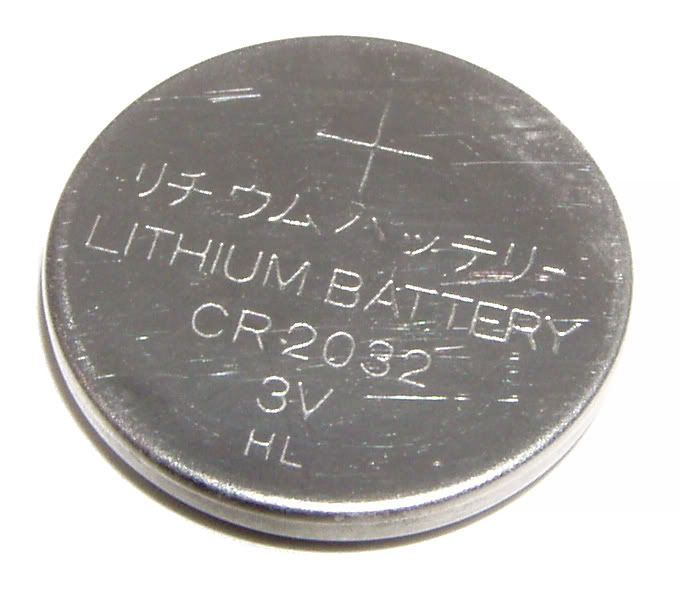
Batteries. The pair of guards takes eight CR2032 batteries; that’s two in each half. Our batteries lasted maybe two weeks. Order them online from batterybob.com and you can get a package of 10 for $14. Buy them at Walgreen’s and you can spend $20 for eight. Can you hear my wallet’s silent scream?

Weight. Geez, these guards are heavy. Nearly every time Ice Girl wears them, that’s what she says.

Quality. Something fell off the battery compartment when I removed it from the guard. Removing the battery compartment is pretty easy if you have a tiny screwdriver and you can keep track of the microscopic screws. However, a piece of something fell off when I removed a battery compartment. It looked a lot like a bit of hot glue. Other battery compartments had the hot glue in tact, but this bit just fell off. I shrugged, replaced the batteries, and hoped the stupid things would still flash. They do, but I worry that the lump of glue was necessary for…something.

Performance. They protect the blade just like their cheaper, non-flashing cousins.

Bottom line: Would I buy these again? Nope. Yeah, they’re cool, but they’re costly – not just up-front, but in long-term maintenance, too (unless your dad is Battery Bob). If you’re Ice Girl, though, you’re going to have to resign yourself to non-flashing, heavy guards. No way is Ice Mom shelling out $13 – 20 for batteries every two weeks.

Sunday, February 22, 2009

The Horror: Moldy Figure Skating Boots

Yesterday I hauled Ice Girl and Ice Friend through the snow to Milwaukee's Pettit National Ice Center and the Rainbo Sports pro shop.

Our mission: to exchange Ice Friend's old blades with Ice Coach's used blades.

The problem: mold and mildew.

Ice Friend bought her boots and blades a year ago at a different shop. The shop folks took her money and sent her on her way. Ice Friend had no idea that the untreated figure skate boot soles would trap moisture and encourage mold and mildew beneath her blades.

Ice Friend was ticked when she saw that mildew (the black stuff in the photo above). However, Renee at Rainbo said she'd take care of it, the mildew would be manageable, and Ice Friend's blade wouldn't fall off during a salchow.

When we bought Ice Girl's new boots, we waited an additional two weeks while Renee sealed the leather soles with marine-grade varnish and a bit of glitter. Varnish and careful drying of the boot and blade after ice time is the best way to make sure the darn things don't rot. That's Plan A for avoiding boot mildew.

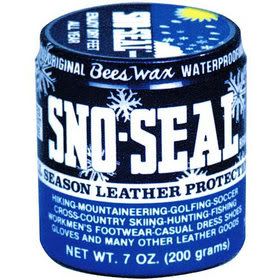
Here's what Renee did for Plan B, the solution to Ice Friend's problem. Renee removed the blade (don't do this at home), dried out the soles with her heat ray gun (a hair dryer will do), blasted the can of Sno Seal with her heat ray to melt it, and then used a cheap foam craft brush to paint the entire sole, heel, and a bit of the white boot with the Sno Seal. She was generous with the amount. Renee let the Sno Seal dry and then wiped off the excess with paper towels. In the photo above, you can see Renee's heat ray, Ice Friend's mildewy boot, and the brush full of molten Sno Seal.

Renee mounted the new blades and sold Ice Friend a $5 can of Sno Seal, which Ice Friend is supposed to smear on her boots once a month. The leather soles are noticeably darker than the untreated leather, but stopping that mildew thing is a big bonus.

For the official directions, you can visit the Sno Seal people's official Web site here: http://www.atsko.com/articles/footware/sno-seal-instructions.html

Monday, February 2, 2009

Quick tip: extra skate guards for competitions

This tip comes from Competitive Skater, who keeps two pairs of skate guards in her bag for competitions. One pair is her wet pair, the other is the dry pair.

At a competition, Competitive Skater wears the wet pair (dry at the time) to the rink, removes them, skates, and then puts them back on.

Competitive Skater returns to her skate bag, dries the guards, dries her boots and blades and puts on her dry guards for photos. No rust. Smart girl, that Competitive Skater.

Competitive Skater Dad is even smarter – he got Competitive Skater’s second pair of guards from the rink manager when the manager was getting rid of a year’s worth of lost-and-found stuff.

I scoured the lost-and-found last night: no dice. So, Ice Girl will be getting her second pair of guards at Badger State this weekend. Renee at Rainbo’s bringing them with her – we just have to pick the color. I’m hoping Ice Girl won’t pick purple, but I’m betting they’ll be sparkly.

Update: Ice Grandma popped for the new blade guards at Badger State Winter Games. When I buy guards, I shell out for the plain ol' guards that cost $9 - 13. Ice Girl has had her eye on these cool flashing guards for $25. You know me. I did the math and figured I could buy two pairs of guards instead of one pair of flashing guards. Or, I could buy one pair of plain ol' guards and one hour of ice. Choose, Ice Girl. She totally outwitted me and hit up Ice Grandma instead. Now Ice Girl has flashing guards (very cool) that require 8 watch-type batteries. They came with batteries, but I'm betting we'll need replacements soon. I did lobby hard for the orange flashing guards, but both Ice Girl and Ice Grandma looked at me as if I were nuts. She chose clear flashing guards - the better to see the cool lights.