Monday, March 22, 2010

How-to: Tie Figure Skates

This guest post comes to you from Ice Coach. My blog, Ice Mom's Adventures in Figure Skating will move to IceMom.net on Saturday, April 3. Joining me in blogging will be Ice Coach, Ice Girl, and Synchro Mom. Together, we'll try to give you honest answers and occasional laughs as we look at figure skating from different perspectives. This guest post will give you a little introduction to what you might find on Ice Coach's blog.

Tying figure skates correctly is important because improperly tying skates could lead to injury and bad habits. The biggest issue of tying skates is making them tight. I have repeatedly seen new skating parents not tie skates tight enough. Their child gets on the ice; his or her ankles are falling inward and not supported at all. I also know of parents who thought they needed new skates or blades remounted because their child was having difficulty skating. When it came down to it, the solution was simply tying the skates tighter.

No socks. If you’re a competitive skater you should not be wearing socks in your skates. Socks can lead to blisters, which are no fun. What’s worse than socks? Bare feet. Bare feet lead to blisters and smelly skates. Skates should fit as snug to your foot as possible leaving little room for your foot to slide around. I recommend trouser socks; they are form- fitting and thick enough to wear multiple times without getting numerous holes. You can even get moisture wicking trouser socks.


Untie your skate all the way. (See photo above.) I have seen many people untie the first couple holes only. Make sure the laces are loose enough to easily slip your foot inside the boot. Start tightening the laces at the toe and work your way up the boot. Tie the skates tight, but not so tight they cut off your circulation. I always tie my skates as tight as I can pull and never have an issue with numb feet, and I always have enough bending room. New skates are a different story. You might want to only lace the top three hooks on new skates so you have room to bend.

No skate lace tighteners. Does anyone like these things? They seem like more of a hassle.  You can tie your skates faster and tighter by using your fingers.


Cris-cross the laces and wrap them around the fourth hook, the one closest to the lace holes. (See photo above.) I prefer wrapping them over the hook rather than under it, but you can go under to over, too.


Wrap the laces. (See photo above.) On the third hook, when you cross your laces, wrap them around each other a couple of times to keep them from slipping. Do this on the first hook as well.

Bunny ears. (See photo above) On the first hook, tie a bow. Take the bow’s right “bunny ear” and hook it around the first hook again and tighten it; do the same with the left “bunny ear.” Your skates should not slip.

Never wrap extra laces around your ankle or boot. If your laces are long enough to do this, they are too long. Buy a shorter pair. Skates should bend at the ankle; if you wrap laces around the top part of the boot it will prevent this.

Lace materials. If your laces still slip and you’re using 100% cotton blends, try a nylon/cotton blend. I personally prefer them and think they slip less. But I have others tell me that the cotton ones slip less. It just depends on what you like.

Tying your skates well will help prevent injury and is the first step to proper skating technique.

Do you have a suggestion about tying skates? Do you have problems with it? Let Ice Coach know what you're thinking in the comments! If you have other questions for Ice Coach, you can put them in the comments or e-mail her at IceCoach@IceCoach.net

As always, if you have a question for Ice Mom or the Advisory Board, please send it to me. If you have an idea for a post you'd like to see, let me know that, too. Are you an expert? Wonderful. I'm looking for figure skating experts. E-mail me if you'd like to write a guest post. icemom.diane@gmail.com 

Ice Mom's Summer Camp Survey

Friday, March 19, 2010

Ask the Ice Moms: Dealing with Figure Skating Burnout

I’ve written about figure skating burnout before, but I think it’s a big topic that deserves a lot of text.


Here’s the reader’s question:

Just wondering if you have any advice for a little girl who still love skating and wants to skate every day, but is not her usual self on the ice (tired with some tears, missing her usual enthusiasm, no more smiles). I’m thinking of removing her from the ice for a week or so despite her coach’s unhappiness about it. Any help would be most appreciated!

From Pairs Mom, the mom to one-half of December’s Junior National Intermediate Pairs gold medal winners:

I have seen this happen among many skaters of all ages and levels. Does you have access to any type of club ice events or "team skating" such as Theater On Ice or Synchro at your rink? Sometimes when they are put in a group situation it changes the whole dynamic of a normally "individualized" sport. I have seen the enthusiasm come back in the singles skating because of the "group" skating.
Is your skater having to give up being involved in some other activity in order to be at the rink training? Girl Scouts, church activities for youth, school sports or clubs, choir, etc.? If so, then try to work out a compromise so she can be involved in both for awhile even if it means cutting back a little bit on the skating. On the other hand, it could be over-stimulation of being involved in too many activities that makes her too tired or stretched to enjoy her skating.

Get her to talk about it with you and just listen.
From Xan, figure skating coach, mom to a show skater, and blogger at Xanboni!

There are lots of reasons a child might lose enthusiasm for skating that aren't related to burn out. She might have had a bad fall and gotten scared; the coach might have said something coach-y to her that she took too much too heart and is now afraid of displeasing the coach. There might be issues with other skaters on the ice, or it might be entirely non-ice related. Talk to her classroom teacher at school and see if there are any issues there.

The coach is unhappy? Who cares? Has the coach expressed concern about the child's well being (I certainly hope so.) Maybe this family could exchange one or two practice sessions a week for one or two on-ice play dates with friends for a couple of weeks or a month, no practice or lesson required, so the little girl can find the joy in her skating again. Nationals are over, lol. We call this "early off season" and it's exactly the time to get back to the why and forget about the what and the how for a while.
From Kel, mom to a 9-year-old skater:

Instead of removing her from the ice for a week or so, I would decrease her weekly hours for a month or so. Hopefully she would be more anxious to get on the ice when she is there. Depending on the age, I would include the skater in filling out the next month's contract. I'd ask the skater what she wanted to do -- give her some control of her skating. Too bad the coach is unhappy -- I would hope that all coaches would want happy skaters.

From me, Ice Mom

As an education writer, I talk to all kinds of education experts about teaching and learning. In February Nathan Eklund, M. Ed., visited my office to record a series on teacher burnout. He used the clinical definition of it to explain that people can recognize the symptoms, treat them, and avoid burnout.
Eklund sited Herbert Freudenberger, who wrote in 1974:
 “Burnout is a state of exhaustion that results from working too intensely and without concern for one’s own needs”
What can I add? Freudenberger says it’s a clinical condition. I say take the time off that you've been considering and make sure she has a life outside the rink
What about you? Do you have advice for this mom? Should she give her skater some time away from the rink? How do you deal with figure skater burnout?

Hey! Do you have a question for the Ice Moms? Are you an expert and would like to guest post on the Wednesday Ask the Expert feature? Terrific! E-mail me at icemom.diane@gmail.com

Ice Mom's Summer Camp Survey

Thursday, March 18, 2010

10 Ways to Become Unpopular at the Rink

Friend and advisory board member R.H. once told me something like this:

The only people who are popular at the rink are those with no money and no talent.

Ouch. That seems harsh, R.H. However, I know people who have no money and kids with marginal skills who have made themselves wildly unpopular at the rink. I’m sure you know them, too.

  1. The future Olympic parent. My basic skills figure skater is going to the Olympics. I can tell. My skater is amazingly talented and dedicated. Athletic ability runs in our family – we’re all gifted and we have our own trophy room. Well, yes, my figure skater’s been in Basic Skills for five years, but she’s pacing herself. Level Four is very, very challenging.
  2. The solicitor. I hate to be the one to tell you, but as your friend, you should know that your skater’s figure skating coach doesn’t have good skills. She’s a low-level coach. If you’re serious, if your skater is ambitious, if you have a brain, you’ll switch to my daughter’s coach. You know, my skater’s figure skating coach passed her senior level whatevers and is rated a master fabuloso coach. All of her skaters go to nationals, at least twice. If you switched coaches, I’m sure your skater would have that jump by now. But, if you want to throw your money away, go ahead.
  3. The golden ager. Back in the day, things were just great here. The sun was always shining outside, the ice was perfect, our figure skating club had so much money, everyone loved one another, and skating was practically cost-free. Ah, yes. Those were the days.
  4. The expert. Judges, coaches, figure skating competition organizers don’t know what they’re doing. My skater is truly amazing, but the judges are against him. I tell you, judging is corrupt here. They’ll take just about anyone and give them a score sheet. Our figure skating coach is nice, but I don’t think that my skater has a tough enough program. I mean, he’s an advanced reader at school and in with students two grade levels above his. The coach should put my skater two levels up, too. He’s smart; he can handle it. And these figure skating competition organizers. Why would they set up the groups this way? Don’t they know that all of these kids are skating down? Didn’t they notice that kid at the last competition? I know he skated at a higher level. They’re stacking the deck on purpose so kids from their club win everything.
  5. The club critic. If I were on the figure skating club’s board, things would be different. I can’t believe that the board wants us to pay more, volunteer more, and attend mandatory meetings. Isn’t that why we pay club dues? I pay for this, so I shouldn’t be expected to do anything further. That’s for the little people to do. I don’t have time for this. I need to get my nails done.
  6. The parent of a gifted child. It took my figure skater just one lesson to land an Axel. Isn’t my skater fabulous? She’s only been skating three months and look! She already has her Axel. She’s working on her double Salchow, but, sadly, she only landed six last practice session. Your skater’s been working on her Axel, what? Eight months? Hmm. Yeah. Well, everyone at their own pace, you know. Not all kids are as talented as my skater. But, you know, she comes from a gymnastics and dance background. She was born at the barre, did I tell you? Funny story…
  7. The agent. These low level figure skaters keep getting in my skater’s way. She can’t land her triple-twisty thing because of all these little kids. You know, she’s the only one who has ever landed that jump in the history of this club/this rink/this region/the world. We should have ice just for her because she’s so amazing. She’s the reason that all these little kids are joining the club, you know. They want to be just like her. The figure skating club should subsidize her skating because she brings so many of these annoying low-level skaters to the rink. She’s put this club on the map.
  8. The rink stalker. So, who is your figure skater? Let me check my spreadsheet of all the skaters my daughter has ever competed against. Was she at this figure skating competition? Oh, yes, I see. It was last fall, No Test, and your skater placed third. Her scores were: 3, 3, 4, 3, 2. My daughter placed second out of eight skaters in that group. Want to see the photo? And two years ago, at that same competition, your daughter placed fifth in Basic 5. That time there were only five kids in the event. Oh, and here’s the photo. See? There’s my kid on the stand…
  9. The sidelines parent/coach. Get your arms up, skater! Pull your legs in. That’s it. Now drop and give me five sit spins. Alright. Do your program. Quit wasting time! That program was terrible. Do it again. Watch me. This is how you should move your legs. I don’t care if your coach said something else. This is my money we’re talking about. Don’t whine to me about your pain. Wipe your nose, toughen up, and get moving.
  10. The dream-on parent. Look, coach, I want my figure skater to place first at the figure skating competition next month. My skater should have new music and move up a level, too. No, no. I don’t have time to bring my skater to the rink for more lessons and practice. We can only get here every other Thursday, but this Thursday won’t work and neither will the next two. 
Wait! I forgot one!

The blogger. My husband has zero taste in music. Can you believe he wants our kid to figure skate to horror movie soundtracks? I should blog about him. My kid won't wake up. She's passed out in the van and people in the rink are waiting for her. I should blog about my kid, too. And you? Yeah, you in the blue. Don't tick me off, lady, 'cause I'll blog about you, too!
    This isn't the definitive field guide to unpopular rink parents, but it's a start. If you can identify others, let's start a taxonomy in the comments!

    Would you like to submit a question to Ask the Ice Moms? Do you have a question for Ice Mom, Ice Coach, or Ice Girl? Are you an expert and would like to share your knowledge? Want me to blog about you? E-mail me at icemom.diane@gmail.com.

    Ice Mom's Summer Camp Survey

    Wednesday, March 17, 2010

    Ice Mom's Sewing Guide: How to Airbrush a Figure Skating Dress


    It is my great pleasure to introduce this guest post from reader C.R.H., who responded to my request to explain how to airbrush a figure skating dress. Thank you very much, C.R.H.! Technically, it's also the first Ask the Expert post, too.

    I’ve sewn for my kids for years and in the past six years, most of the local skating club.  Everyone wanted the dip-dyed skirts that one of the fancy dressmakers did.  However we heard of the $400 or more price tags, whispered through the stands, and most of the parents felt it was an expense that wasn’t worth it. The skirts were silk, another cost. They’re really nice dresses. I would have liked one, but I made my own dress and bought freeskate lessons instead.

    I had a chance to talk to that dressmaker about dip dye. Of course she wouldn’t tell any of the process involved, but did say that she made a lot of garbage before she got the technique down. I left it at that, and besides, I had boys in skating, so I wasn’t personally driven to figure it out.

    A few years later, a dressmaker at another rink that I was at experimented with dying. I again heard of the rumors of disaster and messes, and she had some limited success, mostly with painting on the dye.

    Then I met a parent, whose husband had a workshop. She made her kids’ dresses because she wanted to and they had airbrushing on them. I asked her how. She said, very directly, “I went out to the shop and put paint in the gun and sprayed the pieces.” Like we would all naturally go out to the shop and put paint in the spray gun but, that’s exactly what you do!

    Quickly, difference between dip dye and airbrushing: 
    • Dying: The fabric is immersed in the dye, and depending on the fabric (synthetic vs. natural cotton/silk) there is complete color change on both sides of the fabric. Some dyes make a very solid band, mostly with synthetics, others make the gradient effect, most noteably on silk. Chemicals are required with synthetics to set the dye and dye is very good for entire color changes or the edge of a skirt. There is not much of any change of hand of the fabric. (Note from Ice Mom: a fabric’s hand is how it feels.)
    • Airbrushing: The dye or paint is blown onto the surface of the fabric and doesn’t entirely soak through the fabric, so the original color remains on the underside.  It can be applied in different areas of the garment easily and can be over sprayed or painted. Heavily applied paint can make for a stiff fabric. And lastly, airbrushing is LOUD.
    So I’ll quit talking about dye because I don’t really do that.

    Part 1: Materials

    What you need for airbrushing, in order of expense:
    • Air
    • Brush
    • Paint
    • Something to spray it on.
    Air: The thing that took me the longest to figure out was air. My friend with the body shop? She used the huge compressor in the shop. Lotsa Air. Big Air is Good.

    Textile paint is thick and has big particles (they’re really tiny, but in paint terms they are big). Imagine trying to blow a large pea through a little straw, it takes a lot of force. So it takes a high consistent pressure to blow textile paint. The amount of pressure that works for me is about 40-45PSI.

    Don’t even consider buying the cans of air. Not enough ooomph and they freeze up in a minute.

    When you look at airbrushes, and there are tons of sites on the internet, they show airbrush compressors that are these little small things. They are great for artists and thin art paint. Their PSI is not so big, but they are quiet. There is big air that is quiet, but it’s expensive. I am cheap, er, thrifty.

    Chain stores sell compressors for the shop that blow up to 100 PSI for about $70. Or less. They have tanks on them. Big tank is good but takes up too much space.   I have something like this with a 3-gallon tank:

    It’s bigger than a breadbox and smaller than a Zuca bag. It was also on sale for $65. Remember I said LOUD?  The drawback is when this thing runs to fill the tank, it is like a JACKHAMMER. I wear earplugs. Once you start airbrushing, after about five minutes the tank has run out of pressure so the motor runs to fill it up and you jump when it kicks on. Basically, the motor runs a lot. If I had a big 25-gallon tank model out in the shop, this would not be a problem, but I don’t have a shop nor the space for something the size of a horse. So, I wear earplugs.

    Bonus point: Men don’t seem to complain when you buy a compressor.

    Brush: I use a Paasche H series. Airbrushes come in three sizes, 1, 2, and 3, meaning the size of the swath they spray, and most importantly it has a single-action siphon feed with a cup. The major airbrush makers are Paasche, Iwata and Badger. Badger also has a single-action siphon, and so does Iwata, but the surplus store had a Paasche on clearance, so that’s what I have. They also had no-name airbrushes for $12.95, so I have one of those, too. It sprays like a $12.95 airbrush.  Buy a name brand brush, and make sure it has a siphon feed.

    You could read lots about airbrushes and I recommend you do; in particular, search out T-shirt airbrush painters. Here’s the difference: there are single-action and double-action airbrushes. Single action sprays a defined width of spray that is adjusted by twisting a ring on the tip. Double action can adjust the spray by toggling the spray button. Double action mixes the paint with air in the brush; single action does it at the tip. Single action can also handle bigger paint. Since for dress hems, we’ll mostly be cranking up the air and spraying a swath, single action is perfectly fine, and quite inexpensive, but the cheapest starting price is around $50.


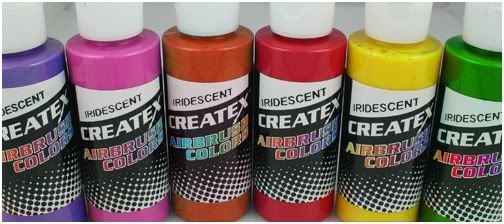
    Paint: I recommend using specialized fabric paint. Createx and Jacquard are the two name brands that will work perfectly fine. There is also Setacolor, but it is more expensive.

    Createx


    Jacquard


    Jacquard makes a few lines of paint. I use the Textile Colors because I can water them down for airbrushing or use them directly for painting. They are sprayed on, let dry, then iron to heat set it into the fabric. There is an additive that you can put into the paint instead of heat setting. I’ve never tried it, and would be curious to hear if anyone out there uses it. These paints feel like they’re part of the fabric and not sitting on top of it. They will soak into the fabric, so use that as an effect; it's difficult to get a hard edge, unless you use a stencil or a shaper to cover or redirect the spray off the fabric. (Google: airbrush Frisket) These paints and colors are acrylic paints, so they’re thinned with water and clean up with water. There is an extender that can be used to thin the paint, but I use water. Createx paint can be used right out of the bottle. Jacquard makes an airbrush paint, but I use Textile Colors and thin it down, almost 50% (20% is the recommendation) and spray more layers. I like using the textile paint instead of the airbrush colors because I use the same paint for silkscreening onto fabric and/or handpainting and stamping. (another topic for another day)

    I’ll throw this in here: These paints are acrylic.  You can spray any acrylic paint onto fabric and it will stay because it stays on my clothes when I accidentally spray paint myself. I’m not convinced that heat setting is necessary; sometimes just letting the pieces sit for a few days works. I’ve tried the craft paint from the dollar store and it sprays just fine, but it sits on top of the fabric and doesn’t sink in, so it's stiff. It might work for the bodysuit, but not a skirt if it's sprayed heavy for a deep color. Depending on what you are spraying and the budget, consider this a thrifty option for cases where you need 30 carnival pumpkin face costumes. The airbrush manual will warn not to do it, it’s up to you, thin it down and try some samples. It’s all about the particles of the paint fitting through the needle of the brush. If you jam the brush, there are a lot of YouTube tutorials of how to disassemble and clean the airbrush.

    Anyway, a big set of Createx colors is around $30.

    You could spray with dye. I haven’t tried it, but if anyone has, I’d like to hear from them. I imagine that spraying with dye on silk would be amazing…or not? It would have a huge soaking in factor. One day...


    To summarize this section, if you’re my friend with the workshop husband, she had all the tools; she just had to buy some fabric paint to put in the gun. (She has since bought a real airbrush.)For the rest of us, after buying a compressor and a brush, and a couple of bottles of paint, it’s about $125 or more. Add in the ear plugs remember. And fabric for the dress, too.

    Now go buy a roll of paper towels, find a big cardboard box, and 2-3 yards of white Lycra, and maybe 2-3 yards of chiffon or georgette – whatever you like to use for skirts. If you just want to do a skirt, then stick with the chiffon/georgette. Polyester is fine; this paint sticks to everything.

    Stretch velvet? You could try. I did. It feels like I painted the cat. It might work if I wanted some crazy effect involving painted cats, but I wouldn’t plan on airbrushing stretch velvet. In dresses on the market with airbrushing, you will find airbrushed Lycra and mesh in the bodysuit and chiffon/georgette for the skirts, nothing else. It leads to a bit of a conundrum, because some skaters love stretch velvet for its matte look and want airbrush effect on the bodysuit. Which leads to part 2, making samples. When in doubt, make a sample.

    Part 2: Practice

    Cut 18-inch or thereabouts square pieces of whatever fabric you’re going to use. A meter of 60 inch Lycra will get you six 3x20x18-inch squares. This is the time to make samples of what works and what doesn’t. Pin these to your spray wall. Spray wall?

    The cardboard box is your spray booth. Spray wall is more like it. Although it seems natural to spray on something lying flat on the table, the spraying works better when the fabric is vertical. Cut open the box and find a place where you can attach it to a wall. I have a big cardboard that I’ve covered with brown paper, which I change occasionally. It doesn’t have to be entirely vertical. Think of it as an easel. Pin the squares to the spray wall. Pin them tight, but not stretched. That 45 PSI will blow wind at them and cause them to flutter around if they’re loose.

    Attach the airbrush to the compressor. Wait for everyone to leave the house, turn on compressor (follow their instructions) and psssst, hit the button on the brush. Prepare the paint by either using Createx from the bottle, thinning Jacquard textile colors, or using airbrush paint straight.

    I’ll have to digress here. There’s the airbrush bottle and the siphon cup. For now, pour your paint into the bottle and attach it to the brush. Take those paper towels and make a thick pad out of some of them and holding the brush level, spray into the pad until paint starts coming out of the end. You’re ready.

    Starting off the edge of the fabric, push the button, start spraying across the fabric without stopping and take your finger off the trigger once you’re off the fabric. It’s basic spray painting. Did you like the effect? Change the spray width on the nozzle, test, stand closer, stand further, play around with this for a long time until you’re confident you’re comfortable with the brush and how it sprays. You will get sputts and splatters, it’s either related to the air or the pressure on the trigger. Occasionally it can be because the paint was not thinned properly and a chunk has gotten stuck in the nozzle. In that case, spray it out into your paper towels and/or rinse out the nozzle and try again. There’s a lot of YouTube videos about specific techniques. How to spray flames on the hood of your sports car can work out to being flames on a man’s bodyshirt. I just need a man who wants a flaming bodyshirt... Anyone?

    Let the samples dry, heat set them by either ironing them for a few seconds on the reverse side (I use a teflon sheet ) or throwing them in the dryer. Then wash them and dry them just for good measure to see what happens. This is overkill, but it’s a good idea to see what happens with your combination of fabric and paint. Washing it also takes out the stiffness that can build up.

    Some airbrush sites say to spray on paper to learn technique. I say use fabric, because the paint does soak in and it's something you need to learn how to deal with. It doesn't have to be white Lycra actually; it could be that yard of ugly that's been in your stash for years. Just use a very contrasting paint. Knowing how the paint covers on color fabric is also something to learn.

    Do not skip making practice samples. Here are just a few of mine, with different paints, fabrics and lots of splatters.


    Part 3: Doing It


    Cut out whatever you want to spray. Pin the pieces to the spray wall. Put the pins where the seam allowances will be. Make sure they’re tight, but not stretched.

    If I’m spraying a bodice and a back, I line them up side-by-side so that I can spray across both. Sleeves would be the same. For skirts, pin them so that the bottom edge is at the bottom obviously if it’s a full circle, put lots of pins at the top, and you could angle your spray wall flatter.

    Think about what direction the pieces will go when they are put together.  If you're spraying a sleeve, and you want the spray to be horizontal, it might mean spraying the sleeve sideways, or even a U shape.

    Here is a sleeve where I decided to add a purple effect, after the fact. Neckband, and the right sleeve. The pattern is somewhat raglan, it's actually a test of a new pattern draft and I decided to do two tests in one, sew it out of white Lycra for pattern test and then airbrush the heck out of it. I think this is the way that the purple will line up:


    Then once all the pieces are done, I lay them out to make sure I've got it right before sewing it together. In this particular case, I didn't like the way the left sleeve had the purple on it, so I discarded it and cut a new sleeve and sprayed again.


    Getting down to the details:

    Prepare the paint. If I’m doing a multicolor effect, I use the siphon cup and keep pouring the paint in as it empties. It makes a nice color change doing gradients. This is a bit advanced and you’d work it out in practice on samples. For now, try a color effect on a hem.

    Pin up the skirt. Starting off the hem, begin spraying with the center of the flow on the edge of the skirt. This puts the most solid color on the hem. Sidenote: I hem the skirt afterwards. Spray another swath overlapping that one and continue upwards. If you angle the brush upwards, you’ll get a thinner effect as you get closer to the top of the skirt. (You worked this out on samples, right?) Let it dry (it probably is already), and then go back and layer that same color on top until it’s evenly thick. It’s common to get a lined effect. You want solid.

    To add another color, start with the second color where you want the transition and spray a swath and continue upwards going overtop where you left off with the first color. Go back and deepen the color when it looks like you should. Let it dry and then look again.

    For a white hem:


    For a skirt, start at the waist edge and spray a circle. Do the same on the other side if it’s two pieces, or if it’s one (pinned up circle) make sure you keep consistent pressure. Do more circles outwards until you’ve reached how far you want to go. I am assuming that you’re going to have a white-edge hem. Then, starting back at the waist, develop the color layers by spraying on top. The paint will dry very quickly. I prefer to water down my paint and make many, many layers. Keep spraying until you’re happy with it, and let it dry. If matching the skirt to a bodysuit fabric, let it dry, compare the color, and possibly respray. It’s tricky to color match an airbrushed piece to an existing Lycra or stretch velvet. Tip: I don’t try to match the Lycra, I cut the entire garment of one color and spray the whole thing. Velvet is easier to match “close enough” because of the shading in velvet.

    Perfectionist moment: Because the paint stays mostly on the top of the fabric, if I think the underside is ugly, I’ll turn it over and spray the underside. You could try to spray more densely on the top so that it soaks through, but the soaking is inconsistent. It all depends on the fabric. With the crepe georgette that I use, it soaks right through and looks like dye. With Lycra skirts, the paint sits on top.

    Take the fabric off the spray board, heat set and sew it into the garment. After you sew the garment together, you might find that the sides don’t match up evenly or it needs a little extra, like one of the spots where a pin was. You can touch it up by holding the dress over your arm with your arm inside the dress. If you pin it back on the board, made up, make sure you put plastic, or a piece of cardboard between the front and the back in case of soak through.

    I'm deciding how to rhinestone the top and I'm still not happy with the transition to the purple. Can you see that the purple in the armpit doesn't match up to the back of the sleeve? That's partly because of trying to draw a new pattern and not sewing it up yet and not thinking out where everything goes together. I will overspray this to touch it up. There is also a dot at the center front of the skirt from a pin that needs to be touched up.  The bodysuit pattern in this particular dress didn't work out quite the way I wanted it, so it's been great to use for airbrush practice.

    If I could offer just one piece of advice, this is it: Less is More. Airbrush is a great effect and a little goes a long way.

    Thank you, C.R.H.! If you have questions for C.R.H. this is your opportunity! Leave your questions in the comments.

    Do you have questions for Ice Mom or the Advisory Board? No problem! Send me an e-mail! Are you an expert like C.R.H. is? Terrific! Contact me about writing a guest post. E-mail: icemom.diane@gmail.com.


    Ice Mom's Summer Camp Survey

    Tuesday, March 16, 2010

    Review: MySkatingMall.com

    PSA Master-rated coach and 2003 World Team Member Ryan Jahnke has been working hard on his new online concept: MySkatingMall.com. It’s not just another online retailer. This is one that gives back to local figure skating clubs.

    MySkatingMall.com will be the link between buyers all over the world looking to save money on gently used figure skating gear and sellers who want to clean out their closets. The best part? Five percent of the sale goes to the buyer’s home club. Sellers must donate at least 2.5 percent  to their figure skating club, but they can donate more of the sale amount, too. Users must be 18 or over to join the free online registration. Jahnke is very careful to make the site family-friendly. He includes a video of himself explaining that users should report inappropriate content so he can remove it from the site.

    Until March of next year, listing figure skating items for sale on the site won’t cost you anything. After that, listings cost a flat $1 for an entire year, or until the item is sold. Sellers can improve their listings with low-cost upgrades like title bolding, featured listing, and better placement. All transactions are done through PayPal, so users will need a free account at that secure site.

    MySkatingMall.com also has online retail partners who sell new figure skating items. You’ll recognize names like Lauren Downes’ Sk8Strong off-ice DVDs, Annette Thomas’s balletforfigureskaters.com, Champion Cords, Sk8Mix music, and Brad Griffies custom skate outfits. Jahnke is still searching for online stores as retail partners, so the list grows all the time.

    As of this posting, the site is in testing. However, individuals can visit the site and poke around to see how it works. In addition to the sales, you'll find a blog, videos, and links to informational figure skating sites.This is a terrific time for figure skating clubs to sign up their club to benefit from their members’ sales and purchases, too.

    I plan on telling our club’s board all about MySkatingMall.com and asking the board members to promote the site in the club newsletter. I’m for anything that saves me money as a figure skating parent and brings down my ice costs at the club. Great idea, Ryan! I wish you success!

    Ryan's full site launches on Friday, April 26.

    Have a question for Ice Mom or the Advisory Board? Do you know a figure skating expert who would be a good fit for The Wednesday Ask the Expert feature? Have a suggestion for a post? Awesome! E-mail me at icemom.diane@gmail.com
     
    Ice Mom's Summer Camp Survey

    Monday, March 15, 2010

    Announcement: New Sites Coming - plus - Ask the Expert feature

    Three new sites. On April 3, if the techno gods favor me, I’ll be launching my new site at icemom.net. Also launching on April 3 are icecoach.net and icegirlblog.net. These two blogs will cover figure skating from the coach and student perspectives. I receive a lot of great questions in my e-mail box that are better suited to a coach or skater to answer, so now everyone will be able to share rinkformation at all levels of involvement.

    All three of us will post on Mondays starting in April about the same subject from different angles. One of these joint posts we have planned is about the process of running a competition. Ice Coach is going to cover securing judges and setting it up, I’m going to write about strong-arming volunteers, and Ice Girl will talk about being a runner and how to have fun in a high-pressure situation.

    We’ll also have a contest to kick off the launch with fabulous prizes. Not millions – we’re in figure skating. But you’ll like the contest – it’ll be funny, I promise.

    Ask the Expert.
    On Wednesdays, I’m starting a new feature called, Ask the Expert. Each Wednesday, I’ll try to invite someone who knows way more than I do to write something and answer your questions in the comments.

    Wednesday, March 24, Annette Thomas, a classically trained ballet instructor, will post about ballet. She wrote the book Fundamentals of Alignment & Classical Movement for Figure Skaters and she’s very knowledgeable. My questions for Annette were along the lines of: is ballet worth it? So, start thinking about what questions you’d have for a classical ballet teacher who knows a lot about figure skating, too. You can also send in your questions in advance to me (icemom.diane@gmail.com) and I’ll store them up for Annette to answer. Of course, you can also add them to the comments on March 24 for Annette to answer that day.

    I’m lining up more guests: a former show skater, coach Xan of Xanboni! and Ice Coach, soon to be of icecoach.net, will answer questions about USFSA/ISI, and Allison Scott, Jeremy Abbott’s mom, will talk about interacting with judges.

    As always, advertisements are independent of editorial content. These aren’t ads, anyway. They’re an opportunity to ask questions you’ve always wanted to ask of people who are really knowledgeable. Should be fun!

    If you have a suggestion for an expert or you are an expert, e-mail me at icemom.diane@gmail.com.  I’d love for you to let us know more about figure skating.


    Also, if you have a suggestion for post ideas that you’d like the three of us (Ice Mom, Coach, and Girl) to write about, that would be fabulous! If you have other ideas for us, too, hey: we’ll take ’em! E-mail me at icemom.diane@gmail.com.


    Ice Mom's Summer Camp Survey

    Friday, March 12, 2010

    Can You Help This Mom? Inappropriate Figure Skating Music

    This question comes from, um, a friend. Not me. A friend. Let's call her, um, Mice Mom, er, Nice Mom.

    So. Nice Mom's husband wants, um Nice Girl, to figure skate to some music that Nice Mom and Nice Girl think is just...wrong.

    Ice Dad, I mean, Nice Dad says that we spend so much money on figure skating that he deserves to pick Nice Girl's figure skating music just once. This is something we have to, I mean Nice Mom and Nice Girl have to really consider because Nice Dad deserves a voice in her music, too.

    Help me. I mean, help my friend.

    Suggestion #1: Theme song from Curb Your Enthusiasm.

    For those of you who are not familiar with the HBO show from Larry David, Curb Your Enthusiasm is about a clueless idiot, Larry, who says naughty things to nice people. He is socially inappropriate and not a role model, Ice Dad. I mean, Nice Dad.


    Click here to listen to the theme song. It's heavy on the tuba and is just...wrong...


    Suggestion #2: Theme song from Dexter.

    Showtime's TV show, Dexter, is about a serial killer who kills serial killers. Despite the violent theme, I really, really like this show.

    However, Nice Dad, that does not mean that a serial killer's theme song should be used as your daughter's figure skating music!

    Click here to listen to the theme song and watch the opening credits.

    Suggestion #3: Theme song from Halloween.

    Halloween is the scariest horror movie of all time, in my opinion. I don't watch horror movies, but just listening to the music completely creeps me out.

    Click here to listen to the theme song.

    So. Help me out here, people. I mean, help out Nice Mom. We all know that these songs are not appropriate figure skating music. Let's come up with a ton of reasons why Nice Dad is totally wrong. Please.

    Have a question for Ice Mom or the Advisory Board? Know more than Ice Mom and want to write a guest post? Have an idea for a post? E-mail me! icemom.diane@gmail.com

    Ice Mom's Summer Camp Survey